

U.S. President Donald Trump speaks to reporters aboard Air Force One before taking off from Joint Base Andrews, Maryland, February 19, 2026.
Saul Loeb | AFP | Getty Images
Oil prices hovered near six-month highs on Friday after US President Donald Trump warned Iran that “really bad things” would happen if there was no deal over its nuclear program.
Brent crude oil futures, the international benchmark for April delivery, were trading 0.7% lower at $71.17 a barrel around 10:25 a.m. London time (5:25 a.m. ET), erasing earlier gains. west texas intermediate Futures for March delivery fell 0.6% to $66.02.
Both contracts hit six-month highs in pre-market trading as energy market participants continued to monitor supply risks in the oil-rich Middle East.
The United States and Iran held talks in Switzerland this week aimed at resolving the conflict over Iran’s nuclear program. But initial reports of progress have been replaced by Washington’s accusations that Iran has not met core American demands.
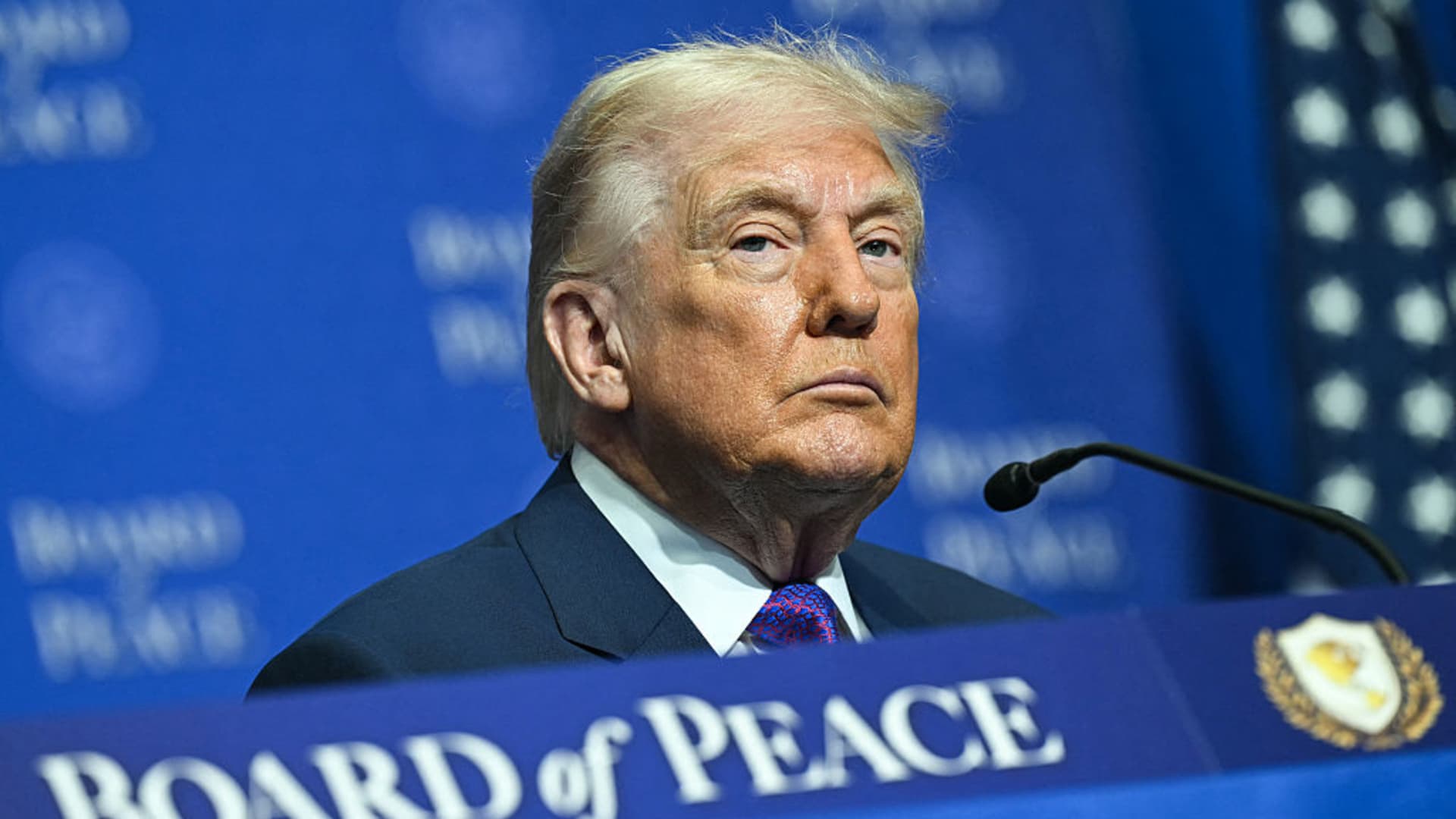
At the peace commission’s first meeting in Washington on Thursday, the president said “bad things will happen” if Iran doesn’t agree to a deal over its nuclear program.
Trump added that the world will find out over the next 10 days whether the United States will reach a deal with Iran or take military action. Later, he told reporters aboard Air Force One that he hoped to reach an agreement within “10 to 15 days.”

Brent Crude Oil Futures for the past 6 months.
His comments come in the wake of a major buildup of U.S. forces in the Middle East, and reports that the White House is considering new military action against Tehran as early as this weekend.
Trump said Iran’s nuclear potential was “completely destroyed” by the U.S. attack on Iranian facilities last June, before adding, “We may or may not need to take another step forward,” without providing further details.
Iran reportedly said in a letter to UN Secretary-General António Guterres on Thursday that it would respond “firmly” if it were to be subject to military aggression.
In recent days, the Islamic Republic has held military exercises in the strategic Strait of Hormuz, as well as joint naval exercises with Russia in the Gulf of Oman, also known as the Sea of Oman.
Iranian and Russian naval forces simulate the rescue of a hijacked ship during a joint naval exercise at Bandar Abbas Port near the Strait of Hormuz in Hormozgan, Iran, February 19, 2026.
Anadolu | Anadolu | Getty Images
“Everything is ready or will be ready by Saturday night for the strike to begin, so at that point the window opens,” former U.S. Ambassador to Israel Daniel Shapiro told CNBC’s “Access Middle East” on Friday.
“That doesn’t mean it’s going to happen right away. The president has indicated that he’s waiting to hear from Iran to see if it’s willing to make concessions on its alleged nuclear program,” Shapiro said.
“I think it’s unlikely. I don’t think it’s likely that Iran would agree to that because I’ve never seen Iran respond to those kinds of concessions. That means the president will have to make a decision on a military strike within a few days,” he added.
‘Very well-supplied’ market
The Trump administration said it still wants a diplomatic solution to Iran’s nuclear program, and White House press secretary Caroline Levitt said Wednesday that it would be “very prudent” for Iran to reach a deal.
Martin Lutz, chief commodity strategist at Morgan Stanley, said the oil market is “very well-supplied” globally, but there are three factors pushing prices up.
“Obviously we’re concerned about Iran, and also the fact that China is buying an unusually large amount, just for stockpiling. You wonder what they’re going to do with all that inventory, and our freight rates are also very high,” Lutz told CNBC’s “Europe Early Edition” on Friday.
“The most prominent of these three factors is, of course, the issue of Iran,” Latz said.

Barclays strategists said Friday that while stock markets have largely avoided geopolitical noise so far, tensions have risen since Vice President Vance accused Iran of failing to discuss so-called “red lines” alongside reports of a U.S. military buildup in the region.
“As was the case last summer, we believe any attack should be time-limited and use clear targets (nuclear, ballistic missiles),” the strategists said in a research note.
“With midterm elections later this year and the administration’s prioritization of affordability for U.S. consumers, consumer willingness to tolerate significant increases in oil prices and potential casualties over an extended period of time appears to be limited,” they continued. “Therefore, if conflict is imminent, in our view it is likely to be short-lived.”
