

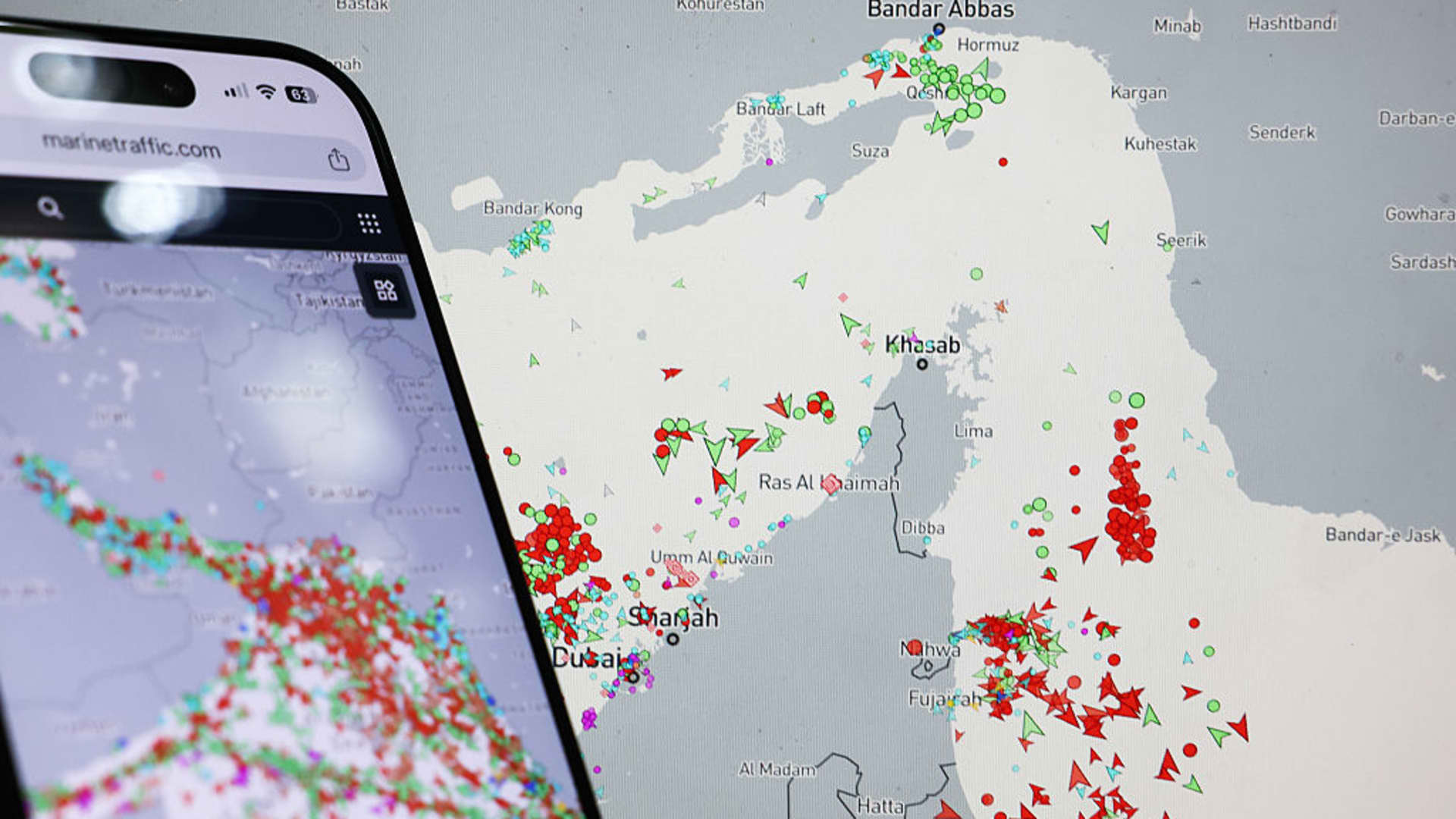

President Donald Trump is prepared to use the U.S. Navy to escort oil tankers through the Strait of Hormuz as the war with Iran escalates, but providing safe passage for the large amount of traffic that normally passes through the waterway has proven difficult.
U.S. oil prices rose 28% this week to more than $86 a barrel as Iran attacked a tanker, effectively halting shipping traffic through the strait. Brent crude oil rose 22% this week to $89 a barrel.
If the waterway is shut down for an extended period of time, global benchmark Brent crude oil would rise above $100 a barrel, Wall Street analysts said. At that level, oil prices could push the global economy into recession, they say.
The narrow strait is the only way for tankers to enter and exit the Persian Gulf. According to energy consulting firm Kpler, more than 14 million barrels of oil per day passed through the strait in 2025, about a third of the oil exported by ship worldwide.
100 cases per day
Under normal circumstances, about 100 tankers and cargo ships pass through the strait every day, and about 400 tankers are currently stuck in the Gulf as a result of the war, said Matt Smith, an oil analyst at Kpler.
“There are still hundreds of ships in the Middle East Gulf,” said Matt Wright, also a senior cargo analyst at Kpler. The U.S. Navy would “take an inordinate amount of time to escort even a few people at a time.”
President Trump’s promises to escort tankers if necessary and provide political risk insurance to shipowners helped calm oil markets on Tuesday and Wednesday.

But prices soared Thursday after Iran announced it had attacked a tanker with a missile. Meanwhile, the Royal Navy reported that there had been a major explosion on a tanker that was anchored in Iraqi territorial waters.
enough ship
“The key question is whether there are sufficient naval assets to escort the destroyers and continue operations against Iran,” Helima Croft, head of global product strategy at RBC Capital Markets, told clients in a note Tuesday.
Kpler’s Wright said insurance isn’t really an issue for ship owners. He said the tanker was not being moved due to concerns for its physical safety, and a period without attacks would need to last before the ship’s owner could transit the strait again.
Wright said there is a high degree of urgency to recover oil flows from the Gulf. But “we need confidence that Iran’s ability to continue the war has diminished,” the analyst said.
Yemen’s Houthi rebels have disrupted traffic in the Red Sea with missile attacks for more than a year since late 2023. “It’s nothing compared to the sophistication of the Iranians, so it’s a completely different threat,” Wright said.
Analysts at Rapidan Energy said in a note Wednesday that a U.S. naval escort could help in the nick of time, but they would not be able to reopen the strait alone. Instead, they said, the United States needs to systematically reduce Iran’s military capabilities, which will take time.
1980s war
Croft said the U.S. Navy escorted tankers through the strait in 1987, when commercial ships were targeted during the Iran-Iraq war. But the U.S. military at the time was not simultaneously waging war against the Tehran regime and ensuring safe navigation for ships, she said.
Energy Secretary Chris Wright said Wednesday that the Trump administration would provide a naval escort “as soon as possible.”
“Right now, our navy and military are focused on other things, disarming this Iranian regime that is attacking our neighbors and Americans in every way possible,” Wright told Fox News.
“In the not-too-distant future, we will be able to use the navy to provide energy again, but in the meantime, the market is very well-supplied,” he said.
No timeline
White House press secretary Caroline Levitt told reporters Wednesday that the Trump administration does not have a timeline for when the strait will be safe again for commercial shipping.
“I don’t want to commit to a schedule, but I do know that both the Department of the Army and the Department of Energy are actively calculating it,” Levitt said at a news conference.
Analysts say the longer the tanker is in the Gulf, the bigger the problem for global oil markets.
Natasha Kaneva, head of global commodity research at JPMorgan, said storage capacity in Gulf states could be depleted as stranded barrels pile up. This could force production halts and send Brent prices soaring to $120 a barrel, Kaneva said in a note on Sunday.
Iraqi officials told Reuters on Tuesday that Iraq had already cut production by 1.5 million barrels a day due to storage shortages caused by the Hormuz closure. Kaneva said on Tuesday that production outages could double in four days.
“The Strait of Hormuz remains inactive and the clock is ticking,” Kaneba said.
