

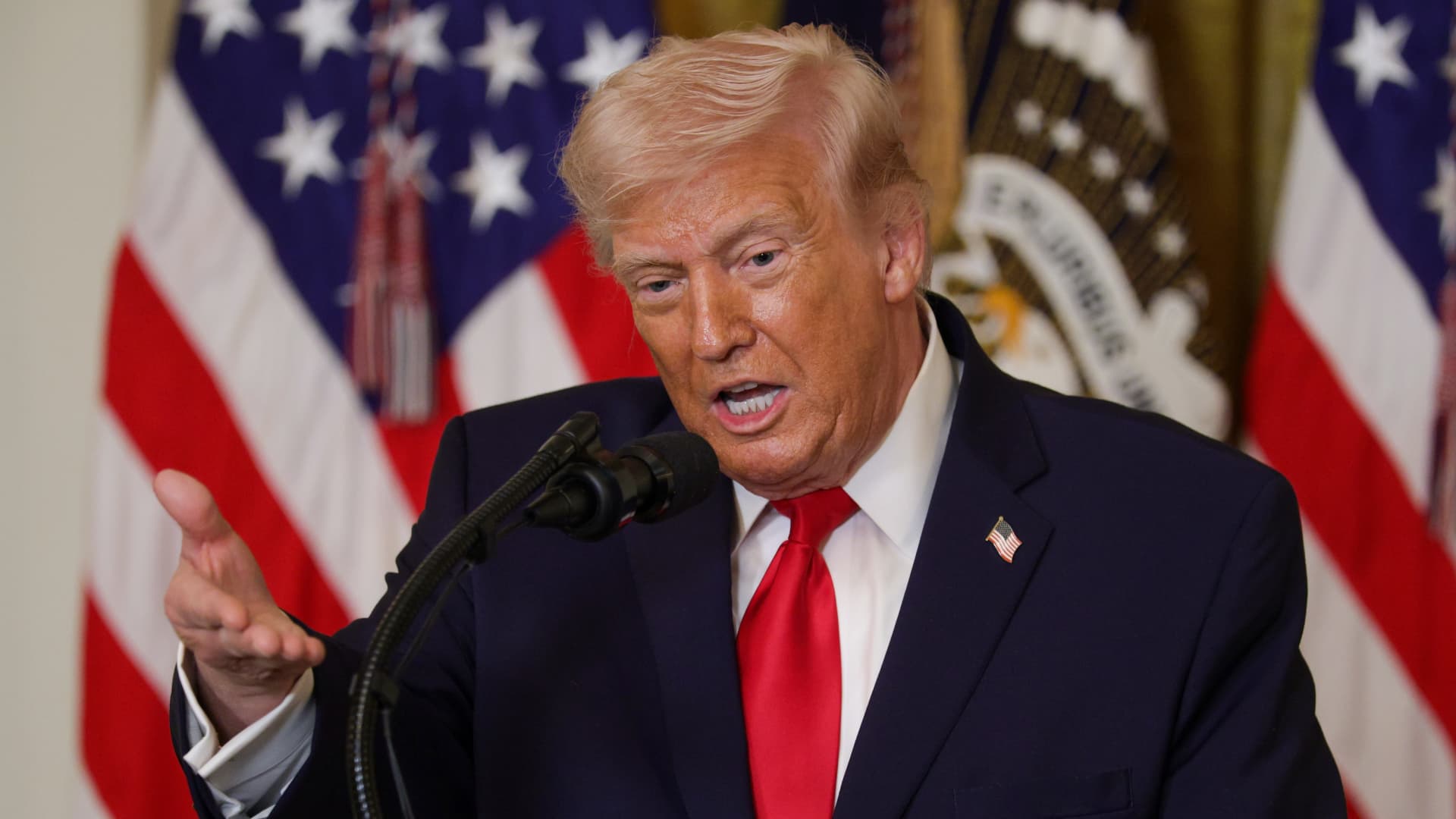

President Donald Trump has granted a 60-day waiver to long-standing U.S. shipping laws in an effort to stabilize oil markets amid the Iran war, the White House confirmed to CNBC on Wednesday.
White House press secretary Caroline Leavitt said in a statement that the suspension of the Jones Act “will allow critical resources such as oil, natural gas, fertilizer and coal to flow freely into U.S. ports for 60 days.”
Levitt said the Trump administration “remains committed to continuing to strengthen critical supply chains.”
The Jones Act, signed by then-President Woodrow Wilson in 1920, mandated that transportation of goods between U.S. ports must be carried out by U.S. ships.
This law was aimed at growing the domestic shipping industry after World War I. The law has been criticized as a form of protectionism, with some economists recently arguing that it hinders domestic trade.
President Trump’s two-month waiver was announced as oil prices resumed rising in the wake of the Iran war, which has put key energy infrastructure under attack and effectively shut down the Strait of Hormuz.
In recent days, President Trump has vented his frustration at U.S. allies’ reluctance to help secure the strait, a globally important oil shipping route that has been largely shut down due to threats from Iranian forces. At the same time, the president asserted that the United States does not need any assistance in the ongoing operation against Tehran.
The international benchmark Brent price rose 3.83% on Wednesday to close at $107.38 per barrel. US crude oil prices ended the day almost unchanged at $96.32 per barrel.
Less than 100 ships are compliant with the Jones Act, so exempting them would allow more international tankers to transport fuel between U.S. ports, said Daleep Singh, chief global economist at asset management firm PGIM.
However, Singh said the impact of suspending the law may still be limited. That’s because of a “mismatch” in that the United States primarily produces light shale oil, while most of its refineries are built to process Middle Eastern crude oil.
“In layman’s terms, the U.S. can now move fuel more easily, but it has not been able to refine enough of what it produces to be self-sufficient,” Singh said in a client note Wednesday.
A coalition of nine U.S. maritime labor organizations said late Wednesday that it was “deeply concerned” about the suspension of the Jones Act.
Broad exemptions “undermine our national security, weaken our military, and leave critical maritime operations in the hands of foreign vessel operators,” the groups said in a joint statement.
They also argued that the measure would not significantly reduce gasoline prices.
“Multiple analyzes clearly show that the primary driver of gasoline prices remains the global cost of crude oil, with domestic transportation accounting for less than 1 cent per gallon,” the labor group said.
—CNBC’s Spencer Kimball and Matt Peterson contributed to this report.
