

On October 13, 2025, US President Donald Trump, who is visiting Israel and Egypt, arrives at Ben Gurion Airport in the Lod suburb of Tel Aviv and gestures as he exits Air Force One.
Saul Loeb | AFP | Getty Images
US President Donald Trump embarked on a trip to the region on Monday to finalize the Gaza peace deal and declare the Middle East war over.
President Trump arrived in Tel Aviv early Monday to commemorate the release of Israeli hostages held by Hamas after being held captive for more than two years.
Trump arrived at Israel’s parliament, where he was scheduled to address lawmakers, and told reporters that Hamas would disarm, according to comments reported by Reuters. Asked whether the war was over, he told reporters: “Yes.”
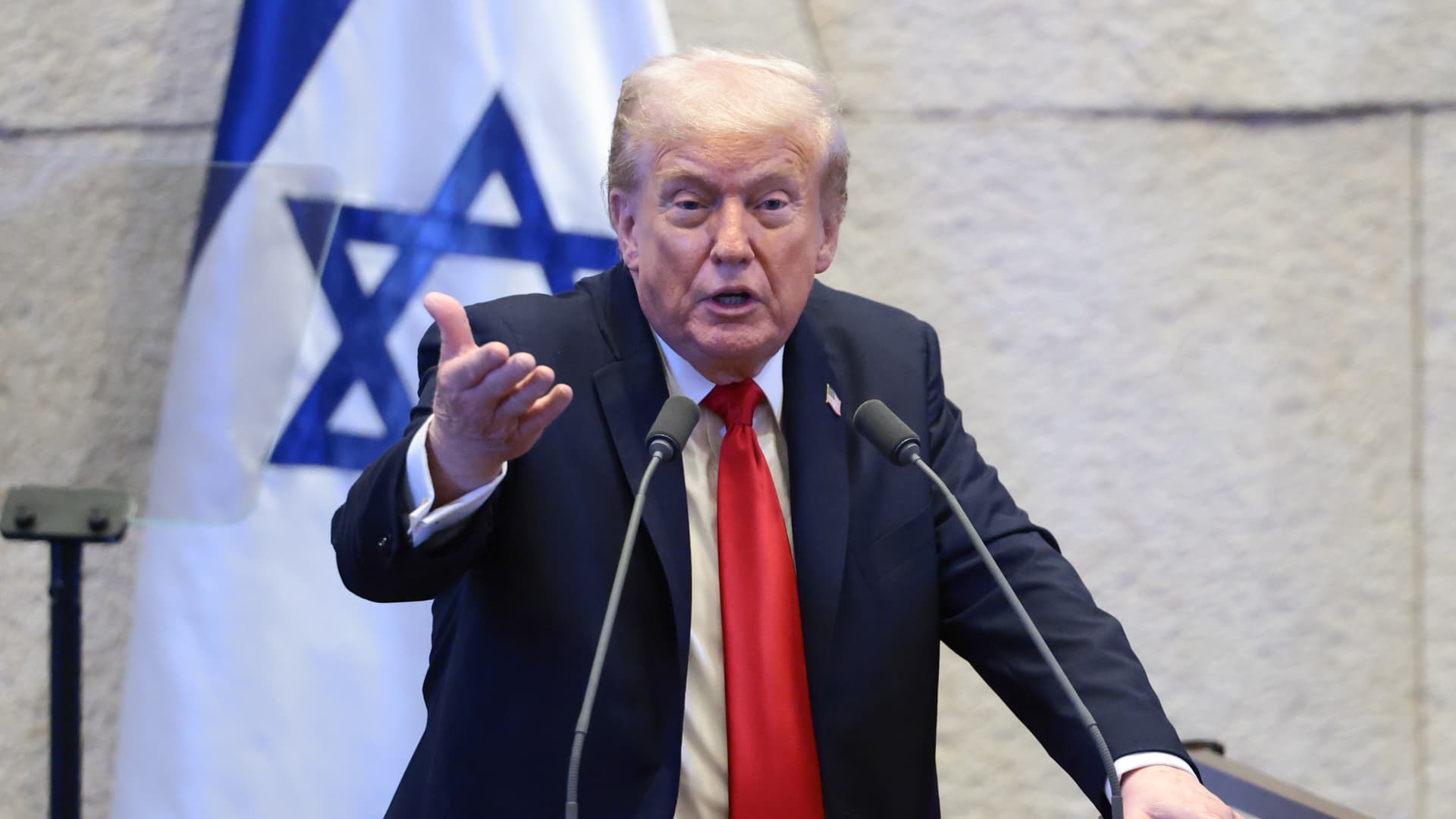
Trump spoke at the Capitol to trumpet fanfare, a standing ovation and cheers, saying the “long, painful nightmare” for both Israelis and Palestinians was finally over. President Trump said the United States has made two “everlasting pledges” to its allies: “never forget, and never again.”
The president signaled a conciliatory mood, calling the ceasefire “a very exciting time for Israel and the Middle East,” and noting that Israel had won as much victory as it could by “force.” The time has come, he argued, to transform these efforts into peace and prosperity.

The president called for a peace agreement with Iran, saying the arms of friendship and cooperation remain open “even to the Iranian regime that has caused so much sacrifice in the Middle East.”
“What I’m saying is they want a deal,” Trump said, adding, “We’re always ready.”
Iran is Hamas’ main foreign backer, and its October 7, 2023 attack on Israel killed 1,200 people and took hundreds hostage.
The Israeli response and ensuing war have left more than 67,000 Palestinians dead, including thousands of civilians, according to the Gaza Health Ministry. Gaza itself was largely destroyed, with most buildings in ruins.
“Because we won, we can now build and do things we never thought possible,” Trump said, encouraging Israel to focus on long-term peace efforts.
US President Donald Trump speaks at the Knesset, Israel’s parliament, in Jerusalem, October 13, 2025.
Pool | Getty Images News | Getty Images
He also repeatedly returned to the theme of reconstruction and reconstruction, telling the Knesset that “the people of Gaza must be fully focused on restoring the fundamentals of stability, security, dignity and economic development.” President Trump said the United States would support them in this purpose.
The US president praised Israeli Prime Minister Benjamin Netanyahu and military leaders, as well as the Arab states that helped broker the ceasefire. He also praised the efforts of senior officials and advisers, including Special Envoy for the Middle East Steve Witkoff, Secretary of State Marco Rubio, his son-in-law Jared Kushner, and Pete Hegseth.
A total of 20 Israeli hostages are expected to be freed on Monday, along with another 28 prisoners. Of these, 26 people were confirmed dead, and two people’s identities are still unknown. Israel plans to release approximately 2,000 Palestinian prisoners and detainees in exchange for hostages.
Israeli hostage Eitan Abraham Mor gestures to well-wishers for his release as he arrives at Rabin Medical Center Beilinson Hospital in Petah Tikva, central Israel, on October 13, 2025.
Menachem Kahana | AFP | Getty Images
President Trump will address the Israeli parliament after meeting with hostage families. He will then travel to Sharm el-Sheikh, Egypt, to attend a major international summit with about 20 other world leaders to hammer out a deal to end the war in Gaza.
President Trump’s first phase of the Gaza peace deal and the release of Israeli hostages have been hailed as great humanitarian and geopolitical developments, but the economic impact has been limited.
“This shows that the United States still has preeminent global influence and can achieve results if used in the right way,” Holger Schmieding, chief economist at Berenberg Bank, said on Monday.
“However, the impact on the global economy and markets should be very limited. If the Houthis stop interfering with shipping through the Red Sea, global shipping costs may drop slightly. If tensions in the Middle East ease further, the global impact could become more pronounced in the long term, but that’s still a very big story,” Schmieding said.
