

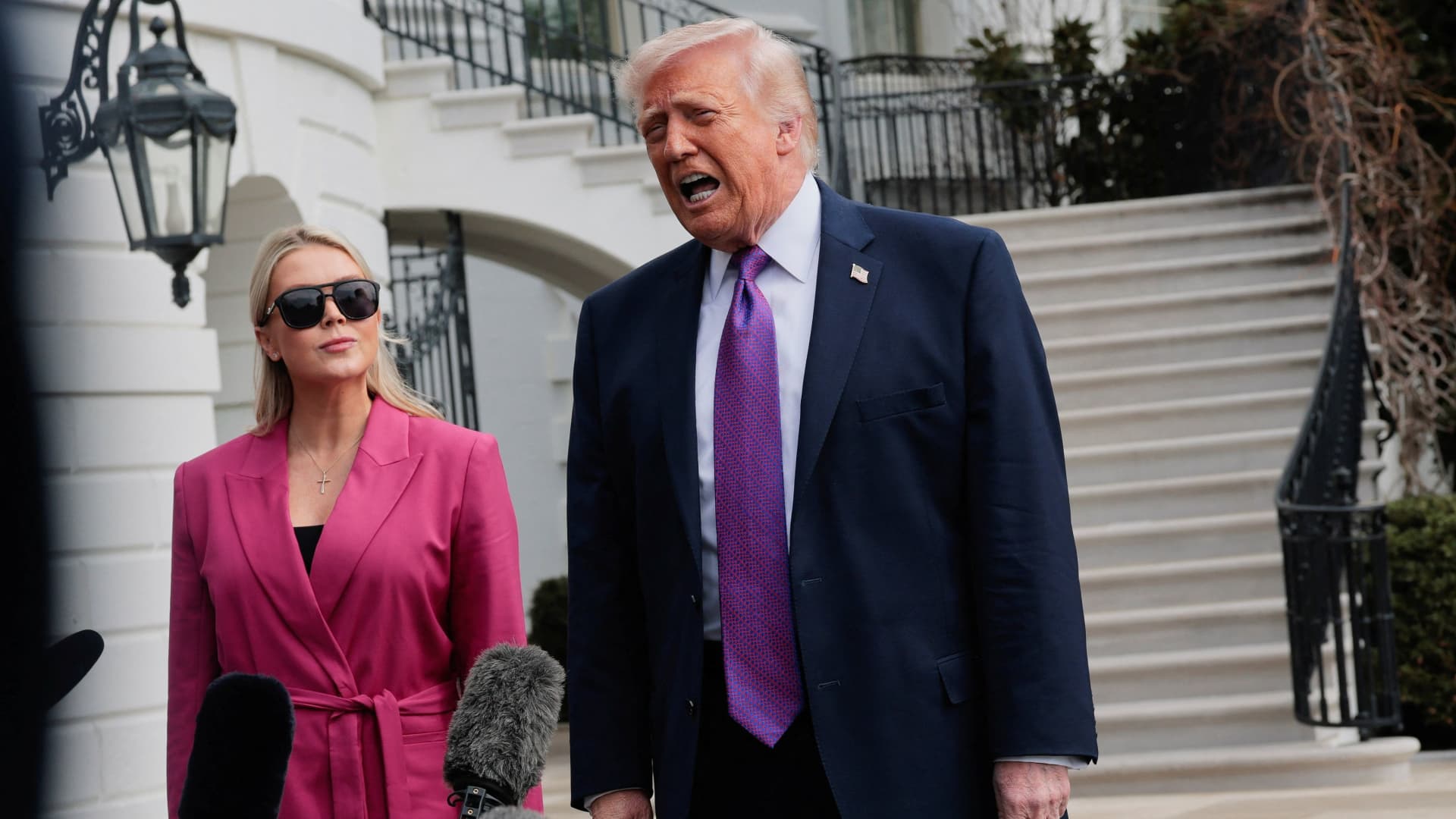
U.S. President Donald Trump speaks to the media next to Presidential Press Secretary Caroline Leavitt at the White House on March 11, 2026 in Washington, DC, USA.
brian snyder reuter
President Donald Trump said Wednesday that he is not worried that Iran will carry out terrorist attacks in the United States in retaliation for the ongoing war between the United States and Israel.
Asked if he feared such a domestic attack, Trump told reporters outside the White House: “No, I don’t.”
President Trump also touted progress in the war against Iran, which is entering its 11th day, before departing on a trip to Kentucky and Ohio.
“Right now they have lost their navy and air force. They have no anti-aircraft equipment at all,” the president said. “Their leaders are gone. We could do worse.”
President Trump said the U.S. military “has some things left” in Iran but could destroy it by this afternoon if necessary, adding that “it will literally never be possible to rebuild that country.”
Later that day, President Trump arrived at Joint Base Andrews in Maryland and told reporters that the United States had identified all Iranian “sleeper cells” – clandestine cells that lie dormant in foreign countries until they are activated to carry out terrorist attacks.
“We know where the Iranian ‘sleeper cells’ are…We’re keeping an eye on all of them,” Trump said, adding that the U.S. is in “very good shape” in the war against Iran, according to a Reuters feed of his statement.
President Trump said the U.S. military had destroyed about 16 mine layers in Iran. Asked whether Iran had drilled in the Strait of Hormuz, the world’s most sensitive chokepoint for oil shipments, Trump said: “We don’t think so.”
CNN, citing two people familiar with U.S. intelligence reporting, said in a Tuesday report that Iran has begun laying dozens of mines in the strait in recent days.
“I think” they should send tankers to the narrow strait, which remains effectively closed because of the war, Trump said, referring to the chief executives of major oil companies.
Iran’s Foreign Ministry spokesman warned on Monday that tankers transiting the strait “need to exercise extreme caution.”
The Strait of Hormuz is located off the southern coast of Iran and connects the Persian Gulf and the Arabian Sea.
Insurance giant Chubb announced Wednesday that it will serve as lead underwriter of a U.S. government-led program to provide insurance to ships passing through the strait.
President Trump on Wednesday brushed aside questions about the New York Times report, saying, “Newly released video adds to the evidence that a U.S. missile likely hit an elementary school in Iran, reportedly killing 175 people, many of them children.”
Trump said, “I don’t know about that,” which confirmed other analyzes that the U.S. military was involved in the Feb. 28 attack on Shajara Tayebeh Elementary School.
The president once again criticized Spain’s leadership for not supporting the U.S. war effort.
Trump has a tendency to use tariffs and other retaliatory trade practices as leverage against other countries, saying he “could cut off trade with Spain.”
Spanish Prime Minister Pedro Sánchez has angered President Trump by banning the US military from using two bases in Andalusia to attack Iran.
“In conversations with the presidents of both the Russian and Pakistani governments, while announcing the Islamic Republic’s commitment to peace and tranquility in the region, we emphasized that the only way to end the war started by the warmongering of the Zionist regime and the United States is the acceptance of Iran’s indisputable rights, the payment of reparations, and firm international obligations to prevent Iran from war,” Iranian President Masoud Pezeshkian wrote in X-Post on Wednesday. Aggression due to relapse. ”
