

India appears to be pushing back against US President Donald Trump’s claims that he has agreed to halt imports of Russian crude oil, suggesting that the issue that has strained relations is unlikely to be resolved anytime soon.
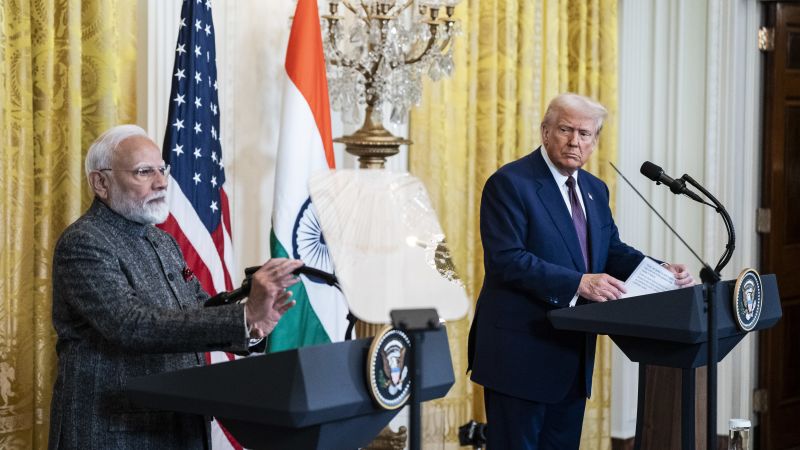
President Trump said on Wednesday that Indian Prime Minister Narendra Modi “committed today that they (India) will not buy oil from Russia, which is subject to U.S. sanctions,” calling this a “huge step.”
But on Thursday, Indian External Affairs Ministry Spokesman Randhir Jaiswal told reporters he was “not aware of any conversations” between President Trump and Prime Minister Modi, nor was he aware of any commitments by the Indian leader to stop buying Russian oil.
Earlier, India’s Ministry of External Affairs said the country was a “significant importer of oil and gas,” but did not mention Russia by name or mention Prime Minister Modi’s purported assurances.
“Energy price stability and security of supply have been the twin goals of our energy policy. This includes widening the scope of energy procurement and diversifying it appropriately in response to market conditions,” the statement said.
India has long had close ties with the Kremlin and is expected to host Russian President Vladimir Putin later this year. The company has emerged as one of the biggest buyers of Russian oil since the Russian government’s invasion of Ukraine in 2022. The war led to massive sanctions on Moscow’s oil industry, causing prices to skyrocket.
For months, New Delhi resisted President Trump’s calls to halt purchases of Russian oil, insisting it would not compromise energy demands driven by a booming economy and a growing population (now more than 1.4 billion people).
In August, President Trump announced an additional 25% tariff on India as a penalty for Russian oil and gas imports, on top of the previously announced 25% tariff.
Muyu Xu, senior oil analyst at trade intelligence firm Kpler, said it would be nearly impossible for India to suddenly stop buying oil from Russia, its largest supplier.
Russia is shipping about 1.7 million to 1.8 million barrels per day, Xu said, citing figures for the first nine months of this year.
“I don’t think India can stop buying Russian oil overnight. The amount is simply too much,” he told CNN. “Replacing that volume from the spot market is not an easy task. Not only is the volume huge, but differences in crude oil quality and refinery yields make the substitution far from a one-for-one exchange.”
State-owned refiners have reduced their purchases of Russian barrels in recent months, while some private companies have increased their intake of Russian barrels, according to Kpler data.
State-run Indian Oil Corp. bought 10.35 million barrels of Russian crude in January, compared with 4.62 million barrels in September, according to Kpler data. According to the data, till October, Indian Oil Corporation had purchased 7.03 million barrels.
CNN reached out to Indian Oil Corporation Limited to ask if it plans to continue purchasing Russian crude oil and what factors are guiding its sourcing strategy from Russia.
Mr. Modi’s refusal to bow to U.S. pressure has implications for his political brand, built around his image as a strong leader leading India to serve its interests on the world stage.
In recent weeks, officials in New Delhi and Washington have focused on diplomacy to get relations back on track, with trade delegations focused on striking a deal.
Earlier this month, Indian Foreign Minister S. Jaishankar acknowledged that India “has problems with the United States” and that a significant part of the friction lies in unresolved trade negotiations.
He said the two countries “haven’t reached the point of trade talks yet” but that India is actively working to find a solution.
“These issues need to be negotiated, discussed and resolved. That’s exactly what we’re trying to do,” he said.
