

Havana
—
Donald Trump wants us to believe that a deal with Cuba is on the horizon. After this past week, I’m not so sure.
“They don’t have energy. They don’t have money. They’re in a serious situation,” Trump said, explaining why he believes the Cuban government is desperate to reach a deal to save the country.
President Trump is correct in pointing out that Havana was under the most intense pressure since the 1962 missile crisis, and that a U.S. invasion of Havana was almost certain.
Now, as then, Cuba faces a blockade by the United States. Through military action in Venezuela and threats of tariffs on Mexico, President Trump has blocked oil from flowing into the country, decimating an economy already hampered by the communist government’s own disastrous restrictions on private industry.
President Trump’s Secretary of State Marco Rubio, a Cuban-American and fierce critic of the island’s leadership, is leading negotiations with Havana. He has been preparing his entire professional life for this moment.
In mid-January, as Cuba picked up the bodies of 32 soldiers killed protecting President Nicolás Maduro during the U.S. offensive that captured the Venezuelan leader, I heard Cuban President Miguel Díaz-Canel vow at a mass demonstration outside the U.S. Embassy in Havana that his government would make no concessions to the Trump administration.
But then, as the oil blockade hit the already beleaguered Cuban people hard, signs of an agreement began to emerge.
After weeks of rumors and leaks in Washington, Cuba acknowledged that negotiations were taking place. The government released 51 prisoners, some of whom had been imprisoned for protesting against the government, and announced long-awaited reforms that would allow Cubans living abroad to invest on the island, although the scope is still limited.
A haggard-looking Diaz-Canel, swaying nervously back and forth during a television appearance, acknowledged that the same talks were taking place that the government denied days earlier.
“Each time there has been a tense situation in relations with the United States, efforts have been made to find a path for dialogue,” he said.
And as soon as the negotiations were approved, Trump seemed to have dashed any chance of them taking a lead anywhere.
On Monday, as Cuba endured a nationwide power outage, President Trump stood alongside Rubio in the Oval Office and declared, “I believe we will have the honor of occupying Cuba. That would be a great honor. So whether we liberate it or not, we will have it. I think we can do whatever we want with Cuba.”
Mr. Rubio appeared to confirm earlier reports in the Miami Herald and New York Times that the administration is calling on Mr. Diaz-Canel and other officials it sees as obstacles to change to resign.

“Those in charge don’t know how to rebuild (Cuba’s economy),” Rubio said. “Therefore, we need to appoint a new person in charge. That is inevitable.”
President Trump also mused about Cuba’s “amazing weather,” while bizarrely falsely claiming that the island, which is just 90 miles from Florida, “is not in hurricane territory.”
The comment was a nod to Cuba’s hard-liners, who have long maintained that the United States’ ultimate goal is to annex the island.
The Cuban government quickly hit back at Trump’s claims, with Díaz-Canel writing on X: “Facing the worst-case scenario, Cuba faces certainty: any external aggressor will come face to face with an impregnable resistance.”
Officials said allowing the United States to choose someone to lead the island would be tantamount to surrender and would not be considered.
“Neither the president nor the leadership of Cuba is subject to negotiations with the United States,” Carlos Fernández de Cossio, Cuba’s diplomat for U.S. affairs, told reporters in Havana on Friday.
Cubans are now treated to the surreal sight of the island’s most famous living musician, Silvio Rodríguez, receiving a machine gun along with the Cuban president and senior military officials.
Rodriguez, an ardent supporter of the revolution who has been dubbed the “Cuba Bob Dylan,” has criticized Diaz-Canel’s management of the economy in recent years. But on Friday, he gave it his all.

“If they attack me, I will demand my AKM. I mean it,” the 79-year-old musician posted online, referring to the standard-issue rifle in the Cuban military that replaces the AK-47.
State media said Rodriguez, whose songs about love, social justice and relationships have reached millions of records over the decades, called for weapons to defend the island.
President Trump’s threats and oil blockade appear to have united Cuban officials and supporters at the same time that the government is trying to divide its inner circle.
“The (Cuba) government’s claim that it is responsible for the U.S. embargo has faded a little bit because they have been making that claim for many years,” William Leogrande, a professor at American University, told CNN.
“Of course, the U.S. embargo had a huge impact on the Cuban economy, but people were starting to blame the government for its mistakes.”
Keep talking and buy time
Despite rising tensions and Trump’s bellicose rhetoric, Cuban officials said they would continue negotiations.
“We are ready for a serious and responsible dialogue with the US government, without interfering in our internal affairs or in our respective political, economic and social institutions,” Foreign Minister Bruno Rodríguez Parrilla said Saturday at a forum for Latin American, Caribbean and African countries.
Cuba’s strategy appears to be to continue dialogue to buy time until the U.S. midterm elections in November, when Democrats could likely take back Congress. It’s unclear how much time they actually have, but both Venezuela and Iran were in talks with the United States when President Trump ordered the attacks on those countries.

And there are reports that the Trump administration may indict former Cuban leader Raul Castro, who remains the country’s most powerful figure, for his role in the 1996 Brothers to the Rescue shootout and his decades-long involvement in drug trafficking, which the Cuban government has long denied.
If the United States indicts Mr. Castro, 94, any chance of a diplomatic solution is likely to disappear.
Initially, President Trump appeared to be proposing an economic opening that some Cuba watchers called Obama 2.0, a reference to a deal his predecessor had negotiated but abandoned after leaving office.
No matter what sanctions relief or collateral deals President Trump promises Cuban officials, it is clear that his goal is to end the revolution that Fidel Castro started.
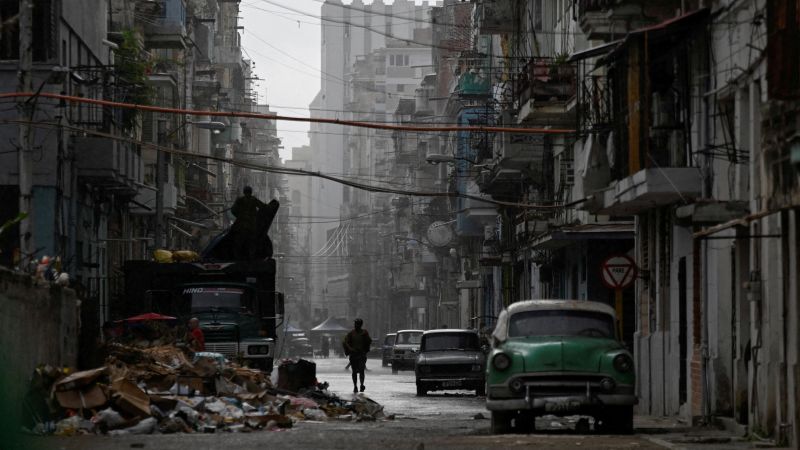
But for many Cubans, the benefits brought by the island’s socialist system have long since disappeared. The government’s food distribution system is now delivering only minimal supplies, the island’s proud health and education systems have been severely curtailed, power outages have lasted almost all day, and entire neighborhoods have been buried under uncollected trash.
“It’s like we’re not humans, we’re animals! It’s a lack of respect,” Centro Havana resident Joani Manuel Tablada Fal told CNN on a street where garbage was knee-deep for more than a block.
Frustrated by the deteriorating situation, Cubans have taken to the streets night after night, banging pots and pans in forbidden protests demanding change.
The Trump administration has promised a quick deal and the Cuban government is preparing to invade, but neither scenario may come to fruition. Instead, the island could slowly decline and disappear if left under the harshest economic sanctions the Cuban people have ever experienced.
