

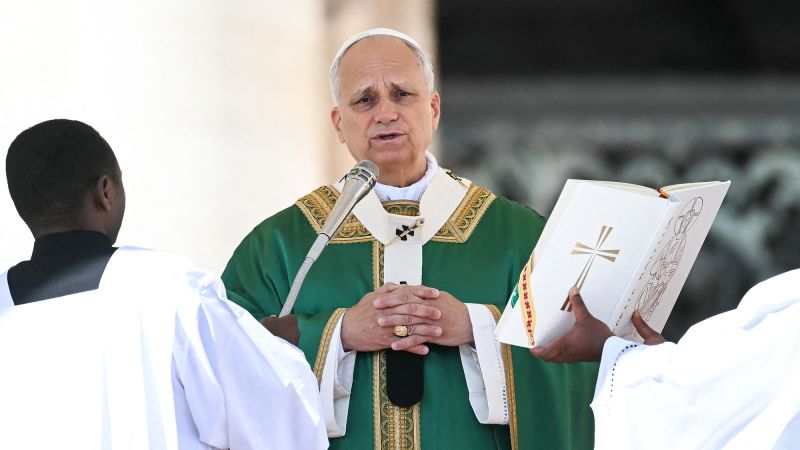
In his first major document as pontiff, Pope Leo
Leo’s nearly 40-page document released Thursday focuses on poverty, highlighting the Catholic Church’s long-standing commitment to vulnerable groups and offering a strong critique of the global economic system.
America’s first pope called on Catholics to work to eradicate “unfair” economic structures and insisted that caring for the poor is non-negotiable. Leo also criticizes those in the church who simply want to teach “sound doctrine” and “mocking” charity.
“We must increasingly address the structural causes of poverty,” Leo wrote in his “Apostolic Exhortation” entitled “Dilexi te” (“I love you”).
“Unjust structures need to be recognized and eradicated by the forces of good, by changing mindsets, but also by developing effective policies for social change, with the help of science and technology,” he writes.
An exhortation is a high-level document from the pope and is an appeal to Catholics, usually centered around a particular topic. Leo explained that “Dilexi te” had been in preparation by Pope Francis in the final months of his life, but that he was “delighted to be able to make this document his own.”
Mr. Leo’s recommendations regularly quote Mr. Francisco, including his concern that inequality leads to a “trickle-down” economy and a “killing economy.” Leo has shown that he shares the late pope’s concerns, although he faced criticism from some American Catholics for his criticism of the global economic system.
He criticizes “pseudoscientific data” that claims a “free market economy” will lift people out of poverty or that it is the government’s responsibility to address the problem.
And Leo warns about “secularity” within the church, which suggests that instead of gaining privilege and security, the church finds solutions by collaborating with “elites.”
“We must therefore continue to denounce the ‘killing economic dictatorship,'” Leo wrote.
“There is no shortage of theories that try to justify the status quo and explain that we need to wait for market forces, invisible to economic thinking, to solve everything. Yet the dignity of every human being should be respected today, not tomorrow, and the extreme poverty of all those who are denied this dignity should always weigh heavily on our conscience.”
Cardinal Michael Czerny, a member of the panel that presented the document at a Vatican press conference, was asked to what extent it was the work of Leo and Francis.
“This is Pope Leo’s document and the magisterium of the Church,” Czerny said, but added that no pope starts with “an empty desk and a clear agenda.”
Cerny, who heads the Vatican’s “integral human development” department, said he felt that the attacks Francis experienced from some conservative groups within the church were “always a sign that he was actually doing something.” The late pope was sometimes labeled by critics as a “Marxist” or “communist.” “The problem is not with Pope Francis or Pope Leo. The problem is with the attackers,” Cerny said.
Leo explained that caring for the poor includes support for immigrants, which is backed by the Bible, includes “refugee reception centers and border missions,” and is defined by efforts to “welcome, promote, protect, and integrate” new arrivals to the country.
“When the world faces threats, she (the Church) focuses on children and where walls are built, she builds bridges,” Leo explains.
“She (the church) knows that the proclamation of the Gospel becomes credible only when it is translated into gestures of intimacy and welcome. And she knows that among rejected immigrants, it is Christ himself who knocks at the door of the community.”
The Chicago-born pope also cited as a historical example the work of St. Francis Xavier Cabrini, an Italian-American nun who died in 1917 and the first American to be declared a saint.
Leo points to his work assisting poor Italian immigrants who arrived in the United States in the late 19th and early 20th centuries, quoting Pope John Paul II, who said these newcomers were “often victims of vice.” Cabrini, who founded schools, hospitals, and orphanages, was declared “patron of all immigrants” by Pope Pius XII in 1950.
Mr. Leo, who has adopted a more modest and reserved style than his predecessor, is currently facing criticism from the same circles as Mr. Francis, having raised concerns about what he calls the “inhumane treatment of immigrants in the United States.”
As a sign of continuity with his predecessor, Leo signed the document on poverty on October 4, the feast day of St. Francis of Assisi, the late pope’s namesake.
On the same day his recommendations were released, Leo met with labor leaders in Chicago and expressed his gratitude for their “welcoming of immigrants and refugees.” The Vatican also issued a message to a Catholic Charities USA Network gathering in Puerto Rico, where he described migrants as “missionaries of hope.”
The day before his recommendations were published, Leo met Bishop Mark Seitz of El Paso, Texas, a prominent figure in U.S. refugee advocacy, and told Seitz that the church “cannot be silent” about the plight of immigrants.
He encouraged them to help “our newly arrived brothers and sisters become living witnesses of hope, recognizing that they have essential human dignity and are called to participate fully in the life of their communities.”
In the document, Leo cited the Catholic Church’s contributions to social justice in Latin America, advocated “preferential treatment for the poor,” and said that as a former missionary to Peru, he was “deeply grateful” for its contributions.
