

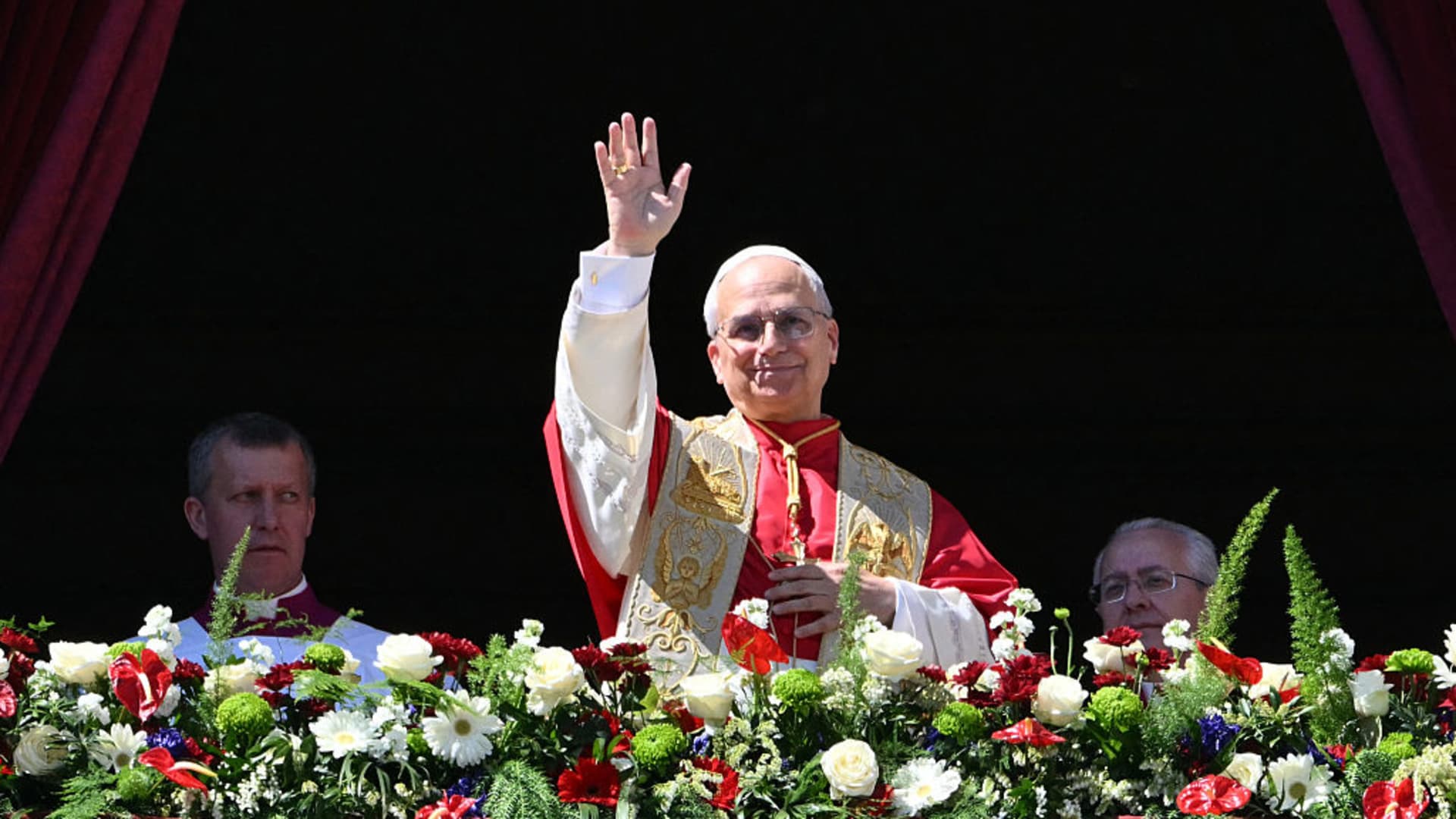
Pope Leo XIV waves to a crowd from the main balcony of St. Peter’s Basilica during the Urbi e Orbi message and blessing for the city and the world as part of the Easter celebrations, in St. Peter’s Square, Vatican, April 5, 2025.
Alberto Pizzoli | AFP | Getty Images
On Sunday, Pope Leo
In both his benediction and sermon, Leo, the first American-born pope, emphasized the message of hope for Easter, which celebrates the resurrection of the crucified Jesus.
“Let our hearts be changed by God’s immense love for us! Let those who carry weapons lay down their weapons! Let those who have the power to provoke war choose peace! Not through peace imposed by force, but through dialogue! Not by the desire to dominate others, but by encountering them!” the Pope implored.
As the United States and Israel’s war against Iran enters its second month and Russia continues its operations in Ukraine, Leo acknowledged indifference “to the deaths of thousands of people…to the hateful and divisive effects of the conflict…to the economic and social consequences it produces.”
Without mentioning the war by name, Leo quoted his predecessor, Pope Francis, who, in his final public appearance from the same loggia on Easter Sunday last year, reminded the faithful of “the great thirst for death and slaughter that we witness every day.”
Francisco became weak after a long illness and died the following day, Easter Monday.
The blessing of Urbi e Orbi, which means “to the city and the world” in Latin, traditionally includes the couplet of the tribulations of the world, and Leo followed that formula during his Christmas blessing.
Earlier, Leo addressed some 50,000 faithful from an open-air altar in St. Peter’s Square flanked by white roses, and the steps leading to the square where the faithful gathered were lush with spring perennials, symbolically echoing the pope’s words.
The Pope implored the faithful to maintain hope in the face of death. Death lurks “in the idolatry of profit that plunders the earth’s resources, in the violence of war that kills and destroys, in the abuse that crushes the weakest among us.”
Speaking at the Loggia, the Pope announced that a Vigil for Peace will be held at the cathedral on April 11.
“On this day of celebration, let us renounce all desires for strife, domination and power, and ask the Lord to grant us peace in a world ravaged by war and characterized by hatred and indifference that makes us feel powerless in the face of evil,” he said.
small changes in tradition
Leo greeted the world’s faithful in 10 languages, including Arabic, Chinese and Latin, reinstating a practice abandoned by his predecessor, Pope Francis.
Before retreating into the cathedral, Leo stepped forward from the shadows of the loggia and waved to the cheering crowd below. He then greeted people in the square from the Popemobile and continued his tour down Via Conciliazione towards the Tiber River until he returned.
View of St. Peter’s Square during the Easter Mass celebrated by Pope Leo XIV in the Vatican on April 5, 2026.
Anadolu | Anadolu | Getty Images
During Marathon, which is Holy Week, Leo also reinstated the tradition of washing the feet of priests on Maundy Thursday as a sign of encouragement to the clergy, after Francis chose to take a more inclusive path and visit prisons and disabled institutions to wash the feet of women, non-Christians and prisoners.
The 70-year-old pontiff also became the first pontiff in decades to carry a light wooden cross throughout the 14 stations during the Good Friday Way of the Cross.
Christians celebrated a peaceful Easter
Traditional ceremonies at the Church of the Holy Sepulcher, revered by Christians as the traditional site of Jesus’ crucifixion and resurrection, have been curtailed following an agreement with Israeli police. As missile attacks continue, authorities have placed limits on the size of public gatherings.
The restrictions also affected the recent Islamic holy months of Ramadan and Eid al-Fitr, as well as the Jewish festival of Passover, which is currently celebrated over a week. Sunday’s blessing by a Jewish priest at the Western Wall, which normally draws tens of thousands of people, was limited to just 50 people.
The restrictions strained relations between Israeli authorities and Christian leaders. Police last week prevented two of the church’s top religious leaders, including Latin Patriarch Pierbattista Pizzaballa, from celebrating Palm Sunday at the Church of the Holy Sepulcher.
On Tuesday, the Pope expressed hope that the war could end before Easter.
