

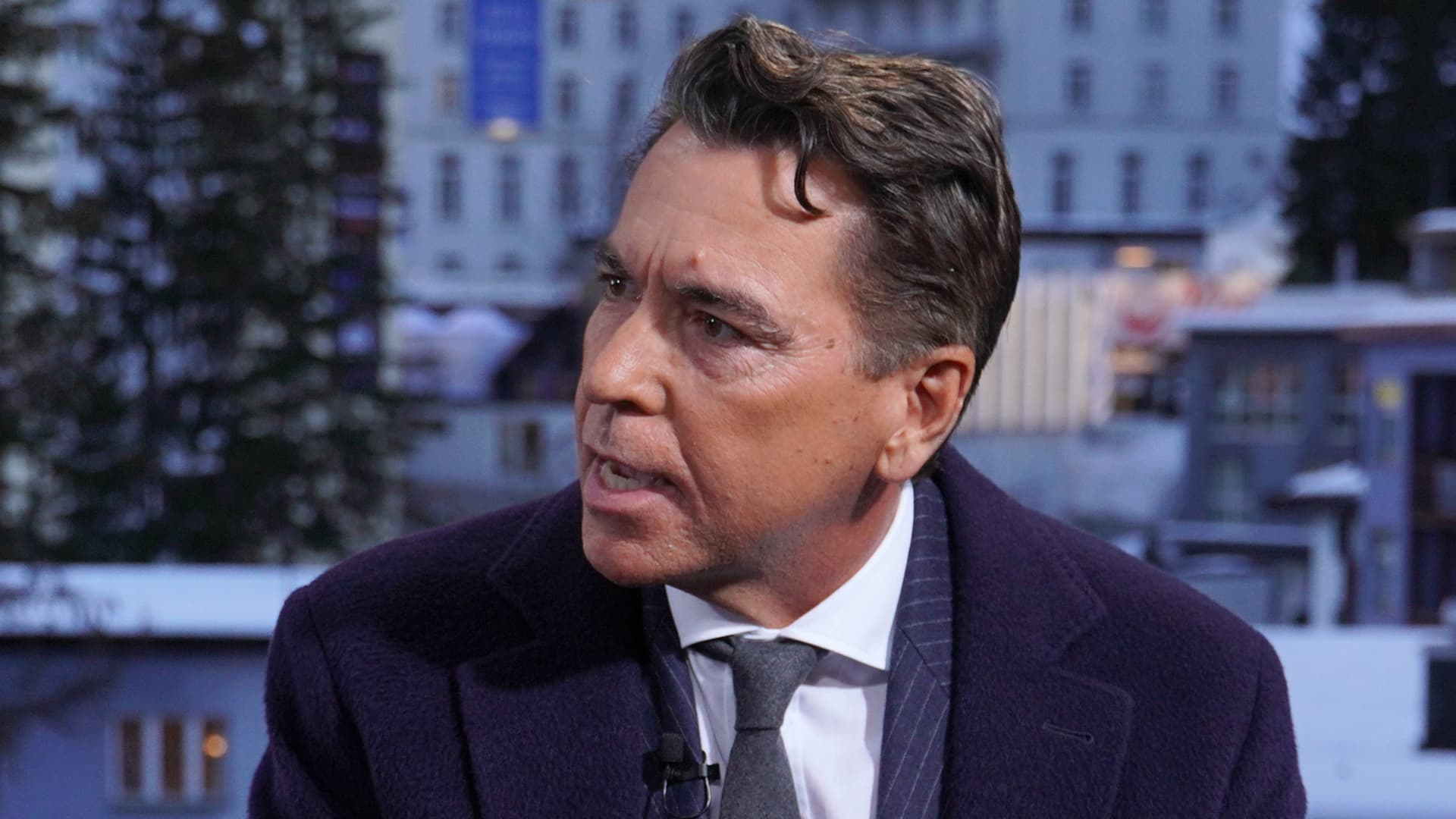
Orlando Bravo, managing partner of Thoma Bravo, speaks at the World Economic Forum’s “Squawk on the Street” in Davos, Switzerland, on January 21, 2026.
Oscar Molina CNBC
Orlando Bravo, founder and managing partner of Thoma Bravo, pushed back against growing criticism of the private market, saying deep sector expertise will separate winners from losers as artificial intelligence disrupts the entire software industry.
“We’ve been living in the details of this space for a very long time. We don’t invest at a high level, we don’t invest in stocks, but we invest in companies and customer contracts and we know the details. So, yeah, as experts in the private equity space, our firm is very, very different,” Bravo said in an interview with CNBC’s Leslie Picker on Tuesday. “Given the choices we made professionally, we are very happy with our personal credit book.”
His comments come as investors are increasing scrutiny of private market valuations and liquidity following a wave of discounting and redemption pressure across private credit and equity funds.
Morgan Stanley recently said it expects the default rate for direct loans to reach about 8%, nearing its peak during the coronavirus era. Meanwhile, Apollo Global Management’s John Zito told UBS clients last month that the private equity firm had widely misrepresented the value of its software holdings and that “every valuation is wrong.”
Mr. Bravo said Thoma Bravo’s investor base, which includes major U.S. pension funds and global sovereign wealth funds, maintains their confidence because of the company’s long track record and transparency.
“They’ve seen our tracks, they’ve seen our exits, they’ve seen our progress,” he said. “Everyone is very comfortable.”
Bravo acknowledged one of the company’s more visible failures: overpaying customer experience software company Medallia. Apollo’s Zito specifically pointed to this $6.4 billion go-private deal in 2021, saying it would be “worse than people are expecting,” according to the Wall Street Journal.
“At the time of the acquisition, we overestimated or extrapolated the company’s very high growth rate into the future. We made a mistake, and that cost us a lot of money. Now, the capital from our perspective has been impaired for a long time,” Bravo said. “Our investors, this group that controls the world’s capital, have known this for years, so there is no new news.”
Still, he said the broader portfolio is performing well.
“The other 77 companies that we have are, for the most part, very relevant to AI, and they’re completely crushing AI,” Bravo said.
Bravo made a clear distinction between private equity-owned companies and many publicly traded software companies, saying the latter are facing accelerating disruption. He noted that the recent declines in valuations for some stocks are “very justified.”
“If you look at the public markets, there are a lot of software companies in the public markets that will be disrupted by AI. Those companies will be disrupted anyway. AI will create disruption much faster,” Bravo said.
