

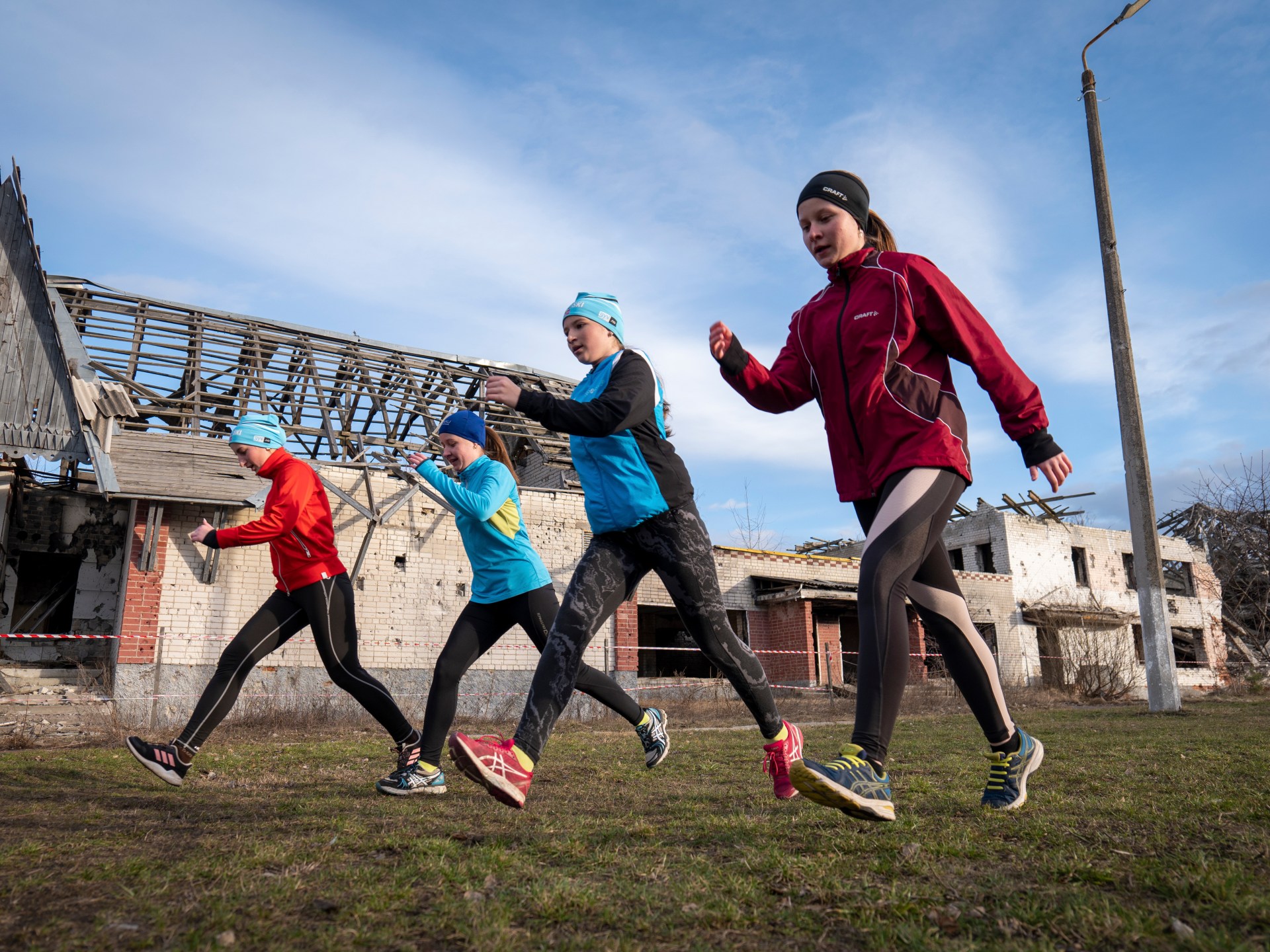
Young athletes in northern Ukraine spend their days cross-country skiing through scorched forests, concentrating on their form until sirens inevitably shatter the silence.
Instead of panicking, they reacted quickly, ditching their skis and following their coach to an underground bomb shelter.
Recommended stories
list of 4 itemsend of list
This is a normal training session at the complex that produced Ukraine’s first Olympic medalist.
Children sleeping in the dormitories of the bombed facility no longer dream of Olympic glory, and unexploded ordnance has made nearby land off-limits. But about 350 children and teens, including some of the country’s best young cross-country skiers and biathletes, are still practicing in a fenced-in area amid the sporadic sounds of explosions as drones pass overhead and then are shot down.
“We have adapted so well that even the children sometimes don’t even react,” said 67-year-old coach Mykola Forchak. “This is against safety regulations, but the children have been hardened by the war. They have also changed mentally as they adapt.”
The war dealt a huge blow to Ukrainian sports. Athletes were evacuated or called into battle. As soccer matches are often interrupted by air raid warnings, attendance is limited by the capacity of air raid shelters. Elite skaters, skiers and biathletes typically train overseas, with local facilities closed due to attacks and frequent power outages.
However, the government-run Olympic Reserve Sports Ski Base hosts cross-country skiing and biathlon (an event that combines skiing and shooting). The vast complex is on the outskirts of the city of Chernihiv, two hours north of Kiev, along a path of destruction left by Russian forces in their 2022 attempt to seize the capital. Chernihiv remains a regular target of air attacks targeting power grids and civilian infrastructure.
Several temporary structures at the sports center serve as locker rooms, restrooms, and coaches’ offices. Athletes train on snowy roads during the winter and use roller skis on blast-scarred asphalt tracks the rest of the year.
Biathletes take aim at electronic targets with laser rifles, and between shooting drills they sling skis over their shoulders and trot back to the start of the course, cheeks red from the cold.
Ukraine’s first Olympic medal
Valentina Czerve-Nesina spent her youth training in these same ways at the Chernihiv Center, where she won a bronze medal at the 1994 Lillehammer Winter Games. This was Ukraine’s first Olympic medal as an independent country.
“The conditions weren’t great, but we couldn’t have asked for anything better. And for us, this was like a family. It was our own little home,” she said, whose apartment’s shelves and walls are lined with medals, trophies and memorabilia from competitions around the world.
Zerve Nesina, 56, was shocked when she visited the complex in 2022. Shelling tore apart buildings and fires consumed others. Broken glass littered the floor of the room where she and her friends once excitedly checked their taped report cards.
“I went inside and went upstairs to the old room and it was gone. There were no windows or anything,” she said. “We recorded a video and found a trophy left at the base. It was completely burnt.”
While her husband, a veteran, returned to the front, Tserbe-Nesina volunteered to organize funerals for fallen Ukrainian soldiers in her hometown. They meet once a year and whenever his unit allows a short vacation.
One of the adults, who completed his service in the Territorial Defense Forces of the Ukrainian Armed Forces in 2022, still occasionally participates in training with the center’s youth. Kristyna Dmitrenko, 26, will represent her country at the Milan-Cortina Winter Olympics, which begin on February 6th.
“Sports can show that Ukraine is strong,” Dmitrenko said in an interview next to the shooting range. “We will represent Ukraine on the international stage and let other countries, athletes and nations see our unity, strength and determination.”
The International Olympic Committee imposed bans and restrictions on the Russian team after the invasion of Ukraine, effectively extending previous sanctions related to state-sponsored doping. However, a small group of them will participate in the next Winter Olympics.
After being screened for non-military status, they must only compete in non-team events without displaying national symbols. This means Russian and Ukrainian athletes could compete in some skating and skiing events. An appeal by the Russian government at the federation level to allow biathletes to compete is pending.
Many Ukrainians therefore view training for these events as an act of rebellion. Former Olympic biathlete Nina Remesh, 52, pointed out that some of the young Ukrainians who first picked up rifles and skis at the Chernihivsky base during the war went on to become international champions of their generation.
“Fortunately, Ukrainians are here, and they always will be,” she said, standing next to a destroyed dormitory. “This is the next generation of Olympians.”
