

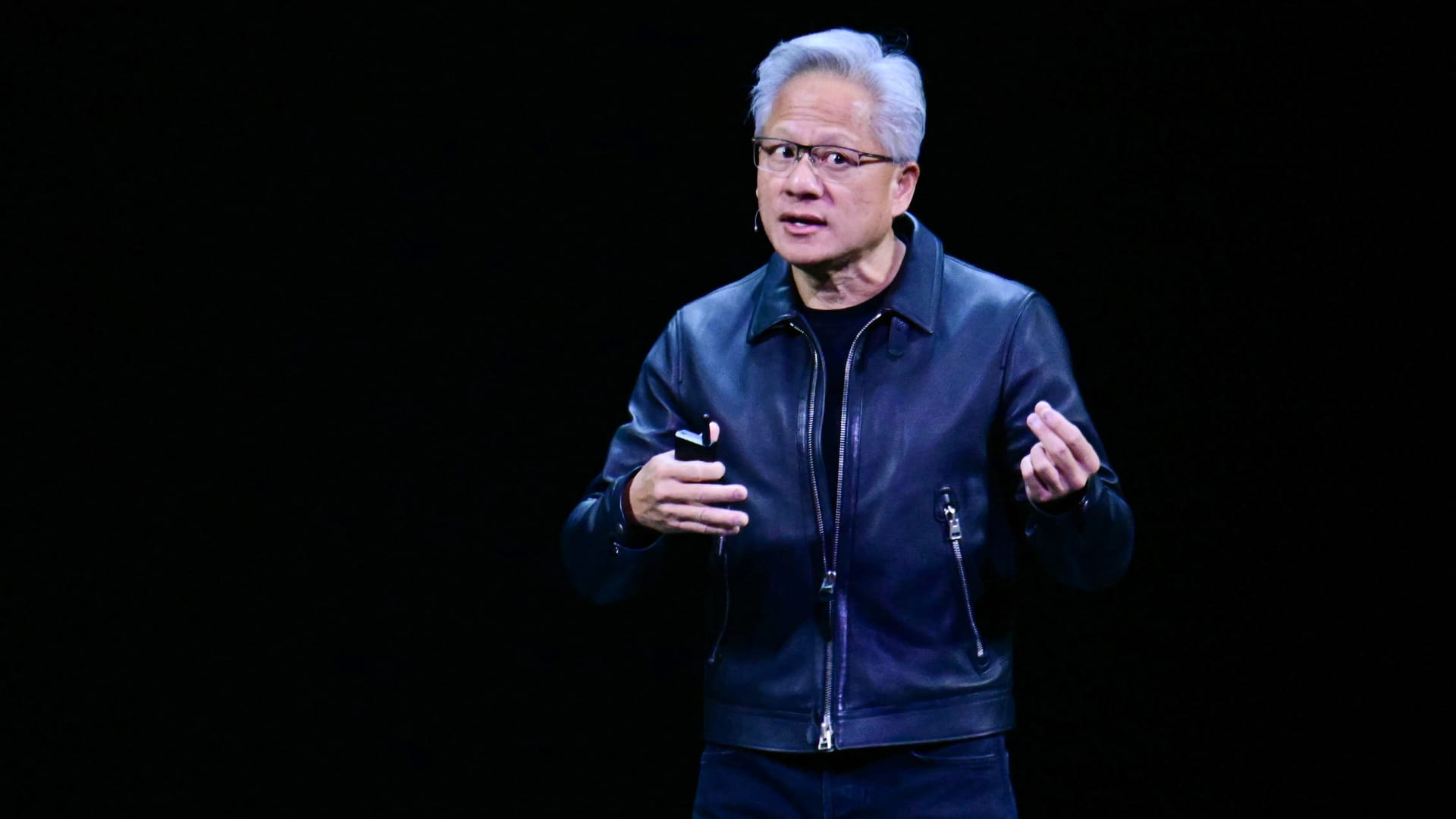
NVIDIA CEO Jensen Huang speaks during the Nvidia GTC (GPU Technology Conference) Live Keynote Pregame on October 28, 2025 in Washington, DC.
Jim Watson | AFP | Getty Images
Nvidia CEO Jensen Huang said Friday that artificial intelligence has reached a “virtuous cycle” and the industry is showing signs of continued growth.
Speaking at the APEC CEO Summit in South Korea, Huang said significant improvements in AI models have led to increased investment in the technology, resulting in further improvements in AI models.
“We have achieved what is called a virtual cycle,” he said on stage at the event, wearing a suit instead of his usual black leather jacket.
“AI gets better. More people use it. When more people use it, more profits are made and more factories are created. As a result, we can create even better AI, and more people can use it. A virtual cycle of AI is being designed, and this is why…the world’s capital investment is moving so fast.”
His comments come as Big Tech is spending billions of dollars to build AI-related infrastructure and provide services to end users.
Spending on AI was expected to be big this year, with Meta, Amazon, Alphabet, and Microsoft announcing plans to spend more than $300 billion on AI technology and building data centers. For every profit reported this week, tech giants plan to increase spending again, a situation that is expected to continue through 2026.
Dan Ives, global head of technology research at Wedbush Securities, described Nvidia as “the foundation of the AI revolution” in comments to CNBC following Huang’s onstage comments.
He described the virtuous cycle of AI as, “The more demand there is, the more AI building blocks are built. And that demand creates more demand and capital investment.”

Huang emphasized that profitability is at the heart of the current AI capital investment boom.
“When something becomes profitable, you want to make more of it. Just like when you make chips and wafers and DRAM, when it becomes profitable to make those chips, you want to build more factories to make more chips,” he added.
A new era of computing
This is the beginning of a new era in computing, with AI “fundamentally changing every layer of the computing stack,” Huang said on stage.
We are at the beginning of a decade of building this new era, he added.
“AI runs on the GPU (graphics processing unit), whereas hand-coded software runs on the CPU (central processing unit). This entire software stack, every single layer of computing, has fundamentally changed, from the energy, chips, and infrastructure needs to all the software associated with the system, the AI model, and the applications on top of it,” he said.
“Think about it: The computer industry has remained largely unchanged for 60 years, but now, with AI and high-speed computing, every layer of the computing stack is changing. Every computer we’ve ever created, $1 trillion worth of computers, probably more, needs to be migrated now and moved to a new computing platform,” he added.
Nvidia, which earlier this week became the first company to have a market capitalization of more than $5 trillion, announced a partnership with South Korean semiconductor giant Samsung earlier Friday. Samsung plans to purchase and deploy a cluster of 50,000 Nvidia GPUs to improve chip manufacturing for mobile devices and robots.
Huang painted a picture of a future where AI can “work” rather than just being used as a tool. The CEO highlights the rise of fully automated manufacturing plants and predicts AI will reshape $100 trillion worth of industries around the world.
—CNBC’s Kif Leswing contributed to this report.
