

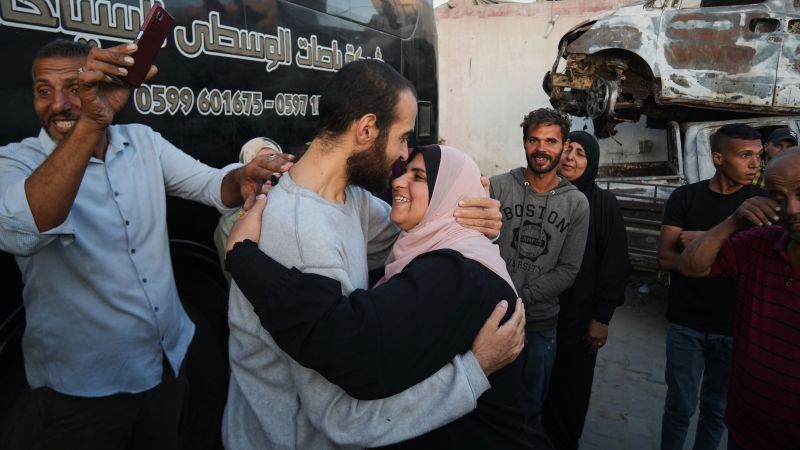
Israel released about 2,000 Palestinians from prison on Monday as part of the Gaza ceasefire agreement, with emotional scenes of families being reunited with their loved ones, some of whom had spent decades behind bars.
More than 1,700 of those released were detainees who had been held without charge by Israeli forces in the Gaza Strip since the start of the war, which began with a Hamas-led attack on Israel on October 7, 2023. A further 250 prisoners were serving long sentences after being convicted of serious crimes, including murder. After his release on Monday, some claimed they were regularly assaulted while in Israeli prisons.
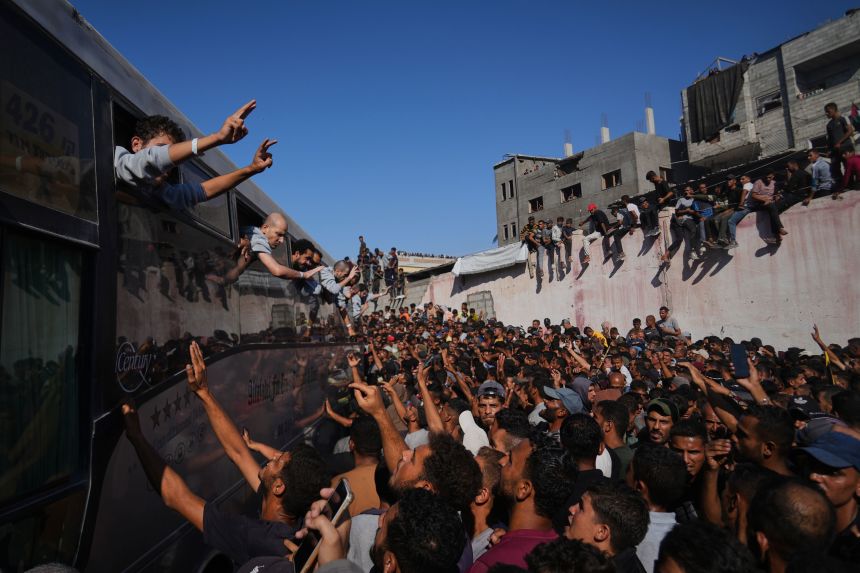
By late Monday, nearly 40 buses carrying detainees were slowly moving through a large crowd at the Nasser medical complex in southern Gaza.
The convoy was followed by a pickup truck carrying dozens of armed and masked men, some of whom fired shots into the air in celebration.
Some detainees leaned out of windows, flashing victory signs or waving or holding Palestinian flags. People in gray prison uniforms climbed onto the roofs of buses, waved to the crowd and unfurled Hamas flags.
A tearful boy was pulled up to the window and hugged by one of the detainees.
Ninety-six long-term Palestinian prisoners convicted by Israeli courts have been released to the West Bank, East Jerusalem, and Gaza. A further 154 prisoners were transferred to Egypt, most of whom were convicted of violent crimes, including murder.
Some had been in Israeli prisons for more than 20 years.
Those released on Monday included members of Hamas, Palestinian Islamic Jihad, Fatah and other Palestinian factions, but Israel has refused to release several high-profile prisoners, including Fatah popular figure Marwan Barghouti. Many Palestinians consider Barghouti their Nelson Mandela, believing he is the only one who can unite their fractured society and lead Palestinians to freedom.
However, Mahmoud Qawasmeh, a senior Hamas official who was arrested for the second time in 2024, was scheduled to be released as part of the deal. Also scheduled for release are Mohammad Zakharneh, who was convicted of plotting to kill a taxi driver in 2009, and Mohammad Abu al-Rub, who was convicted of carrying out a fatal stabbing in 2017.
Large crowds had gathered in Ramallah in the occupied West Bank, with families gathering to reunite with former prisoners of war. Ahead of the liberation, Israeli authorities distributed leaflets in the West Bank warning of celebrations.
The Palestinian Red Crescent Society (PRCS) said several prisoners released in Ramallah were beaten by Israeli guards before boarding a bus.
PRCS spokesperson Hassan Shirwadi said some suffered rib fractures and eye injuries. In response, the Israel Prisons Authority said it was not aware of the allegations and told CNN: “To our knowledge, no such incidents have occurred under the responsibility of IPS.”
Meanwhile, some released Palestinian prisoners have claimed that they were mistreated while in prison.
“It’s been very difficult,” Ahmed Awad, who is serving three life sentences for murder, told CNN. “Any rational person can’t imagine what he’s going through in prison.” “I can’t imagine how they would treat the prisoners. They humiliated us and beat us every day for no reason.”
“There was no treatment, I couldn’t even take painkillers,” Faisal Mahmoud Abdullah Al Khalifi, 45, another released prisoner, told CNN in Ramallah. Al-Khalifi had been convicted of security offenses and weapons offenses. “As for the doctors, the people who were treating us also beat us. It was the doctors who hit (us) first.”
He also claimed that prison authorities “left us out in the sun, on gravel for 12 hours.”
“Sometimes they forced us to stand up, hit us and threw us at our cellmates,” said Al Khalifi, who was imprisoned for 10 years.
“Many prisoners, especially those from Gaza, showed clear signs of physical and psychological torture, and there were records of ill-treatment right up to the last moments of their release,” the Palestinian Prisoners of War Committee and the Palestinian Prisoners of War Association said on Monday.
CNN has reached out to Israeli prison authorities for a response to the allegations.
Human rights groups have repeatedly alleged that Palestinian prisoners are mistreated in Israeli prisons. A CNN investigation last year spoke to three Israeli whistleblowers who worked at one camp and detailed assaults and other abuses.
In response, the Israeli military said it would “ensure appropriate action against detainees in its custody.”
Detainees who have returned to Gaza face an uncertain future. Much of the territory’s infrastructure is destroyed and hospitals overwhelmed. Tens of thousands of homes were damaged or destroyed.
Hamas internal security forces have clashed with several clans in recent days as the group seeks to reassert power across Gaza.
It is unclear when international stability forces and new police forces will be deployed to the enclave under US President Donald Trump’s 20-point peace plan, or if Hamas will disarm it.
