

Thousands of flights have been canceled and hundreds of thousands of travelers are stranded as war rages in the Middle East.
More than 11,000 flights scheduled to depart from major airports in 10 countries have been canceled since the US and Israel attacked Iran on February 28, according to data from Flightradar24.
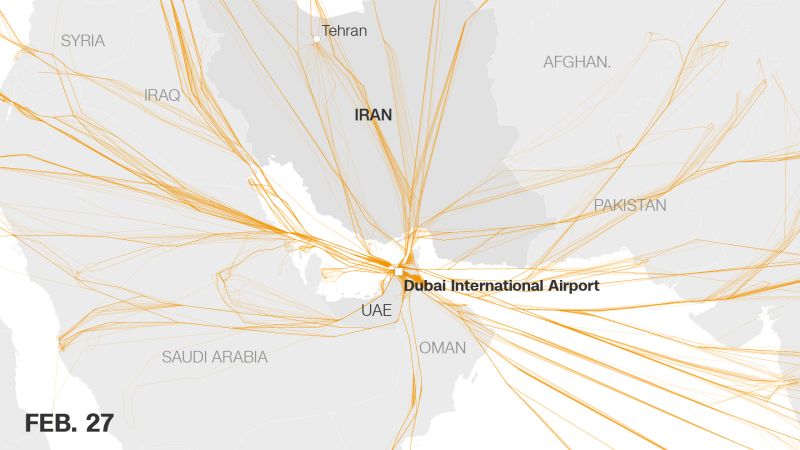
Flight data paints a grim picture of empty flight paths, which typically cross crowded skies. Some airports and airlines in the Persian Gulf have completely suspended normal operations. As of March 4, 10 countries had completely or partially closed their airspace since the airstrikes, according to Flightradar 24.
Dubai International Airport in the United Arab Emirates, one of the world’s busiest aviation hubs connecting 291 destinations, has seen an 87% reduction in scheduled flights since February 28. The airport handled 4.9 million seats in February alone, according to the Official Aviation Guide, a reference source for air travel data.
Other airports in the region have also seen high rates of flight cancellations, including around 91% of flights from the emirate Sharjah, which borders Dubai, and 93% of flights from Doha, Qatar.
Despite continued uncertainty in the region, some airports began resuming operations on Wednesday, including Dubai, Abu Dhabi and King Khalid International Airport near Riyadh in Saudi Arabia.
According to the British Foreign Secretary, more than 300,000 British nationals are living in or moving through the Gulf. And on Wednesday, the US State Department announced that more than 17,500 US citizens have returned to the US from the Middle East since February 28.
