

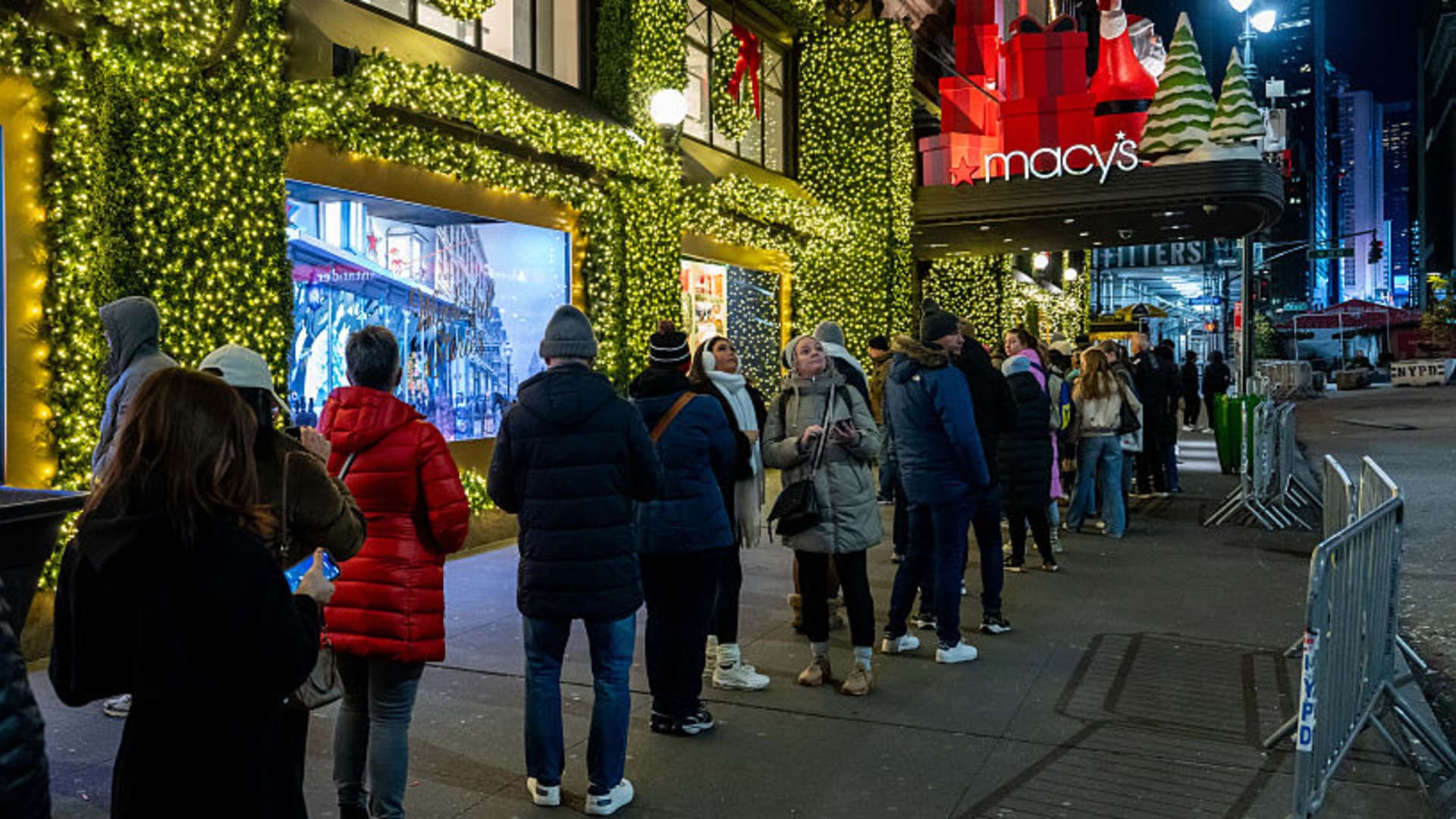

Macy’s The company’s sales on Wednesday beat Wall Street expectations for the third consecutive quarter, posting the strongest growth in more than three years as the company’s turnaround strategy shows signs of momentum.
The department store operator raised its full-year sales and profit outlook after a better-than-expected fiscal third quarter. The company now expects adjusted earnings per share to be in the range of $2 to $2.20, up from the previous estimate of $1.70 to $2.05, and net sales of $21.48 billion to $21.63 billion, compared with the previous forecast of $21.15 billion and $21.45 billion.
Macy’s said it expects sales to be flat to about 0.5% year over year. This compares with previous forecasts of a 0.5-1.5% decline from the previous year. Industry metrics include temporary fluctuations, such as store openings and closings, and Macy’s includes products it owns, branded items that pay for space in its stores, and third-party online marketplaces.
This is the second consecutive quarter that Macy’s has raised its full-year sales and profit forecasts. The company lowered its full-year profit forecast in May, citing higher tariffs, increased promotions and “some moderation” in discretionary spending.
Still, expected full-year sales would be down from last year’s net sales of $22.29 billion. Macy’s said about $700 million of the annual net sales decline was due to the closure of 64 stores at the end of its previous fiscal year, which ended Feb. 1, and at the beginning of this fiscal year.
And Macy’s said in a news release that it expects the two challenging conditions of selective consumer spending and rising tariffs to continue into the holiday quarter.
The company’s shares fell about 1% on Wednesday.
CEO Tony Spring said in an interview with CNBC that the company is taking a “cautious view” on the fourth quarter because it faces a tougher year-over-year situation and because it doesn’t know how much “aspirational customers” — those who want to shop in-store but are financially strapped — will spend during the season.
“We’re happy with the fourth quarter so far, but we have a big holiday ahead of us,” he said.
Spring said Macy’s department store model is advantageous during the gift-giving season because it offers a wide variety of products and a wide range of prices, from off-price to luxury items.
Here’s how the department store operator’s fiscal third-quarter results compare to Wall Street expectations, based on a survey of analysts by LSEG.
Earnings per share: Adjusted 9 cents, expected loss 14 cents Revenue: $4.71 billion, expected $4.62 billion
Macy’s is looking for better and more consistent sales, especially for its namesake brand. Macy’s department stores make up the bulk of the New York City-based company’s business, but their performance has lagged behind that of the company’s upscale department store Bloomingdale’s and beauty chain Bluemercury. In an effort to reverse that trend, the retailer is investing more in staffing, sharper merchandise and eye-catching displays at Macy’s stores. The company first rolled out its strategy at 50 stores, known as the “First 50,” and later expanded the approach to a total of 125 Macy’s stores. This represents more than one-third of the 350 stores with the same name that Macy’s plans to continue operating.
In line with additional investment, Macy’s stores with poor performance were closed. In early 2024, the company announced plans to permanently close approximately 150 namesake stores by early 2027, while adding Bloomingdale’s and Bluemercury stores.
The company has not yet announced how many more stores it will close this fiscal year.
Macy’s net income for the three months ended Nov. 1 fell to $11 million, or 4 cents per share, compared with $28 million, or 10 cents per share, in the same period last year. Adjusted for certain one-time items such as gains on real estate sales, the company reported earnings of 9 cents per share.
Revenue decreased from $4.74 billion in the same period last year.
Third-quarter fiscal year companywide comparable sales increased 3.2%, including owned and licensed products and third-party markets. Excluding stores in which the company will not participate in future operations, the growth rate was 3.4%.
Bloomingdale’s had the strongest performance of any of the company’s brands, with owned and licensed comparable sales, including third-party markets, up 9% year-over-year. Additionally, Blue Mercury’s comparable sales increased by 1.1%.
Mr. Spring attributed the company’s improved results to shoppers responding to changes Macy’s has made to traditional department stores, such as adding quick-response staff and emerging brands like luxury home goods company MacKenzie-Childs.
He said he visited Macy’s and its competitors’ stores on Black Friday and was pleased with what he saw.
“I like what we look like,” Spring said. “We look pretty. We look clean. We look interesting, attractive, exciting and shoppable.”
Cooler weather has also helped, he said. As temperatures cooled in October, shoppers bought items such as cashmere sweaters, outerwear and boots.
Spring said he expects Macy’s store and website, as well as competitor promotions, to be at the same level as a year ago heading into the holiday season.
However, higher tariffs mean higher prices for some items. Macy’s is working with vendors and manufacturers to cushion the impact of the tariffs, and the hit to third-quarter profits was less than the company expected, he said.
Still, Spring said Macy’s has made “selective” price hikes in nearly every category, with some items increasing in price due to improved quality or added embellishments, and some simply due to higher import costs.
As of Wednesday’s close, Macy’s stock is up nearly 33% since the beginning of the year. This outpaced the S&P 500’s increase of more than 16% over the same period. Macy’s stock closed Wednesday at $22.46, giving the company a market capitalization of about $6.03 billion.
