

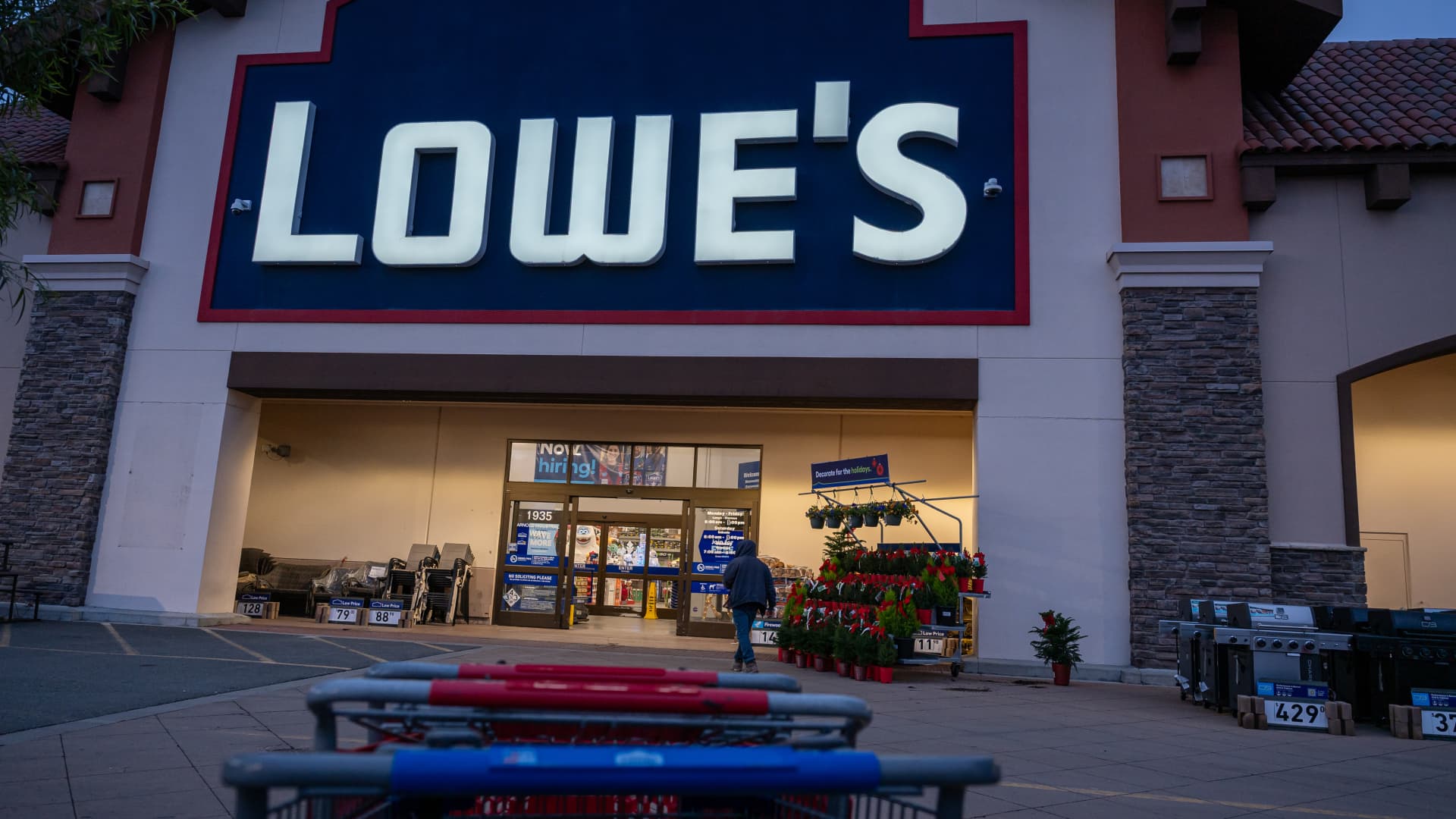
Monday, November 17, 2025, at a Lowe’s store in Concord, California, USA.
David Paul Morris | Bloomberg | Getty Images
lowe’s The company on Wednesday beat Wall Street’s quarterly sales and profit expectations, posting more than 10% year-over-year sales growth, even as the home improvement market’s struggles show little sign of ending.
In an interview with CNBC, CEO Marvin Ellison said the home improvement retailer is “still dealing with a housing market that doesn’t have a lot of tailwinds.” He said the combination of rising inflation, economic uncertainty and rising mortgage rates is creating a “lock-in effect” where American consumers remain in their homes rather than buying or selling.
“For us, the biggest driver for the home improvement industry is when you decide to put a home on the market,” he said. “That’s because the first thing you do when you put your home on the market is spruce up your yard, fix your fence, paint your walls, and do some simple landscaping improvements to your home.”
Lowe’s strategy is resonating with do-it-yourself customers and home professionals, he said, as the waiting game continues for growing demand for home improvement. He acknowledged several company-specific changes, including a better digital experience, flexible delivery options and more installation services.
He said Lowe’s expects demand in the home improvement industry to be roughly flat this year. The company’s own full-year sales forecast is based on expectations that it will outperform the market, he said.
Lowe’s said it expects total sales for the current fiscal year to be in the range of $92 billion to $94 billion, which would be an increase of about 7% to 9% compared to the prior year. The company expects full-year adjusted earnings per share to be between $12.25 and $12.75. Lowe’s said it expects comparable sales, a measure that excludes one-time factors, to be about flat to up 2%.
Lowe’s stock price fell more than 4% in midday trading Wednesday after the company’s earnings per share forecast for this year fell short of analysts’ consensus estimate of $12.95, according to LSEG.
Ellison told CNBC that the company’s outlook is “appropriately conservative” due to the “very fluid, very unpredictable environment” the company faces due to weak home sales and changes in tariff rates.
Here’s how Lowe’s reported for its fiscal fourth quarter compared to Wall Street expectations, according to a survey of analysts by LSEG.
Earnings per share: $1.98 adjusted vs. $1.94 expected Sales: $20.58 billion vs. $20.34 billion expected
Lowe’s net income for the three months ended Jan. 30 fell to $999 million, or $1.78 per share, from $1.13 billion, or $1.99 per share, a year earlier. Excluding one-time factors such as charges related to recent acquisitions, Lowe’s reported adjusted earnings per share of $1.98.
Sales increased from $18.55 billion in the same period last year.
According to Street Accounts, sales rose 1.3% in the quarter, beating analysts’ expectations for a 0.2% increase. Growth was driven by a strong holiday season, as well as growth in home professionals, online sales and home services, the company said in a news release.
Bill Boltz, executive vice president of merchandising, said on the company’s earnings call that Lowe’s recorded growth in nine of its 14 merchandising categories. Bolz said some of the best-selling categories and products have strong ties to professionals, such as sales of plumbing supplies such as water heaters and woodwork for windows and doors. But the company also saw strong paint sales, as customers purchased interior and exterior paints, primers and stains, he said.
Pressured by harsh housing conditions

Lowe’s results add to housing market struggles following those of rivals home depot He said the same reluctance persists when it comes to tackling large-scale housing projects.
Home Depot beat Wall Street’s profit and sales expectations on Tuesday, but stuck to a conservative full-year outlook. The quarterly results reflect continued weakness in home improvement demand as U.S. consumers continue to postpone large projects due to financial concerns, as well as borrowing costs and high home prices.
Like Home Depot, Lowe’s feels constrained by the industry’s tough backdrop. Earlier this month, Lowe’s cut about 600 corporate and support roles, which the company said will free up resources to support its stores. Home Depot announced in late January that it would lay off 800 employees and require employees to work in the office five days a week.
The companies are also eyeing professionals to drive growth by acquiring companies that tend to be more stable sources of business, such as contractors, roofers and electricians.
Last year, Lowe’s acquired Foundation Building Materials, which sells drywall, insulation and other interior construction products to large residential and commercial professionals, for about $8.8 billion. It also acquired Artisan Design Group, which provides design services and installation of flooring, cabinetry and countertops to home builders and property managers, for approximately $1.33 billion.
Lowe’s is also making unique moves to reach customers who are delaying homebuying, such as launching a third-party marketplace to expand its product mix, using influencers to increase its visibility on social media, and restarting its children’s program to reach young families.
But Lowe’s and Home Depot are still waiting for signs that U.S. consumers are ready to jump into buying, selling and repairing homes at a more normal pace.
Mr. Ellison said on the earnings call that the company is watching closely if there is a shift to more expensive discretionary purchases.
“If we start to see a sustained increase in large, discretionary purchases made by DIY shoppers, we will see consumers become healthier and more confident in their purchases,” he said.
He told CNBC that two changes could lead to meaningful changes for the industry. That could be an increase in home sales or an increase in the use of home equity lines of credit. Homeowners might take advantage of the increased value of their home to redo the kitchen, finish the basement, or build a deck while maintaining a low fixed mortgage rate.
“I think at some point, as people continue to be stuck at home and realize, ‘I’m not going to give up on this 2.5% mortgage rate,’ they’ll start investing in housing,” he said.
Customs policy is also creating new uncertainty for retailers after the Supreme Court ruled on Friday that some country-specific tariffs are illegal. Since then, President Donald Trump has announced a 10% global mandate and suggested the mandate could be increased.
Ellison told CNBC that about 40% of Lowe’s products are imported, and fewer than they used to be. He said Lowe’s can rely on its existing tariff strategy, which has become clearer in recent years, even as it calculates how costs will change.
As of Tuesday’s close, Lowe’s stock is up nearly 16% this year, outpacing the S&P 500’s rise of about 1% over the same period. The company’s stock has risen about 15% over the past year, roughly matching the S&P 500’s rise of about 16% over that time.
