

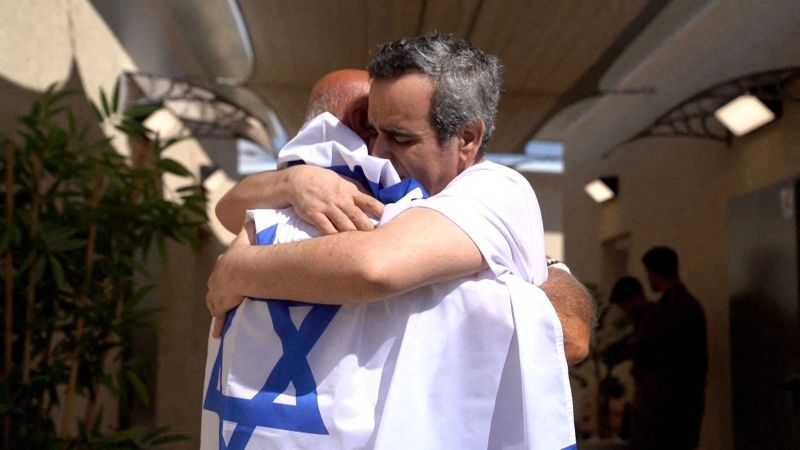
The last 20 living hostages held in Gaza were released on Monday and reunited with their families in jubilant scenes as world leaders gathered in Egypt to discuss the future of Gaza and the next steps in a US-brokered cease-fire agreement.
For the first time in more than two years, Hamas and its allies do not hold any live hostages in Gaza.
Meanwhile, 1,718 Palestinians held without charge in Israel were released on Monday and returned to Gaza. Israel also released 250 Palestinians serving long sentences.
“This long, painful nightmare is finally over,” US President Donald Trump said in a speech in the Knesset, Israel’s parliament, on Monday during a visit to the Middle East.
“This is a historic dawn for a new Middle East,” President Trump told Israeli lawmakers, expressing confidence that the cease-fire agreement would hold and the war in Gaza was over.
But many issues related to the 20-point plan brokered by President Trump, along with Egypt, Qatar and Turkey, remain unresolved.
Here are some key moments from Monday and what could be next for the peace process.
The remaining 20 living hostages were released in two groups on Monday, sparking a sense of elation and relief across Israel.
In Tel Aviv’s Hostage Square, a large crowd cheered, waved flags and shouted “Thank you, Trump!” When news of hostage release was announced.
Emotional scenes unfolded at the Rem military facility in southern Israel as the hostages were reunited with their families after being held captive for more than two years.
In footage shared by the Israeli military, 24-year-old Guy Gilboa Dalal is greeted by his parents and siblings after he was kidnapped from the Nova Music Festival. His family cried and hugged him.

Freed hostage Guy Gilboa Dalal reunited with family

Omri Milan, 48, who was kidnapped when Hamas gunmen invaded his family home in Kibbutz Nahal Oz, was greeted by his wife Rishei Milan-Rabbi and father Dani Milan. In the photo, he was seen playing with his children for the first time in over two years.
“We are at the beginning of a complex, difficult, but emotional journey of recovery,” Milan’s family said in a statement.
Under the U.S.-brokered deal, Hamas and its allies were scheduled to release all remaining hostages, including the 28 killed, within 72 hours of the ceasefire announcement.
Israeli authorities said Hamas on Monday handed over four coffins believed to contain the remains of the four deceased hostages to the Red Cross.
Later that day, Israeli police announced that the coffin had been released to Israel before being escorted to the National Forensic Institute in Tel Aviv for formal identification. Israel has not yet confirmed the identity of the returned remains.
Israel on Monday released 1,718 Palestinians held without charge by its forces in the Gaza Strip over the past two years. The detainees were taken back to Gaza by bus and met by a large crowd at Nasser Hospital in the southern part of the enclave.
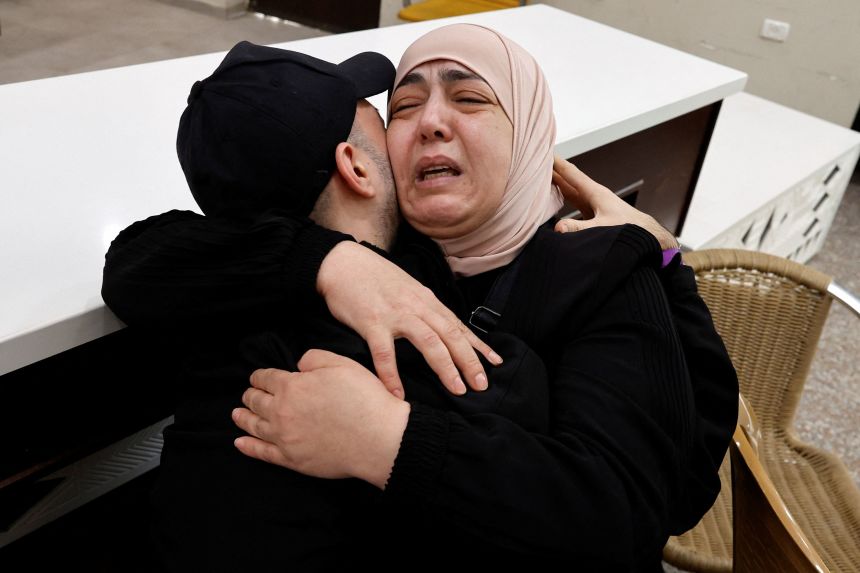
Israel also released 250 Palestinians serving life or long-term sentences.
Some of the released prisoners were taken to the occupied West Bank and were hugged by family and friends as they emerged from a bus in Ramallah. CNN also witnessed a significant presence of Palestinian security forces and medical personnel at the scene.
A further 154 Palestinian prisoners serving long sentences in Israeli prisons have been deported to Egypt, according to the Palestinian Prisoners of War Association. Israeli authorities had demanded that prisoners convicted of “violent crimes” be expelled to third countries rather than being allowed to return to the West Bank or Gaza.
President Trump spoke for more than an hour in Israel’s parliament, winning a cease-fire agreement and repeatedly pleading with Israeli Prime Minister Benjamin Netanyahu not to restart the war.
“Israel, with our help, won as much as they could by force. You won. I mean, you won,” Trump said. “Now is the time to turn these victories against terrorists on the battlefield into the ultimate prize of peace and prosperity across the Middle East. Now is the time for you to enjoy the fruits of your labor.”
The US president also warned that further war would tarnish Netanyahu’s legacy, adding that the cease-fire agreement would leave him remembered “much more than if we continued as is.”
Prime Minister Benjamin Netanyahu has been accused of prolonging the war in Gaza in order to delay and distract from corruption scandals and domestic political problems, charges he has rejected.
President Trump visited Egypt and met with the leaders of Qatar, Jordan, the Palestinian Authority, France, Germany, and the United Kingdom. The group gathered in the resort town of Sharm el-Sheikh, where Egypt and the United States are co-hosting a summit on ending the war in Gaza and the next steps in the peace plan.
During the summit, world leaders participated in the signing ceremony of the Gaza ceasefire agreement.
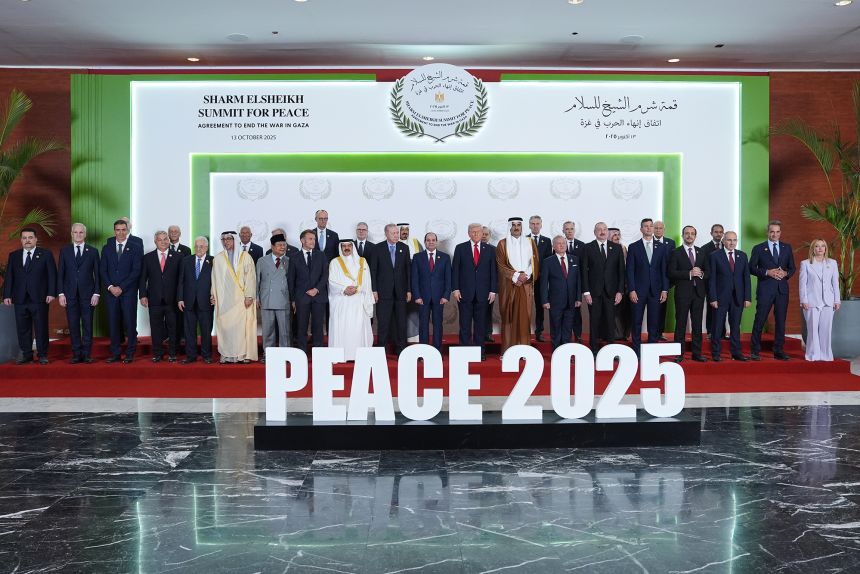
Prime Minister Netanyahu said he was invited but did not attend.
The 20-point ceasefire plan brokered by the United States, Egypt, Qatar and Turkey still leaves several unresolved issues and details to be worked out.
Those concerns include how the largely destroyed Gaza Strip will be governed after the war, and how Hamas’ disarmament and Israel’s withdrawal from Gaza will be carried out.
Under the agreement, a complete withdrawal of Israeli forces is conditional on Hamas’ disarmament, leaving Netanyahu open to insist that Israel is still free to resume fighting.
Hamas’ chief negotiator Khalil al-Khayya said last week that he had received assurances from the United States and international mediators confirming that Hamas’ agreement did not mean a temporary cease-fire but “a permanent end to the war.” It is not clear how such assurances were obtained.
A key unanswered question is what will happen to Hamas, said Burk Ozcelik, senior Middle East security researcher at the Royal Integrated Services Institute (RUSI), a British think tank.
“We’re seeing a path towards a Palestinian state, but at the end of the day, this is a Palestinian state that has no place for Hamas,” Ozcelik told CNN.
“I think Israel will maintain measures that it considers operations in Gaza essential to its national security if it believes there is a credible threat to its security and border areas,” Ozcelik said. “But at the same time, Gaza needs governing institutions. It needs security and law enforcement. It needs to provide basic services and distribute critical humanitarian aid.”
He added that other regional actors, especially Egypt and Turkey, are expected to play important roles in the transition. “For the time being, all sides will want to be seen as doing everything in their power to make President Trump’s plan a success.”
CNN’s Kevin Liptak, Ivana Kottasova, Kara Fox, Tim Lister, Abeer Salman and Eyad Kourdi contributed to this report.
