

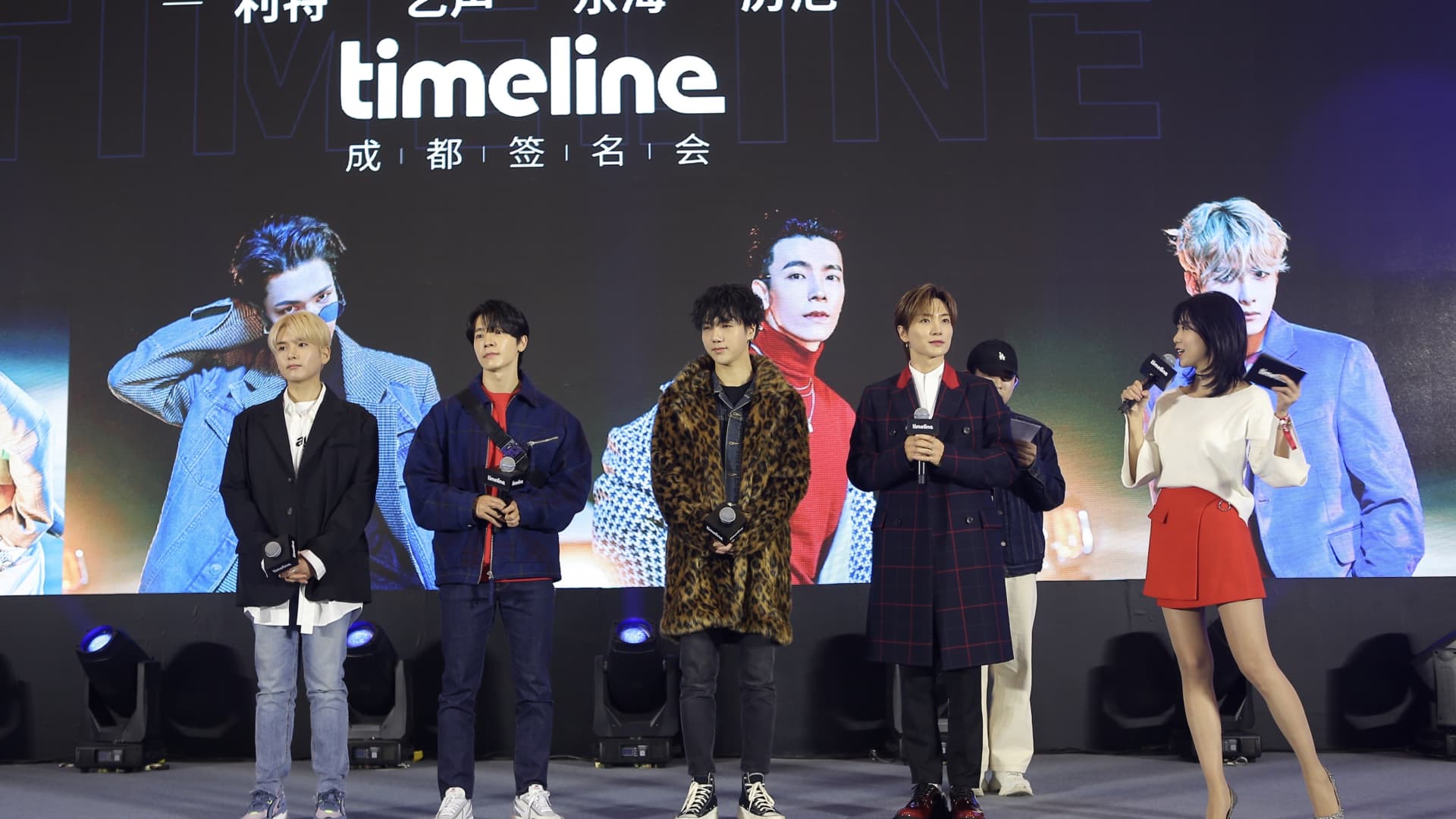
Chengdu, China – January 5: Leeteuk, Yesung, Donghae, and Kim Ryeowook of South Korean boy group Super Junior attend a press conference in Chengdu, Sichuan Province, China on January 5, 2020. (Photo courtesy of VCG/VCG, Getty Images)
Video Visual China Group | Getty Images
A content exchange agreement between South Korea and Beijing could brighten the outlook for K-pop and pave the way for Korean entertainment to re-enter the Chinese market.
South Korean state-run broadcaster KBS signed a media exchange and cooperation business agreement with China Media Group, a Chinese state-run media company, on Saturday. CMG includes state media companies such as China Central Television and is directly controlled by the Chinese Communist Party.
SM Entertainment’s stock price rose by up to 8.11%, while JYP Entertainment’s stock rose by more than 9.39%. YG Entertainment and Hive recorded the day’s highest price increases of about 4% and 3%, respectively. After that, the rise in stock prices diminished.
KBS said the agreement will “fully promote cross-cultural content exchange, not just news and sports, but also the launch of the ‘Music Bank World Tour’ in China.”Music Bank is KBS’s flagship program where K-pop artists appear when they release new songs.
KBS President Park Jang-beom said, “I think it is significant that we have created a breakthrough that will allow the Korean content industry as a whole to once again enter the Chinese market in earnest.”
This took place when South Korean President Lee Jae-myung and Chinese President Xi Jinping met on the sidelines of the Asia-Pacific Economic Cooperation (APEC) summit, with President Lee writing on Facebook that the summit was “very significant in that it completely repaired South Korea-China relations.”
K-pop’s return to China could mark a turning point for the industry since China imposed a “soft ban” on K-pop content in 2016 following South Korea’s deployment of the US Terminal High Altitude Area Defense Anti-Ballistic Missile System (also known as THAAD) on its soil.
Driving force behind stock price
Oh Ji-woo, research analyst at CGS International Securities Hong Kong’s Korea branch, explained why SM and JYP posted even bigger gains on Monday.
The rise in JYP’s stock price was driven by a meeting between founder Park Jin-young and the Chinese president at the state banquet for the China-South Korea summit.
Park, who is also co-chair of the Korean President’s Committee on Popular Culture Exchange, posted a photo on her Instagram account of herself, South Korea’s Lee, and China’s Xi talking.
South Korean lawmaker Kim Yong-bai posted on Facebook that during the meeting, a proposal was made to hold a large-scale concert in Beijing, and that President Xi summoned Foreign Minister Wang Yi to give instructions.
According to Google Translate, Kim said, “I hope that this will be the moment that goes beyond lifting the ban on Korean culture and opens the door to full-fledged expansion into Korea.”
Regarding SM, Oh noted that the company has historically shown the highest sensitivity to China-related news, and that SM’s second-largest shareholder is Chinese tech giant Tencent.
In April, SM subsidiary DearU also partnered with Tencent Music Entertainment to launch Bubble messaging service in China.

According to the station, KBS plans to strengthen cooperation with CMG at the APEC summit to be held in Shenzhen, China next year.
According to KBS, local media also reported that the partnership will help revive the Korean-China Song Festival, an event that was held from 1999 to 2016 and in which Chinese President Xi Jinping’s wife Peng Liyuan performed at the festival in 2006.
“In my view, I think this is a positive sign that cultural cooperation is starting to accelerate again. And when it comes to the agreement between KBS and CMG, I think this is also a very meaningful step towards the normalization of K-pop activities in China,” Oh said.
Although the group has made small-scale K-Pop appearances, such as fan meetings and individual member appearances, no concerts or large-scale activities have been held in mainland China, and the group’s tour destinations have been Macau and Hong Kong.
This is the first time a Korean group has held a concert in mainland China since 2016. Boy band EPEX was scheduled to perform in Fuzhou, China in May, but the performance was “postponed due to local circumstances,” according to South Korean media.
China’s K-POP export share
According to a report by the Korea Creative Content Agency released in July, despite the “softbang”, the combined market of mainland China, Hong Kong, and Taiwan is one of the largest markets for K-POP, and will be the second largest market for music exports from South Korea in terms of export share in 2023. In 2023, it accounted for 26.1% of South Korea’s music export value, reaching $319.58 million.
Japan, South Korea’s largest music export market, accounted for 35.1% of the export share, with music exports worth $429.08 million in 2023.
According to the “2025 Overseas Korean Wave Survey” released by the Korea International Cultural Exchange Foundation, China’s favorable rating for South Korea was 73.5%, higher than the average for the entire survey.
Hallyu, or Hallyu, refers to the spread of Korean content around the world. The survey also pointed out that despite restrictions on direct distribution of Korean content, interest in Korean content in China has not waned.
“Overall, Chinese consumers’ interest in and consumption of Korean cultural content continues to grow, and there is great potential for Korean content to exert even greater economic and cultural influence in the future,” it added.
The survey also noted that the Chinese government’s recently announced policies aimed at attracting foreign investment and easing regulations have raised hopes that the ban on the Korean wave will be eased.
Morgan Stanley noted in a report earlier this year that the rise in K-pop stocks was largely due to investor expectations that China would open up its market to K-pop artists.
—CNBC’s Blair Baek contributed to this report.
