

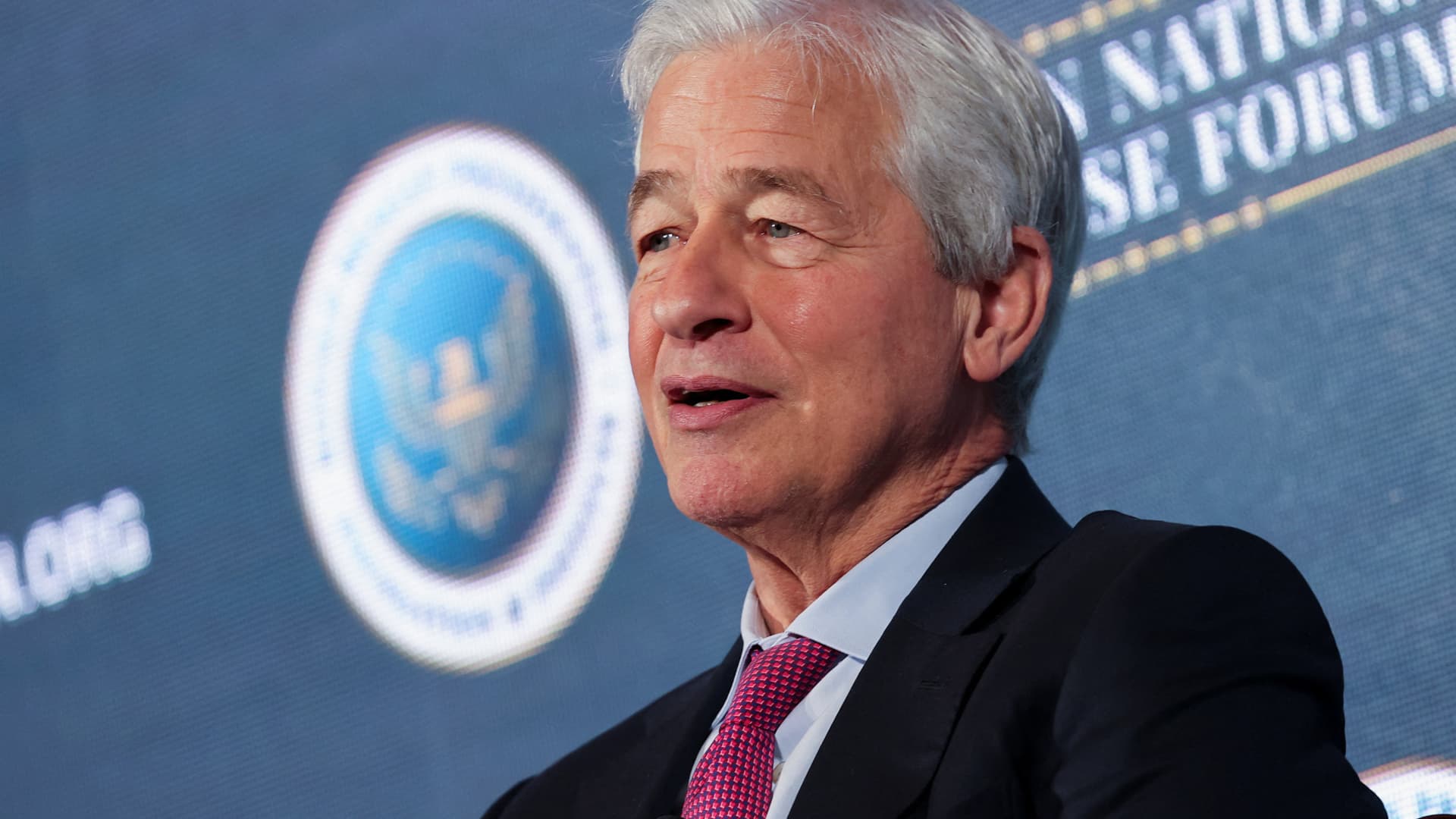

JP Morgan Chase CEO Jamie Dimon is calling for a broader recommitment to American ideals as the bank navigates geopolitical uncertainty, economic instability and the revolutionary impact of artificial intelligence.
In his annual letter to shareholders issued Monday, Dimon called the nation’s 250th anniversary “an opportune time to rededicate ourselves to the values that have made this great nation ours: liberty, freedom, and opportunity.”
“The challenges facing all of us are significant. The list is long, but at the top of the list are the horrific ongoing war and violence in Ukraine, the current war in Iran and broader hostilities in the Middle East, terrorist activity and growing geopolitical tensions, especially with China,” Dimon said. “Even in difficult times, we are confident that America will do what we always have: Let us look to the values that have defined our unique nation and sustained our leadership in the free world.”
Mr. Dimon, who has long led the world’s largest bank by market capitalization, is one of the most outspoken American corporate leaders. His annual letters provide not only a record of the company’s performance, but also a comprehensive perspective on world affairs.
In Monday’s letter, Mr. Dimon cited headwinds such as global conflict, persistent inflation, turmoil in private markets and what he called “poor banking regulation.”
Mr. Dimon said that while regulations like those introduced after the 2008 financial crisis “have produced some positive outcomes, they have also created a fragmented and slow-moving system with expensive, duplicative and excessive rules and regulations, some of which have weakened the financial system and reduced productive lending.”
He specifically cited the negative impact of capital and liquidity requirements, the current structure of the Federal Reserve’s stress tests, and the Federal Deposit Insurance Corporation’s “inadequate” processes.
Dimon also said JPMorgan’s response to the proposed Basel 3 endgame amendments and the global systemically important bank (GSIB) levy issued by U.S. regulators last month was “mixed.”
“While it is good that recent proposals for Basel 3 Endgame (B3E) and the GSIB seek to reduce capital increases from the 2023 proposal, there are still aspects of it that are frankly nonsense,” Dimon said.
The CEO said the proposed levy, totaling about 5%, would require the bank to hold “up to 50% more capital on the majority of its U.S. consumer and business loans when compared to large non-GSIB banks for the same set of loans.”
“Frankly, that’s not right and it’s un-American,” he said.
About trade and geopolitics
Mr. Dimon cited geopolitical tensions – wars in Ukraine and Iran and their impact on goods and global markets – as the main risks facing the bank, calling war an “area of uncertainty.”
“The outcome of current geopolitical events is very likely to be a determining factor in how the future world economic order develops,” he said. “Then again, maybe not.”
He also cited the “realignment of global economic relations” brought about by U.S. trade policy. President Donald Trump has made tariffs a centerpiece of his second term in office, imposing higher tariffs on dozens of trading partners and imports.
“The trade war is clearly not over, and we expect to see many countries analyzing who and how to make trade deals,” Dimon said. “Some of that is needed for the most important national security and resilience reasons, but it is difficult to know what the long-term effects will be.”
About private market
Mr. Dimon also spoke about the recent turmoil in private markets, where concerns over lending to software companies have prompted large repayment claims to private credit funds.
“In general, private credit tends to lack lending transparency and rigorous evaluation ‘marks’. “This makes people more likely to sell when the environment deteriorates, even if their actual realized losses remain largely unchanged,” Dimon said.
The executive added that actual losses are already higher than expected relative to the environment.
“Regardless of how things play out, we should expect that at some point insurance regulators will insist on stricter ratings or discounts, which would likely lead to additional capital requirements,” he said.
About AI
Dimon reiterated Monday that the pace of AI adoption is different from previous technologies. He said that while its introduction will be “transformative,” it remains to be seen how the AI revolution will unfold.
“Overall, investing in AI will not be a speculative bubble, but will instead yield significant returns. However, at this point, we cannot predict the ultimate winners and losers in AI-related industries,” Dimon said.
“We’re not going to lose our heads. We’re going to deploy AI just like we deploy all technology to do a better job for our customers (and employees),” he said.
JPMorgan has been at the forefront of Wall Street companies implementing AI at every level of their business. Last year, Derek Waldron, JPMorgan’s chief analytics officer, gave CNBC an early demonstration of how agent AI could be used to speed up operations and improve outcomes for customers and shareholders.
Dimon said in February that JPMorgan’s workforce is being reshaped by AI and that the bank has a “massive relocation plan” for its workforce.
“We have focused on some of the ‘known and predictable’ events and some of the ‘known and unknown’ events,” he said. “However, huge technological changes like AI always have second- and third-order effects as well, which can deeply impact society. … We need to monitor these types of transformations as well.”
—CNBC’s Leslie Picker and Ritika Shah contributed to this report.
