

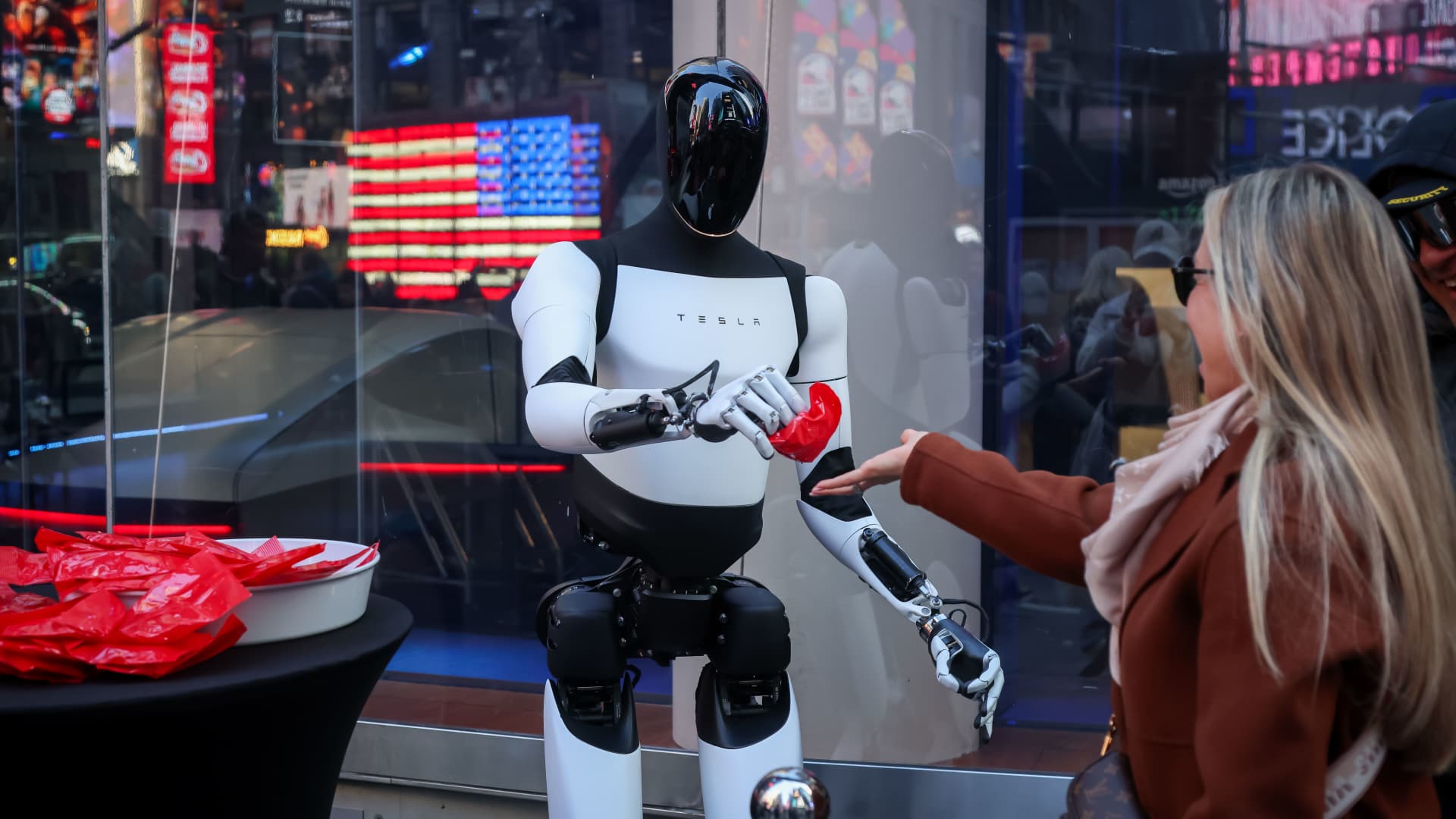
Humanoid robots could be one of the biggest growth opportunities for automation over the next decade, and a few companies will be winners in the boom, Jeffries said. The company said three factors are driving this new era of robotics: increasing demand for replacement labor due to an aging population, declining interest from younger generations in manufacturing, and continued advances in semiconductor and artificial intelligence technologies. “Humanity appears to be on the brink of widespread adoption of humanoid automata,” Jeffries wrote in a research note Wednesday. “While we expect early adoption to occur in commercial environments where the return on investment is well-defined, global demographics, safety concerns, and the desirability of certain jobs will drive widespread adoption.” Analysts at the company shared a list of companies they believe will benefit from the development and deployment of this technology. Tesla is on that list, with analyst Philippe Fouchois giving it a hold rating and a $300 price target. Elon Musk’s electric car maker has touted its recent focus on developing humanoid robots, but the company has also provided few specific details about it, Fouchois noted. “Large-scale applications remain uncertain for the broader robotics industry, suggesting uncertainty about commercial feasibility and market timing,” Houchois wrote. But he added that Tesla’s advantage could come from its head start and scale. “Tesla’s advantage may lie in early applications through its own manufacturing facilities and design-to-build approach…Importantly, unlike many of its peers, Tesla can self-fund the development of AI, Optimus robots, and stationary storage,” said analyst Chris Lafemina, noting that 70% of the humanoid robot’s weight is made of metal. He believes Freeport-McMoRan’s exposure to copper, Alcoa’s exposure to aluminum, and Nucor’s exposure to steel could provide growth opportunities for these companies as demand for these products increases. Semiconductor company Analog Devices also made the list. Analyst Blaine Curtis has a Buy rating on the stock and a price target of $410. The company’s expertise in sensors and analog controls, as well as its partnership with Nvidia to integrate those components with AI computing, positions it well to respond to the environment, Curtis said. “This combination allows ADI to benefit as we scale up humanoid robots, because every joint and sensor in these robots represents a content opportunity for ADI’s signal chain and power technology,” Curtis wrote.
