

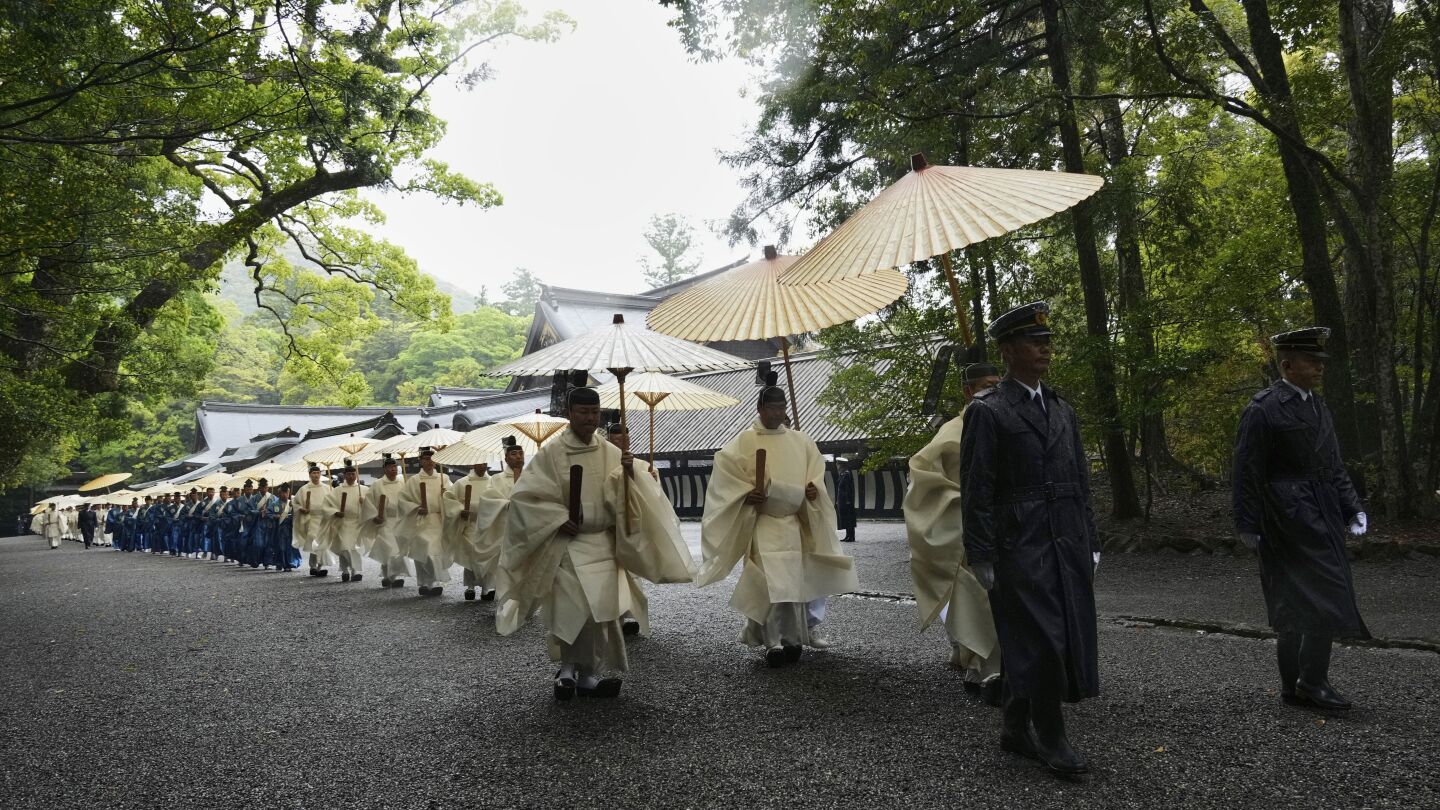
ISE, Japan (AP) — Deep in the forests of the Japanese Alps, Shinto priests keep watch as woodsmen dressed in ceremonial white chop their axes into two ancient cypress trees, timing their swings so that they strike from three directions.
An hour later, the head woodcutter shouts, “A tree is falling!” as one of the 300-year-old trees crashes down, the forest echoing with a deep crack. A moment after, the other cypress topples over.
The ritualistic harvesting of this sacred timber is part of a remarkable process that has happened every two decades for the last 1,300 years at Ise Jingu, Japan’s most revered Shinto shrine.
Each generation, the Ise complex is knocked down and rebuilt from scratch, a massive, $390 million demolition and construction job that takes about nine years. It requires the country’s finest carpenters, woodcutters, builders and artisans to pour their hearts into the smallest details of structures that are doomed from the moment the work begins.
The buildings at Ise will only stand for about a decade before the project starts all over again, but as the priests consecrate the construction, the workers shout: “A building for a thousand years! Ten thousand years! A million years and forever!”
Those close to the shrine often recognize a deep poignancy about the way the never-ending rebuilding intertwines with their lives.
“Twenty years from now, the older generation — our grandfathers — will likely no longer be here. And those of us who are still young now will then see our grandchildren involved in the next” version of Ise, said Yosuke Kawanishi, a Shinto priest whose family company crafts miniature replicas of the shrine. “After 20 years, the shrine we are building will have deteriorated quite a bit. But instead of thinking, ‘It’s a shame to tear down something we worked so hard to build,’ we think, ‘It’s been 20 years, so we want the deity to move into a beautiful, fresh, new shrine.’”
Journalists for The Associated Press are documenting the latest version of this ancient cyclical process, which publicly began this year.
Rebuilding the 125 shrine buildings is a 9-year process
Shinto officials in the priesthood pull a sacred timber on a wheeled platform into a position before unloading and moving it under the roof at the end of Mihishirogi Hoeishiki, a ceremony of the Shikinen Sengu ritual to rebuild main structures of the Jingu shrine complex for Shinto deities, at Toyoukedaijingu, also known as Geku, or the outer sanctuary of Jingu, in Ise, central Japan, Tuesday, June 10, 2025, after the cypress timbers were transported from Nagano prefecture’s Kiso region to the city. (AP Photo/Hiro Komae)
This is the 63rd cycle of reconstruction. The first was documented in 690, during Empress Jitō’s reign, said Noboru Okada, professor emeritus at Kogakkan University and a specialist in Japanese history and archeology.
All 125 shrine buildings will be knocked down and identical structures — as well as more than 1,500 garments and other ritual objects used in the shrine — will be rebuilt using techniques that have been painstakingly passed down over generations. There are 33 accompanying festivals and ceremonies, cumulating in a 2033 ritual that sees the presiding deity transferred to the new shrine.
Ise’s inner shrine is dedicated to the sun goddess Amaterasu who has been enshrined for two millennia among the mountains of Mie prefecture, on the banks of the Isuzu River.
Miori Inata, in a book based on a decade photographing Ise’s reconstruction, offers some theories about the constant rebuilding, including that the 20-year-cycle matches the shelf-life of stored rice or the traditional two-decade phases that make up a human lifespan — birth to adulthood, adulthood to middle age, middle age to death.
Inata writes of the culminating rites marking a new shrine: “I was greatly moved by the realization that what was transpiring before my eyes were precisely the same ceremonies that were performed 1,300 years ago, every 20 years since, and will continue to unfold again and again in the future.”
The rebuilding was stopped only twice, during the civil wars of the 15th and 16th centuries, and after World War II, according to Yukio Lippit, a professor of art history and architecture at Harvard.
“Ise is unique because of attrition — renewal cycles are difficult to maintain — and because of the vagaries of history; many other shrines that once underwent regular rebuilding have stopped doing so,” Lippit said.
Priests ask mountain deities for permission to fell trees
Cypress trees stand at the Akasawa national forest, where cypress trees are felled for a Shinto ritual, in Agematsu, central Japan, Monday, June 2, 2025 (AP Photo/Hiro Komae)
During a recent downpour, priests in starched robes banged drums and marched to Ise’s inner shrines for prayers marking the beginning of the age-old rebuilding process.
“The world where we live and the mountain realm are separate, distinct worlds. Therefore, when people go onto the mountain to cut trees or gather plants, they must first receive permission from the mountain deities,” according to Okada, the historian.
Thousands gather to see the rebuilding ceremonies, part of about 7 million pilgrims a year who converge on the shrine, which has long been the polestar for Shinto devotees. Japan’s indigenous Shinto faith, which also acts as a cultural connection for family and community, is largely rooted in animism. In Shinto there are thousands of “kami,” or spirits, that inhabit the world. While Ise thrives, the number of Shinto shrines has plummeted in recent decades as Japan’s population shrinks and young people increasingly move from the countryside to megacities.
“You can count with one hand the number of times you’ll witness something like this in your lifetime, so I really felt it was a rare and precious sight,” said Yuto Nakase, who was viewing the ceremonies for the first time.
At night the priests assemble with lanterns and march to the mountains for a secret purification rite for a sacred pillar that will be enshrined beneath the floor of the main sanctuary.
The ceremony is off-limits to spectators, but shrine officials say that after the tree is cut down with a special axe, it is wrapped in white cloth, straw mats and reed mats.
Visitors often mention Ise’s deep sense of mystery.
“It doesn’t say much, doesn’t show much and doesn’t offer much explanation. It’s something you feel,” Kawanishi, the Shinto priest, said of the shrine.
Yoriko Maeda, who owns a local sake shop, recognizes a transformation the moment she crosses a bridge into the shrine grounds.
“My breathing changes,” she said. “It really feels different. What I sense also changes. The sounds, the wind or nature, seem to release my stress. … There’s a kind of depth there that, for me, makes it a very comforting and pleasant space.”
Tree-cutting ceremonies show keen attention to detail

A cypress tree falls as woodcutters use axes to fell it during Misomahajimesai, an early ceremony of the Shikinen Sengu ritual to rebuild main structures of the Ise Jingu shrine for Shinto deities, at the Akasawa national forest in Agematsu, central Japan, Tuesday, June 3, 2025. (AP Photo/Hiro Komae)
In the forests of Nagano prefecture, a woodcutter takes the tip of a freshly felled tree and inserts it into the stump of another tree that has just been cut down. The assembled woodcutters then pray and bow together in front of the stump, commemorating these special cypresses that will be used to rebuild Ise.
“It honors the continuity of a tree’s life and is a prayer for the regeneration of the forest,” explains Soju Ikeda, who operates a local lumber company and manages a society for the preservation of traditional tree-felling skills. “You take a moment to appreciate that trees are living beings and engrave that feeling into your heart.”
Over the following days, dozens of men dressed in traditional clothing drag the two-ton logs through the Isuzu River to the shrine, chanting rhythmically as they pull, knee-deep in the water.
At Ise there are ten carpenters’ studios in permanent residence, plus others who are brought in, Lippit, the Harvard professor, said. The miscanthus reed thatch for the shrine’s roofs is specially grown to a length of over 2 meters; this takes about eight years and is timed for the rebuilding.


Cypress groves are specially planted at Ise for the constant construction, and their cultivation often exceeds individual human lifespans, with responsibilities for the trees passed from generation to generation.
Asked about his relationship to the cypress trees that are cultivated for the shrine, Ikeda, the lumber expert, had a one-word answer: “Deep.”
Forty years ago, when he was 24, he drove his grandfather to participate in the tree-felling ceremony. “He said to me, ‘Do you know that the trees cry?’
“I answered, ‘No way, how could a tree cry?’”
But as they watched woodsmen chop down the cypress, “the sound of the axes echoed across the mountains, and after about an hour, when the axe struck the core of the tree, the scent of the cypress filled the air, flowing like blood,” he said.
At the final axe stroke, as the wood snapped, “the sound it made was like a shriek, a high-pitched ‘keee’ sound, and then the tree fell with a thunderous thud. In that moment, I thought, ‘Ah… it really cried.’ I felt as if the tree wept, mourning its own life, as if it knew its life was precious.”
___
AP photographer Hiro Komae contributed to this report.
___
Associated Press religion coverage receives support through the AP’s collaboration with The Conversation US, with funding from Lilly Endowment Inc. The AP is solely responsible for this content.
