

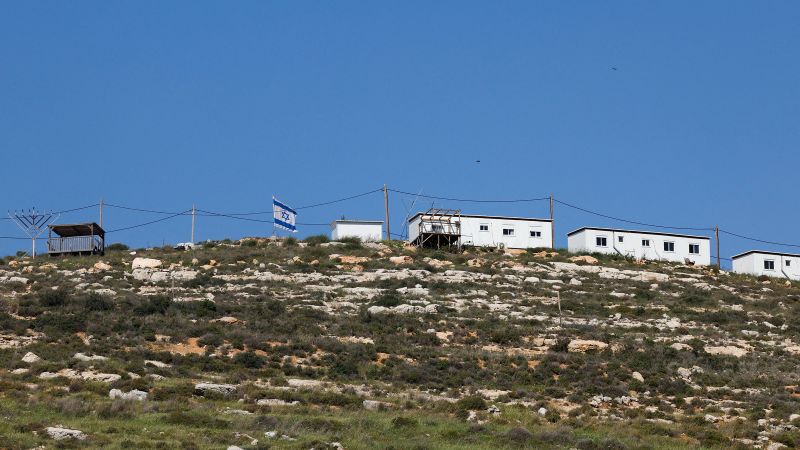
Last month, Israel’s Security Cabinet secretly approved the legalization of more than 30 new settler outposts and farms in the occupied West Bank, according to three Israeli officials familiar with the decision.
Unlike similar decisions in the past, the approval was not made public by Defense Minister Israel Katz and Finance Minister Bezalel Smotrich, who did not respond to CNN’s requests for comment. Two of the sources told CNN that the approval was kept quiet to avoid international criticism, given the surge in settler violence against Palestinians in the West Bank since the outbreak of the Iran war.
The recognition is part of an ongoing push by Prime Minister Benjamin Netanyahu’s right-wing Israeli government to expand settlements and consolidate Israel’s control over the land, with the aim of eliminating the possibility of a future Palestinian state.
Palestinians want to establish a state in territory captured by Israel in the 1967 war, including the West Bank, Gaza and east Jerusalem.
The push to legalize the outposts runs contrary to international law, which considers all Israeli settlements in the occupied West Bank illegal. Although outposts are considered illegal under both Israeli and international law, settlers have successfully established dozens of unauthorized outposts in recent years, eventually winning approval from the Israeli government.
Israeli media reported that the decision also included the construction of electricity and water infrastructure to the outpost.
According to Israel’s Peace Now Settlement Watch, a record number of 86 new outposts were established in 2025. In recent years, settlers at some of these outposts have forced the expulsion and forced relocation of Palestinian communities due to settler violence and harassment.
The Palestinian Authority condemned the move, calling it a “dangerous escalation and gross violation of international law and United Nations resolutions.” The office of Palestinian Authority President Mahmoud Abbas said in a statement that the decision “marks another step by Israel in carrying out its annexation, expansionist and forced migration plans,” and called on the international community, particularly the United States, to intervene immediately.
The decision to legalize the outposts at a March 25 security cabinet meeting came amid a surge in settler violence against Palestinians since the start of the Iran war.
According to Israeli human rights NGO Yesh Din, there were 305 incidents of settler violence between February 28 and March 29, with an average of more than 10 incidents a day, including assaults, property damage, and land theft.
Last month, the Israel Defense Forces (IDF) diverted a combat battalion from its northern border with Lebanon to the West Bank following a surge in wartime settler violence. During the cabinet meeting to discuss the new outpost, Israel Defense Forces Chief of Staff Eyal Zamir warned government ministers that the military was under severe strain due to manpower shortages and growing operational demands, including in the West Bank, two Israeli sources briefed on the meeting said.
At the same meeting, two Israeli officials told CNN that Prime Minister Netanyahu’s security cabinet also supported a directive targeting Jewish “nationalist crimes” in the West Bank. The measure, first reported by Euronews, would direct the IDF and police to crack down on settler violence, increase the military presence in friction areas and create a dedicated unit within the Defense Ministry to tackle the phenomenon of “Hilltop Youth,” a term used to describe far-right extremist religious-nationalist Jewish youth active in the West Bank. One official said the directive was “issued by the prime minister after a series of initial internal discussions and then approved by the cabinet.” The Israeli Prime Minister’s Office did not respond to a request for comment.
Peace Now condemned the government’s decision.
“It is now clear to everyone, and the IDF continues to emphasize this, that establishing a settlement undermines security, imposes intolerable burdens on the military, and undermines the possibility of resolving conflicts and achieving any form of security or future peace.”
The issue of settler violence and settlement expansion in the West Bank generated significant attention and debate in the Israeli media in late March following a CNN report that Israeli soldiers aligned themselves with settler ideology, spoke of revenge for targeting Palestinians, and detained and assaulted a CNN crew in the West Bank. The Israeli military’s top commander took swift action, suspending all operations of the reserve battalion involved in the capture of a CNN team in the West Bank and dismissing one soldier from military service.
CNN’s Ibrahim Daman contributed to this report
