

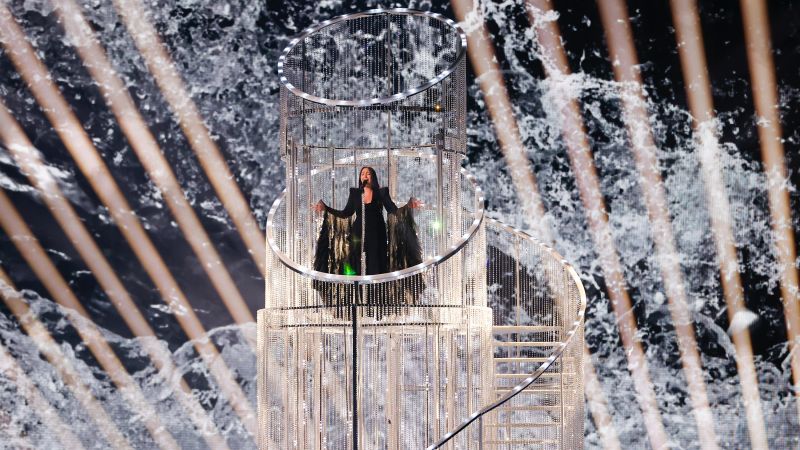
Israel will be allowed to compete in next year’s Eurovision Song Contest after organizers decided not to hold a vote on participation, the European Broadcasting Union (EBU) said. The competition is a fun-filled pop music spectacle that attracts millions of viewers around the world.
Organizers met on Thursday to discuss Israel’s participation, amid calls for the country’s exclusion over the Gaza war and threats of boycott from some member states.
The meeting was held at the Geneva headquarters of the EBU, which is made up of broadcasters from 56 countries, and was held to consider new rules announced last month to limit governments and third parties from unduly influencing votes.
During the consultation, EBU members “supported a series of targeted changes to the rules of the Eurovision Song Contest, aimed at strengthening the credibility, transparency and neutrality of the event,” according to a statement from the union.
“This vote means that all EBU members who wish to take part in the 2026 Eurovision Song Contest and who agree to abide by the new rules are eligible to take part,” it added.
Several countries have expressed concerns about Israel’s participation in the Games due to the Gaza War, which was sparked by a deadly Hamas attack in southern Israel on October 7, 2023. The conflict has killed more than 70,000 people, according to the Hamas-run Palestinian Ministry of Health.
Israeli public broadcaster KAN is reportedly continuing to prepare for the 2026 competition and will express its views on possible disqualification at a meeting on Thursday, Reuters reported.
The EBU said a vote on Israel’s participation could have taken place had member states not agreed to the new safeguard changes. Had there been a vote, the exemption would have needed an absolute majority to pass.
“The majority of member states agreed that there was no need for a further vote on participation and that the 2026 Eurovision Song Contest should go ahead as planned, with additional safeguards in place,” the EBU said in a statement.
Last month, competition director Martin Green said: “The neutrality and integrity of the Eurovision Song Contest is of the utmost importance to the EBU, its members and all viewers. It is essential that the fairness of the competition is upheld at all times.”
He added: “We are taking clear and decisive steps to ensure the contest remains a celebration of music and unity.”
Started in 1956, the Eurovision Song Contest is famous for being a quirky festival where artists from dozens of countries compete for the annual musical crown. According to the EBU, last year’s contest was watched by 166 million people, three million more than the previous year.
Although it has tried to prioritize music over politics, the last two contests in Switzerland and Sweden have featured pro-Palestinian demonstrators.
This is not the first time the world championships have been a divisive issue for the competition, with the EBU banning Russia from participating following the country’s full-scale invasion of Ukraine in 2022.
Spain, one of the so-called Big Five that provides the most money to the contest, along with Ireland, Slovenia and the Netherlands, has threatened to boycott the 2026 tournament in Austria if Israel is allowed to participate. Germany, another major contributor, also supports Israel.
“Israel is participating in the Eurovision Song Contest (ESC),” Culture Minister Wolfram Weimer previously told Reuters. “The ESC should not exist without Israel.”
“Yes, there will be very interesting discussions[about Israel’s participation]so we have to wait until the end of the meeting,” Nicolau Santos, president of Portuguese broadcaster RTP, who arrived for talks on Thursday, told Reuters.
“Eurovision is becoming a bit of a divisive event,” Paul Jordan, a Eurovision expert who goes by the name Doctor Eurovision, told The Associated Press. “The slogan is ‘United by music’…Unfortunately, it’s divided by politics.”
Last week, Austrian Foreign Minister Beate Meini-Reisinger reiterated her long-standing claim that the contest is a politically neutral forum. Noting that a small number of countries are planning to boycott the 70th edition in 2026, she insisted in a post on X that the contest was “not a means of sanctions” and appealed to European partners to find ways to “improve the situation in Israel and Gaza together.”
CNN’s Stephanie Halasz contributed to this report.
