

The sinking of an Iranian warship off the coast of Sri Lanka this week, something a U.S. Navy submarine has not done in more than 80 years, is another sign that the war between Washington and Tehran is on a scale and breadth not seen in decades.
There are also questions about the expansion of the war with Iran.
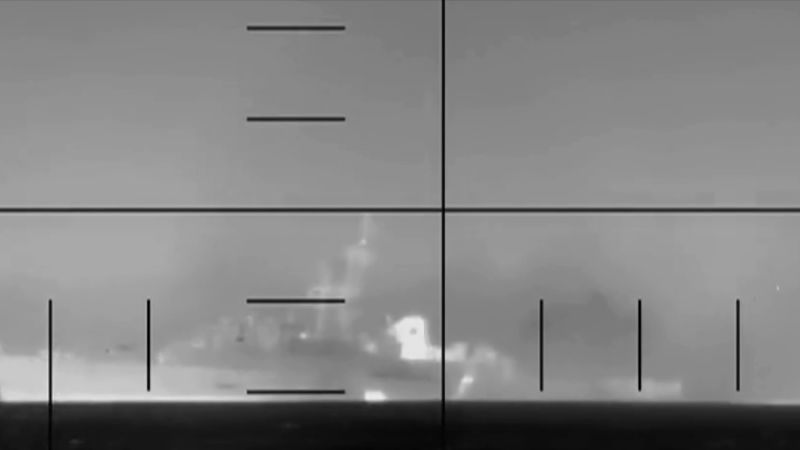
The Pentagon released periscope video of the attack showing the ship with a huge explosion at its stern, as well as what appeared to be still images showing the ship sinking beneath the waves.
Iranian Foreign Minister Abbas Araghchi identified it as the frigate Iris Dena and said it was lost 3,000 miles off Iran’s coast.
Sri Lanka reported receiving a distress signal from the 1,500-ton frigate and dispatching ships and aircraft on a rescue mission. Thirty-two people were rescued and 87 bodies were recovered, with the remaining crew reported missing. According to Araguchi, 130 sailors were on board.
Secretary of Defense Pete Hegseth described the sinking as a “silent death.”
Arraguchi called this an “atrocity.”

The Iranian frigate was reportedly on its way home after taking part in India’s multilateral Milan 2026 naval exercise, which included ships from 18 countries described as “friendly foreign countries” and aircraft from three more countries, including the United States, according to the Indian government’s website.
According to a statement from the U.S. Navy, a P-8A Poseidon maritime patrol and reconnaissance aircraft participated and conducted anti-submarine warfare training with other participating units.
But Milan 2026 is largely a ceremonial event, and two weeks ago a video was posted on social media showing the Dena crew parading at the Visakhapatnam port.
Although its presence in the exercise may have been minimal, Dena is one of the newest and most powerful ships in Iran’s fleet, capable of carrying surface-to-air missiles, anti-ship missiles and torpedoes, according to the website shipshub.com.

Karl Schuster, a retired U.S. Navy captain and analyst who is the former director of the U.S. Pacific Command Joint Information Center, said Dena is a threat in the context of the current conflict between the U.S. and Iran.
“Given Iran’s continued attacks on reachable friendly countries of the United States, it is very likely, and indeed likely, that the frigate was in a position to attack a commercial vessel flagged by or carrying cargo from a friendly country of the United States,” Schuster told CNN.
“This sinking can be justified as a precautionary measure reflecting that concern,” he said.
Alessio Patalano, a professor of war and strategy at King’s College London, said the U.S. legal justification for the ship’s sinking was laid out in a document signed by President Donald Trump on March 2, which said in part that the U.S. took action against Iran to ensure the freedom of goods and traffic through the Strait of Hormuz.
Patalano said in a post on X that Iranian frigates could be seen as a threat to that flow.
But he also noted that it was unclear whether the Iranian warships were in a state of readiness for war or whether the U.S. submarines had alerted them to the planned attack.
Neither would prevent them from attacking armed enemy combatants, but analysts noted that Iranian warships are not nearly evenly matched by U.S. fast-attack submarines.
“We’re seeing an alarming level of lethality with submarines,” Patalano said, adding that Iranian commanders would have been wise to recognize that their country was in an ongoing conflict situation.
“ASW (anti-submarine warfare) should absolutely be taken seriously, despite the risks,” he said.

On Thursday, some observers were pointing out similarities between the sinking of the Dena and Britain’s destruction of the Argentine cruiser ARA General Belgrano during the 1982 Falklands War.
This was the last confirmed case of a submarine sinking a surface ship, when the Royal Navy attack submarine Conqueror attacked Belgrano with two torpedoes, killing 323 Argentine sailors.
The attack was controversial because it took place outside Britain’s originally declared 200 nautical mile exclusion zone around the Falkland Islands, and the ship was reportedly heading away from the islands when it was attacked.
The Royal Navy claimed that the Argentine ships posed a threat to task forces in the South Atlantic. There is also some debate as to whether the ship was far away.
The exclusion zone Britain established around the Falkland Islands in 1982 indicates that the conflict was much more limited in scope than current hostilities in the Middle East. Even before the Dena sinking, it spanned thousands of miles and involved more than a dozen countries.
Since the United States and Israel attacked Iran last Saturday, retaliation by Iran and its proxies has hit not only U.S. military bases, diplomatic facilities, and civilian infrastructure in friendly countries around the Persian Gulf, but also as far away as Cyprus in the Mediterranean.
Thanks to Dena, the combat area extends to the eastern tip of the Indian Ocean.
Iranian Foreign Minister Araghchi warned that Iran would avenge the loss of valuable naval combatants, suggesting the conflict’s geographic scope could widen further.
“Mark my words: America will come to bitterly regret the precedent it has set,” he said in X.

U.S. officials have not said which of the Navy’s 53 nuclear-powered attack submarines were responsible for the sinking, as ship movements are typically a closely guarded secret within the Pentagon.
But whatever submarine fired the torpedo, its historical significance is undeniable.
According to the Naval History and Heritage Command, the last time a U.S. Navy submarine sank an enemy combatant was on August 14, 1945, shortly after noon in Japan, when the USS Torsk torpedoed a Japanese frigate, the second of two Imperial Japanese Navy vessels to sink that day.
This is also one of the few instances in which a submarine sank an enemy ship in combat since the penultimate days of World War II.
Before Belgrano, a Pakistani submarine sank an Indian frigate in 1971 during a conflict between the South Asian neighbors.
The sinking of the Iranian frigate also recalls earlier fighting between the United States and Iran during Operation Praying Mantis in 1988.
The conflict in the Persian Gulf during the Iran-Iraq war occurred after a US frigate struck an Iranian mine while trying to protect a Kuwaiti oil tanker from Iranian attack.
During a battle with the Iranian Navy, the frigate USS Simpson sank an Iranian gunboat with an anti-ship missile after the Iranian gunboat fired its own missiles at the SIMPSON and two other ships.
It was the first battle between U.S. surface ships since World War II, and the first ship-to-ship missile confrontation in U.S. Navy history.
However, the involvement between the US and Iran was over for a day. Current hostilities have been going on for almost a week.
U.S. authorities cannot provide a clear end date. Iran has vowed to keep fighting.
Meanwhile, missiles, drones, and now torpedoes are finding new targets.
