

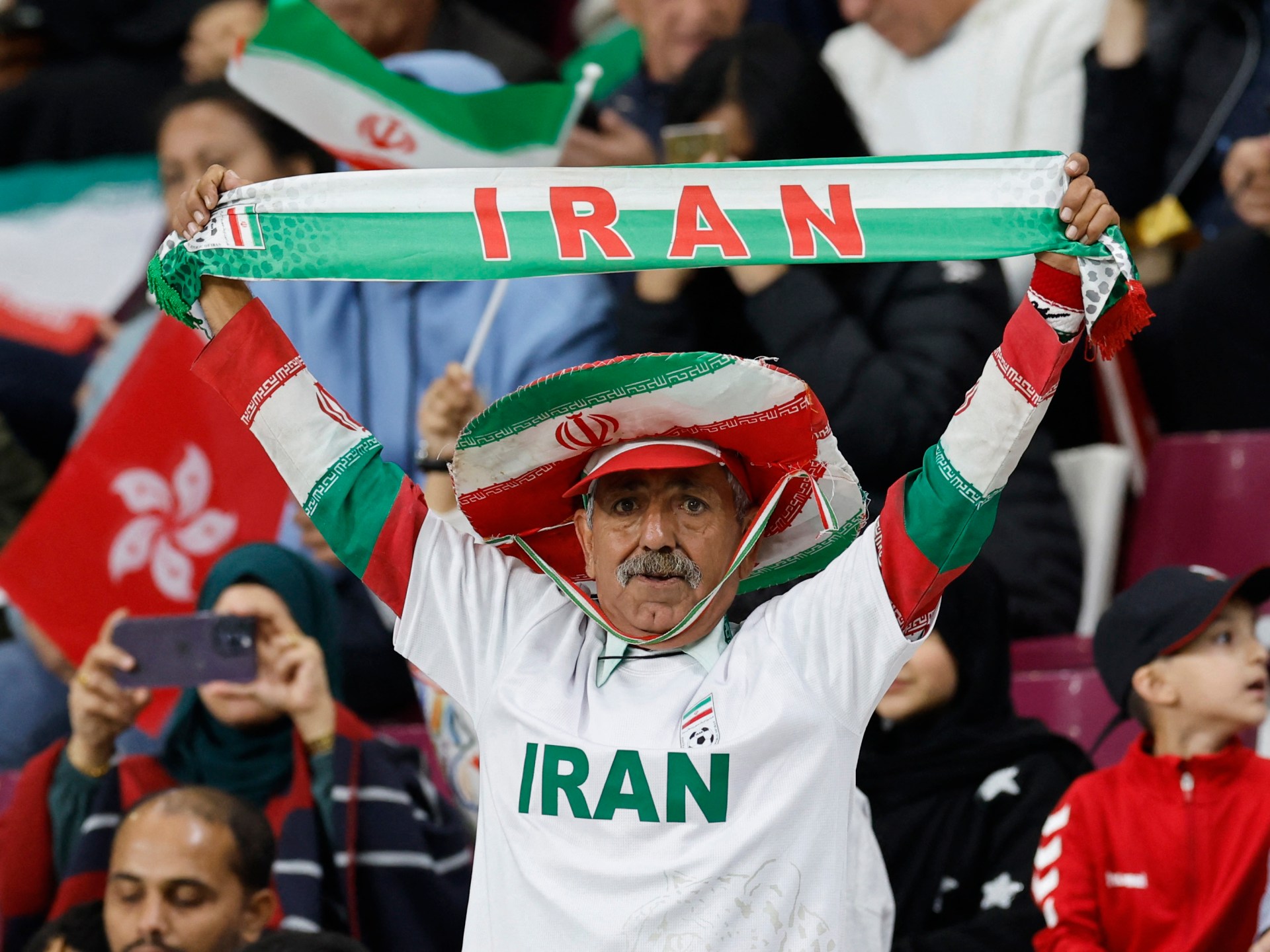
Iran’s participation in the 2026 FIFA World Cup, with less than 100 days to go, has become a hot topic amid the widespread impact of the ongoing conflict in the Middle East.
The global sporting event is scheduled to be co-hosted by Canada, Mexico and the United States from June 11 to July 19, with Iran among the 48 countries expected to travel to North America at least a week before the opening match.
Recommended stories
list of 3 itemsend of list
US President Donald Trump has said he doesn’t care whether Iran participates in the World Cup.
“I think Iran is a country that has suffered a very bad defeat. They are running on fumes,” President Trump told American news site Politico on Tuesday.
The United States and Israel launched attacks on Iran on Saturday that killed at least 1,045 people, including Supreme Leader Ayatollah Khamenei, and sparked a regional conflict that spread to 12 countries.
The Iranian government responded by firing waves of missiles and drones at several military bases in the Middle East where Israeli and U.S. forces operate.
The escalation has put Iran’s qualification for the World Cup in doubt, with officials from the Iranian Football Federation and FIFA not taking a firm stance on the participation of the world’s 20th-ranked soccer country.
Mehdi Taj, president of the Football Federation of the Islamic Republic of Iran (FFIRI), told local sports portal Varzesh3 on Sunday: “After this attack, we cannot expect to approach the World Cup with high hopes.”

unknown territory
Leading sports and geopolitics experts believe Iran’s participation in the Games is in serious doubt amid an armed conflict between one of the host countries and a participating country.
“Ultimately, the diplomatic solution will be for Iran itself to take a step back and withdraw from the tournament,” Simon Chadwick, professor of African and Eurasian sports at Shanghai’s Emrion Business School, told Al Jazeera.
Chadwick said it would be “very difficult” for the United States to allow players, backroom staff and officials into the country.
“The United States is not keen on accepting (Iranian) players, officials and medical personnel who typically travel with teams to tournaments.
“Given that they (Iran) have to play in the United States, I think it’s unlikely that they will play in the United States.”
Chadwick said that despite the logistical quagmire and the low likelihood of a timely resolution, withdrawal is not an easy option for Iran and that it would “think very long and hard before withdrawing.”
The last time a team withdrew from the FIFA World Cup for political reasons was in 1950, when Argentina withdrew due to disagreements with the Brazilian Football Federation.
“We’re in uncharted territory here,” Chadwick explained.
“We tend to associate the Olympics with boycotts and countries not participating in sporting mega-events, but we saw large-scale boycotts in 1980 and 1984 during the Cold War.
“Normally that doesn’t happen at the World Cup.”
Chadwick, who has written several books on the economics and politics of sports, believes the impact of the withdrawal will be as much economic as political.
“On the one hand, we live in very complex and sensitive times, and there are probably reasons for countries to withdraw or be banned,” he said.
“But we (also) live in a highly commercial age, and the economic impact of unilaterally withdrawing from perhaps the world’s biggest sporting mega-event is self-inflicted. We also do not know how FIFA would react if a country were to unilaterally withdraw from a qualification spot.”
Can sports diplomacy save the World Cup?
The tournament will be held across three host countries, but all of Iran’s matches will be allocated to venues on the US West Coast.
This can be largely attributed to the presence of a sizable Iranian community, particularly in Los Angeles, where Team Melli will play two of their three Group G matches.
Chadwick said the team could have swayed its decision to participate if Iran had played in Canada or Mexico. However, organizers are unlikely to move the match outside the United States for now.
“It would be highly unusual to host a match in another country to suit one country, especially when the president of FIFA and the president of the United States appear to be very close,” he said, adding, “The relationship between the United States and Canada and the United States and Mexico is also somewhat complicated.”
FIFA has not made a clear statement on the issue, but its secretary-general Matthias Grafström said the international soccer governing body is monitoring the conflict and the situation arising from it.
“As we are meeting today, it is too early to comment in detail, but we will be closely monitoring developments on all issues around the world,” he said last week.
With just over three months until the tournament, FIFA said it will “continue to communicate with the host country’s government.”
Chadwick believes FIFA will try to avoid an outcome that would exclude Iran. That would create logistical headaches and set the wrong precedent.
“What we’re likely to see is sports diplomacy really taking off,” he predicted.
“The last thing FIFA wants is for a country to be excluded or simply not participate, because that would set a precedent and put pressure on FIFA.”
“The Cold War of Sports”
As the conflict rages into its fifth day and spread further across the Middle East, it is unclear when Iranian soccer officials will approach sending a team to the United States.
However, if Iran chooses to withdraw from the World Cup, it could lead to a sports crisis.
Chadwick believes the impact could be far-reaching and long-lasting.
“Politically, we are probably headed for a new sports Cold War. And what I find very interesting is that Russian President Vladimir Putin and Russia are toying with the idea of creating a world sports championship called the Peace Games, which is similar to the Olympic Games and sounds like the Olympic Games, but is not the Olympic Games.
“And Russia managed to attract more than 70 countries to participate in its sporting event.”
Such an event could have Iranian support if the country is forced to withdraw from the World Cup. According to Chadwick, it could even lead to the creation of similar tournaments.
“It is not inconceivable that at some stage in the future each country could create its own competition comparable to the World Cup of soccer.FIFA in particular is an organization founded by Europeans, its headquarters are in Europe, and its president is typically European.”
“Some countries may use this as an opportunity to think of other ways to host global football tournaments. It’s like the Cold War of football.”
Despite the current scenario and the escalation of the conflict in recent days, Chadwick believes that organizers and leaders can still find a way to include Iran in the World Cup.
“If a new Iran emerges at the end of the conflict, where major apparel companies can sell their products without sanctions and broadcasters win big contracts, the World Cup could serve to build diplomacy between the United States and Iran and reintegrate Iran into the international community.”
