

listen to this article5 minutes
information
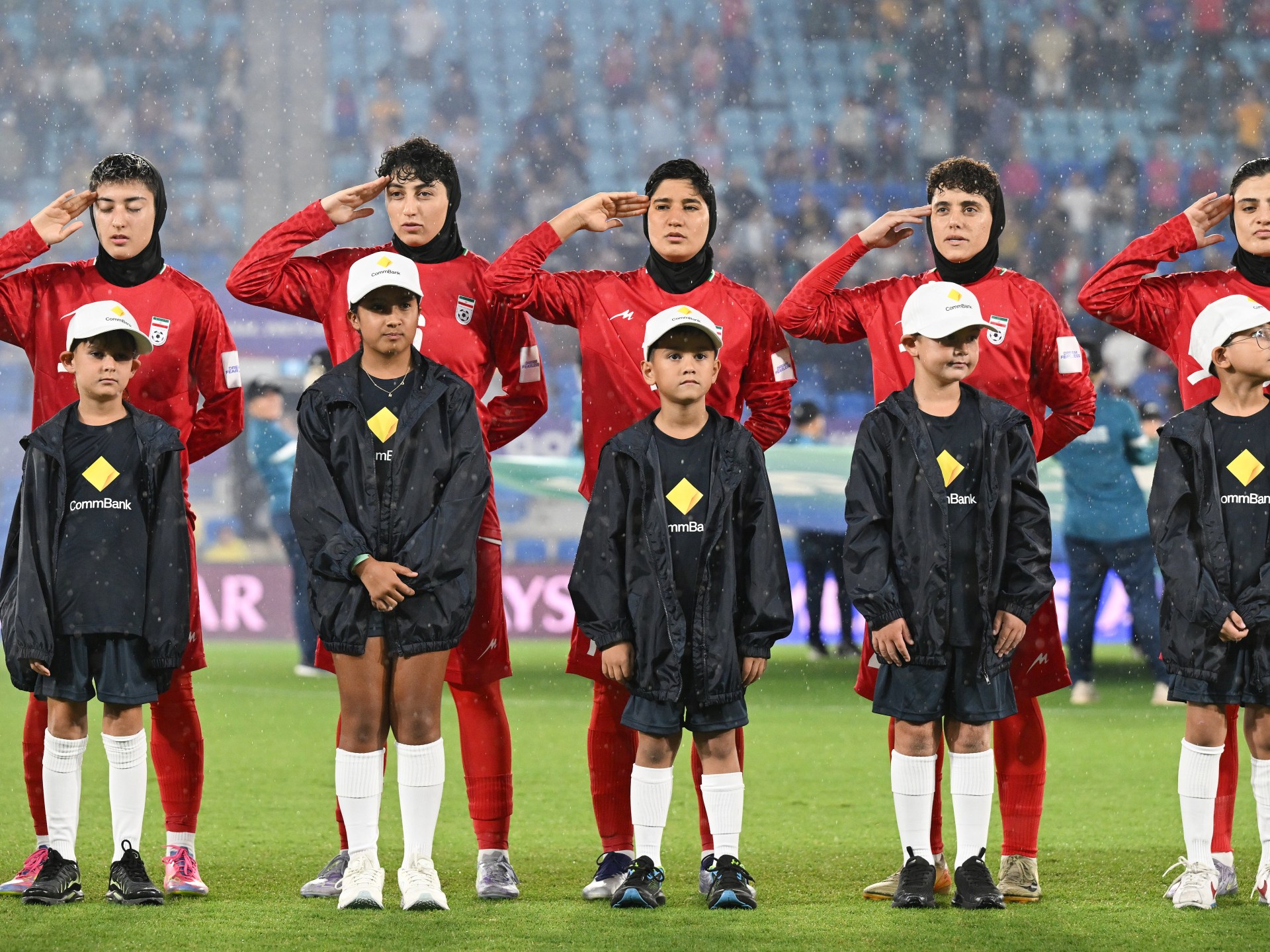
Players of the Iranian women’s soccer team sing and salute during the national anthem before the final match of the Women’s Asian Cup at Australia’s Gold Coast Stadium. Six days after his decision to remain silent during the national anthem, he was labeled a “wartime traitor” on his home country’s state television.
The Iranians, whose situation has become well-known among Australian human rights campaigners, will no longer play in the tournament after losing 2-0 to the Philippines in Queensland on Sunday.
Recommended stories
list of 3 itemsend of list
Their campaign on the continent’s showpiece began last weekend, just as the United States and Israel launched airstrikes on Iran on February 28 that have since killed at least 1,332 people, including Supreme Leader Ali Khamenei.
Iran’s team and management, who have expressed fear and concern for Iranian families, appeared calm and chose not to sing the national anthem during Monday’s opening game against South Korea.
The decision drew criticism in Iran, with Islamic Republic of Iran Broadcasting presenter Mohammad Reza Shahbazi saying in a video that the players showed a lack of patriotism and that their actions amounted to “the height of disgrace.”
The Iranian team sang along to the Meher Khabaran (Eastern Sun) newspaper before their second defeat against the hosts on Thursday, sparking fears among Australian human rights activists that they had been coerced by government monitors.
No public reason has been given for the players’ initial stance on singing the national anthem before games.

“Certain safety concerns”
A petition launched on the Change.org website on Friday calling for Australia to provide shelter to the team had garnered more than 51,000 signatures by late Sunday. The petition asked Home Secretary Tony Burke not to allow the team to leave Australia “while there remain credible concerns for their safety”, but his office did not comment on the petition.
The petition called on local authorities to ensure that athletes seeking protection “can do so safely, confidentially and without interference” and to “make clear that Australia will uphold its humanitarian protection obligations to athletes who are at risk of persecution or serious harm”.
“Silence is not a neutral position when there is credible evidence that visiting athletes may face persecution, imprisonment, coercion, or worse upon their return,” it said. “The current wartime environment intensifies repression, fear, and increases the risks faced by those deemed publicly disloyal by the Islamic Republic.”
Iranian-Australian activist Tina Kordrostami, a local government member of Sydney’s Ryde Council, told The Australian that Iranian athletes “need an opportunity, a safe space, an opportunity to actually speak up about their needs and requirements.”
“Without government assistance, we can’t give them that space,” she says.
Before Sunday’s game, Foreign Minister Penny Wong was asked about the team’s prospects for returning home in an interview on state broadcaster ABC.
“What I want to say about the Iranian women’s team is that it’s really thrilling for Australians to see them in Australia,” she said.
Wong added that the sight of Australian players swapping jerseys with their Iranian opponents was “a very exciting moment”.
“It spoke to unity and how sports can bring us together,” she said.
“We know that this regime brutally oppresses many Iranian women. Obviously, we know that this regime brutally oppresses its people.”
The United States and Israel continued to carry out large-scale attacks against Iran for nine days as the conflict spread to the Gulf region, Lebanon, and Iraq.
Players’ association FIFPRO had previously called on the Asian Football Confederation and international soccer governing body FIFA to follow the broadcast and take all necessary measures to uphold human rights obligations and ensure the safety of the Iranian national team.
The Iranian team finished the season without a win, losing to South Korea 3-0 and Australia 4-0, finishing last in Group A with nine goals conceded and zero points.
Matildas snatch a late draw against South Korea
Australia’s Alana Kennedy scored her second goal in the dying seconds of stoppage time to tie South Korea 3-3, but it was not enough to prevent their opponents from advancing to Group A.
The South Korean team, which secured the top spot by scoring the most points in their three group games, will return to Sydney’s Stadium Australia on Saturday for a quarter-final match against the third-placed team from the other opening round group.
Meanwhile, the Matildas will have to travel across Australia to face either North Korea or reigning champions China in the last eight at Perth Rectangular Stadium on Friday.

