

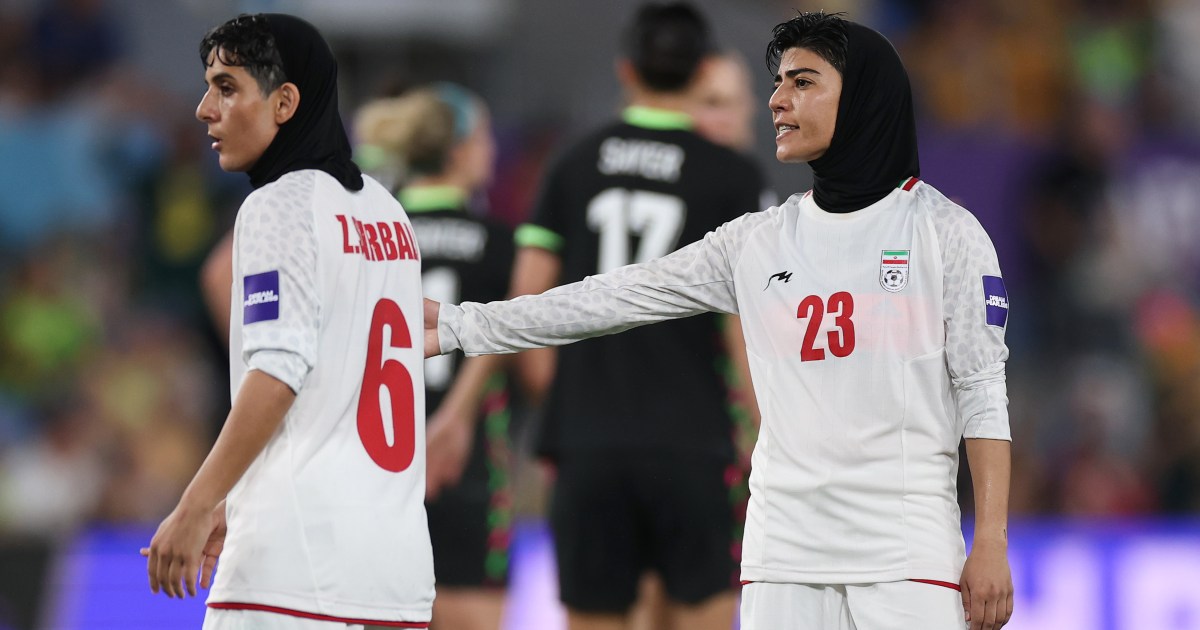
TEHRAN, Iran – When Iranian soccer player Mona Hammoudi boarded a plane to Australia, she had one ambition in mind. It was to play well at the Women’s Asian Cup.
In her own words, she could not have predicted that the tournament would “test everything: her skill as a player, her perseverance, and her ability to make difficult decisions under enormous pressure.”
Recommended stories
list of 4 itemsend of list
Hammoudi, a 32-year-old midfielder, was part of the Iranian national team that traveled to Australia for a tournament in early March. The trip became one of the most scrutinized episodes in the history of Iranian women’s sports.
On March 2, two days after the United States and Israel went to war with Iran and killed Supreme Leader Ayatollah Khamenei, the team remained silent during the national anthem before the opening match of the Asian Cup against South Korea.
Their silence was interpreted by some as a protest against the Iranian government, with Iranian state television branding the women “traitors” and a host saying they had become “the pinnacle of disgrace” and calling for them to be dealt with “sternly”.
The players sang the national anthem in the next two games, but concerns about their safety were further heightened by media reports that they were being monitored by the Iranian government and soccer officials.
After Iran were eliminated from the group stage with three losses, five players, including Hammoudi, applied for asylum and were granted humanitarian visas by Australian authorities. A sixth player and backroom staff have since also applied for asylum.
However, after the rest of the team left Australia on March 10, five of the seven changed tack and said they would return to Iran, including Hammoudi.
Why they returned to Iran and what happened next is a story their players are only just beginning to tell.
“Every choice has consequences”
Hammoudi says the atmosphere felt tense from the moment the team arrived in Australia. The media monitored every training session, every smile exchanged between players, every casual word exchanged.
And the dissident Iranian diaspora in Australia added further pressure with hopes for unity from the players and a clear political stance against the government.
“I felt that any mistake could become a big problem,” Hammoudi told Al Jazeera. “I had to think twice before taking every step.”
Amid stifling pressure and the escalation of war in Iran, a question haunted her. “Should I return to my hometown or seek asylum?”
“This dilemma has caused me constant anxiety because every choice has consequences for my life, my family, and the future of my sport.”
It was a similarly difficult experience for teammate Zahra Salbari, who also withdrew her asylum claim, due to “harassment and constant following from the media and social media, expectations and pressure from the Iranian-Australian community”.
Salbari, also a 32-year-old midfielder, told Al Jazeera that every step was “under close surveillance”.
“I knew that a wrong decision could tarnish the image of my team, my family and the national team.”
Neither player has spoken publicly about what led them to apply for asylum in the first place. Both men declined to answer questions from Al Jazeera on the record.
But both said their decision to return to Iran was inextricably linked to a sense of duty. Not purely free choices made in calm and safety, but to family, teammates, and “national duty.”
Even if the decision to withdraw the asylum claim was difficult, returning home proved to be a challenge in itself.
Both players said returning from Australia was full of nerves.
For Hammoudi, the journey back to Tehran was marked by fear that the incident would end her soccer career or result in severe punishment.
She recalls feeling “a mixture of curiosity, surprise and alarm” when she arrived.
The media attention that followed them throughout the tournament intensified once they returned to Iran. Social media users continued to comment on their every move, expression, and silence in real time.
The soccer federation provided what she described as formal support, a public affirmation of national values and a statement about the importance of actively representing Iran on the world stage.
Upon their return, the players appeared on state television, resumed training as usual, and were welcomed back to Iranian football. No repercussions have been reported by authorities so far.
In Tehran on March 19, thousands of people gathered in Variasr Square, many holding Iranian flags, and the team was given a heroic national welcome. A giant AI-generated image of women was projected on the screen, showing them pledging allegiance to the Iranian flag with the country’s landmarks in the background.
A sign overhead read, “My choice. My home.” When the national anthem was played, all the players sang in unison.
Anxiety about the future remains
Mariam Irandust, former head coach of the Iranian women’s national team, told Al Jazeera: “What happened to the players after they returned from Australia is not a normal sporting event that is seen through the lens of wins and losses.”
She said these experiences bring psychological weight to the pitch and will have a direct impact on performance in training and matches.
Her concerns are both personal and collective. If players feel targeted or treated unfairly, internal divisions can occur, which, in her view, is more detrimental to a team’s development than formal punishment.
“What happens to one member affects the whole team,” he told Al Jazeera, adding: “Hard sentences and direct punishments do not solve any problems. They can derail the future of the players and have a negative impact on the whole team.”
Adel Feldshipour, a veteran Iranian sports journalist and commentator, told Al Jazeera that Iranian women’s soccer had never before attracted so much public attention and received so much media coverage.
He said the incident had completely transcended sports and become a public event, further increasing the psychological pressure on everyone involved, adding that any punishment against the players could deter future footballers from representing Iran.
“Focusing only on public criticism without providing support will set a dangerous precedent that will influence future players,” he warned.
Both Hammoudi and Salbari remain anxious about the impact on their careers and how any future actions will be interpreted.
“I became more aware of the social and political pressures around me,” Hammoudi said, “and realized the value of family support and state involvement in the face of crisis.”
