

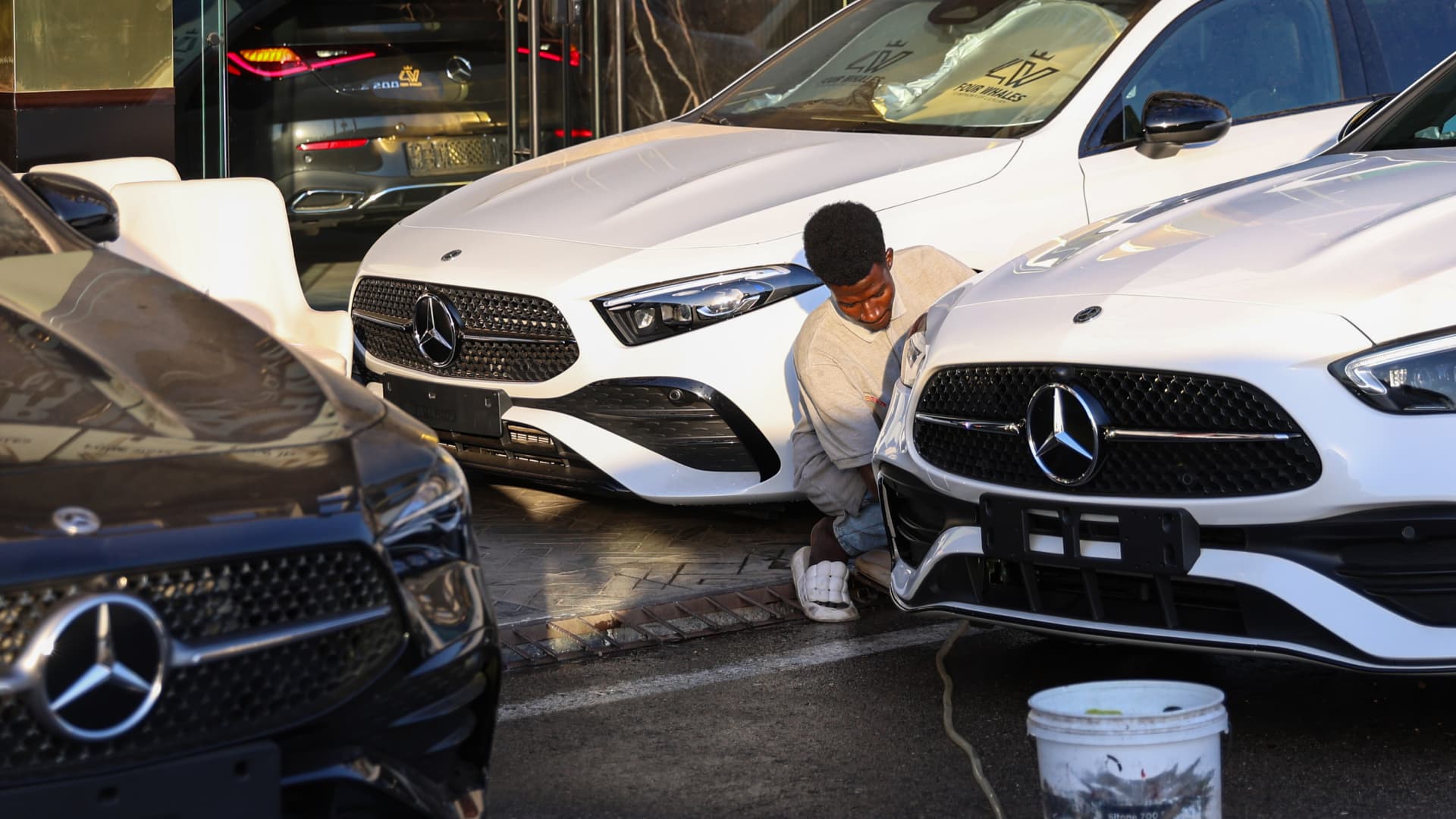
Instability and rising geopolitical tensions brought about by the Iran war pose a threat to automakers based in the Middle East.
European luxury and high-performance brands such as porsche, mercedes benz, BMWrolls royce, ferrari All of these companies have thriving businesses in the Middle East market, and although their market size is less than one-fifth that of the United States, they boast a scale that exceeds that of the United States in terms of profits.
“The Middle East has recently become one of the most profitable structural growth regions for luxury automakers,” said Metzeler Research analyst Pal Sukata.
These automakers face declining market share in China and tariffs in the United States, one of the world’s most important buyers of luxury goods. For this reason, the importance of highly profitable bases like the Middle East for automakers is increasing.
The Middle East region has around 3 million cars per year, depending on which countries are included.
Iran is the region’s largest market, accounting for 38% of the total, according to Bernstein Research. Two of the top three best-selling vehicles are Iran Khodro and SAIPA, domestic car brands sold only in Iran. Other mass-produced brands include Japanese automaker Toyota, South Korean Hyundai, and Chinese manufacturer Chery Motors.
Vivek Sharma, an analyst at GlobalData, said demand for luxury goods is high in neighboring Gulf markets such as Saudi Arabia and the United Arab Emirates, where there is a concentration of wealthy buyers with money to spend. In the United Arab Emirates alone, annual sales typically exceed 300,000 cars, of which a relatively high share, or around 20%, are luxury imported cars, according to GlobalData.
The ripple effects of the Iran war across the region threaten these automakers.
Volkswagen Group CEO Oliver Blume said in mid-March that conflicts in the region could dampen demand for luxury cars, particularly for VW Group’s Porsche and Audi brands.
Porsche told CNBC in an email that it is “continually evaluating the current situation and the potential impact on the company.”
“The current situation in the Middle East could have a negative impact on supply chains and demand in the future,” he added. Porsche has no commercial activities in Iran itself.
The automaker has grown in the region over the past five years or so, both in terms of sales and revenue per vehicle. Skata told CNBC that Porsche made 28% more profit per car sold in the region in 2025 than in 2020.
As of 2024, the Porsche 911, which starts at $135,000 in the U.S., accounts for 20% of the brand’s total sales in the region, and the company’s ultra-luxury customization business, called Sonderwunsch, grew about 125% between 2020 and 2024.
Meanwhile, according to Global Data, the BMW Group’s vehicle deliveries in the Middle East region increased by approximately 10% in 2025 compared to the previous year. High-performance, high-priced models such as the BMW M variant recorded growth of around 38%.
Mercedes-Benz also acknowledged double-digit sales growth in the Middle East. This is one of the world’s strongest markets for luxury cars such as the AMG G 63, which has a starting price of around $200,000.
Broadly speaking, over the past two years, Mercedes-Benz has expanded its presence in the UAE, Saudi Arabia, Kuwait and Qatar.
Mercedes-Benz told CNBC via email: “It is still too early to draw reliable conclusions or identify clear trends. This also applies to the possibility that customers in the Middle East (or other regions) may be reluctant to purchase cars. However, we are closely monitoring the dynamic developments in the dispute and the overall market situation. In principle, we are always ready to respond flexibly to different market conditions.”
The market for ultra-luxury cars is also strong in this region.
ferrari shipped 626 vehicles to the Middle East in 2025, a remarkable amount for a low-volume automaker. The company says this is more than it sent to the UK, Switzerland and France.
And in 2024, the region will have the world’s largest customization of Rolls-Royces by average price per vehicle.
GlobalData said it expects the luxury car segment in the Middle East to grow at an average annual growth rate of about 7 to 8 percent since the start of the war, potentially reaching nearly 300,000 units by 2033.
Metzeler analyst Skarta said there are two main threats. In the short term, the conflict may result in travel and mobility restrictions, which may impact showroom crowding and sales. In the longer term, weak asset prices and financial market volatility could worsen the weather and reduce spending on big-ticket items.
“Ultimately, the impact on the auto sector will largely depend on the duration and intensity of the conflict,” he said.
Watch the video to learn more.
