

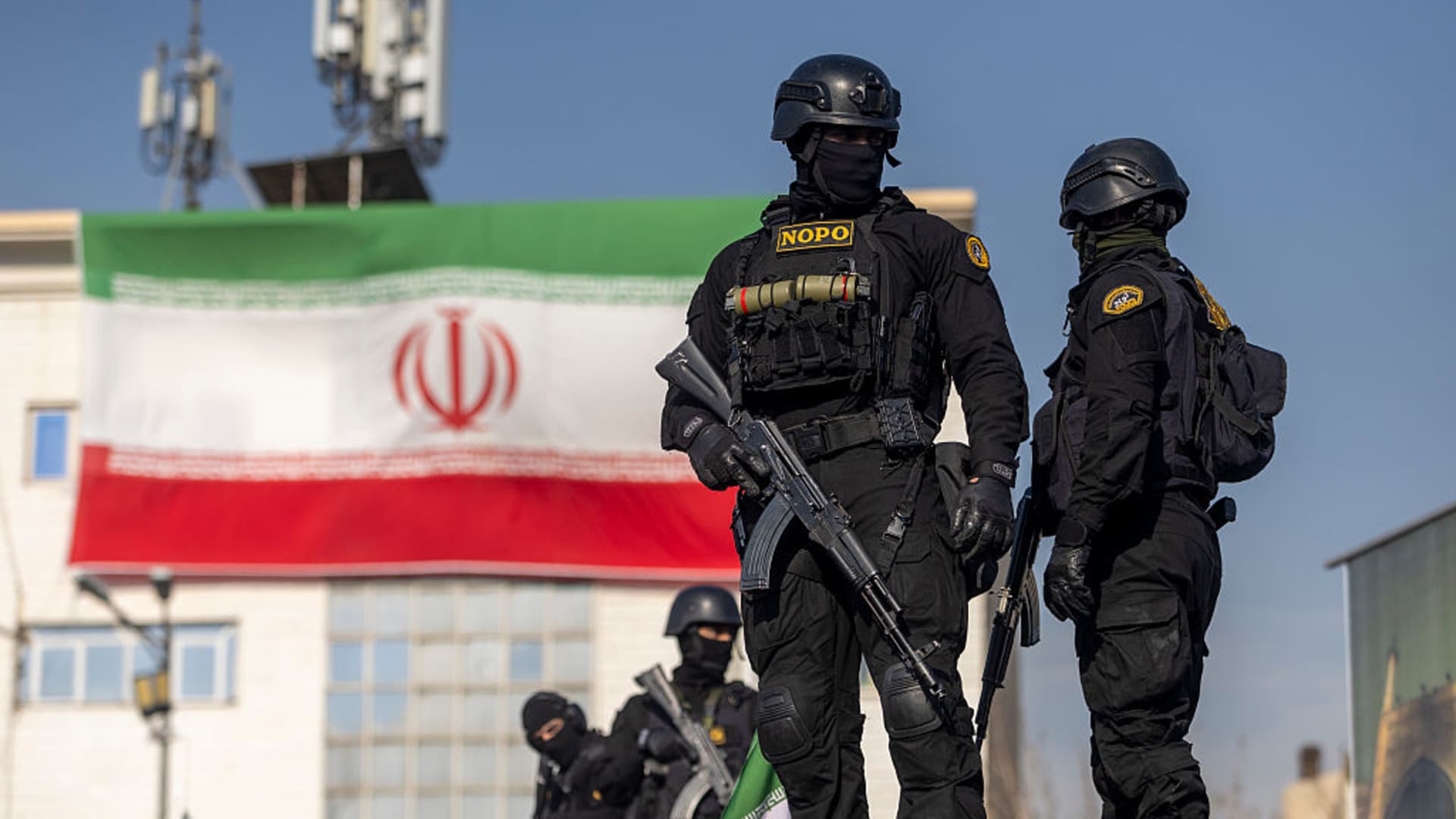
Security forces participate in a pro-government rally in Tehran, Iran, on January 12, 2026.
Getty Images | Getty Images News | Getty Images
Iran reopened its airspace early Thursday after a temporary closure that banned most aircraft for several hours, amid concerns that a U.S. military attack would put airlines at greater risk.
The restrictions ended at 3:30 a.m. UTC (10:30 p.m. ET Wednesday) and remained in place for five hours.
As of 4 a.m. UTC, most planes were still bypassing Iranian airspace, but some domestic airlines had begun to resume operations, according to live data from flight tracker FlightRadar24.
The original order exempted international flights to and from Tehran, subject to prior approval from Iran’s civil aviation authority.
The airspace closure comes amid heightened tensions after US President Donald Trump threatened to intervene following a deadly crackdown on anti-government protests in Iran. President Trump has publicly said he will “rescue” Iranian protesters if the violent crackdown continues.
The United States has begun transferring some personnel and equipment from U.S. military bases in the Middle East amid Iranian threats to attack U.S. military bases in the region if the United States launches an attack.
Trump later appeared to soften his tone. Speaking at the White House on Wednesday night, President Trump said he was confident the killing of protesters in Iran had stopped and that he would “wait and see” about possible U.S. military action.
In recent days, multiple airlines have canceled or rerouted flights to Tehran. India’s largest airline Indigo on Thursday announced that some of its international flights will be affected by the closure of Iranian airspace.
Earlier this week, Germany warned its airlines not to enter Iranian airspace. of Lufthansa Group On Wednesday, it said it would bypass the airspace of Iran and Iraq and some flights would be canceled until further notice.
The US has banned all US commercial aircraft from flying over Iran. Airlines such as Emirates, Qatar Airways and Turkish Airlines have also canceled multiple flights to Iran over the past week.
Protests erupted late last year after Iran’s currency, the rial, fell to a record low, exacerbating the cost of living crisis. The riots later evolved into a broader movement against the government’s theocratic rule, leading to brutal clashes that left at least 2,571 people dead, according to US-based human rights group HRANA.

