

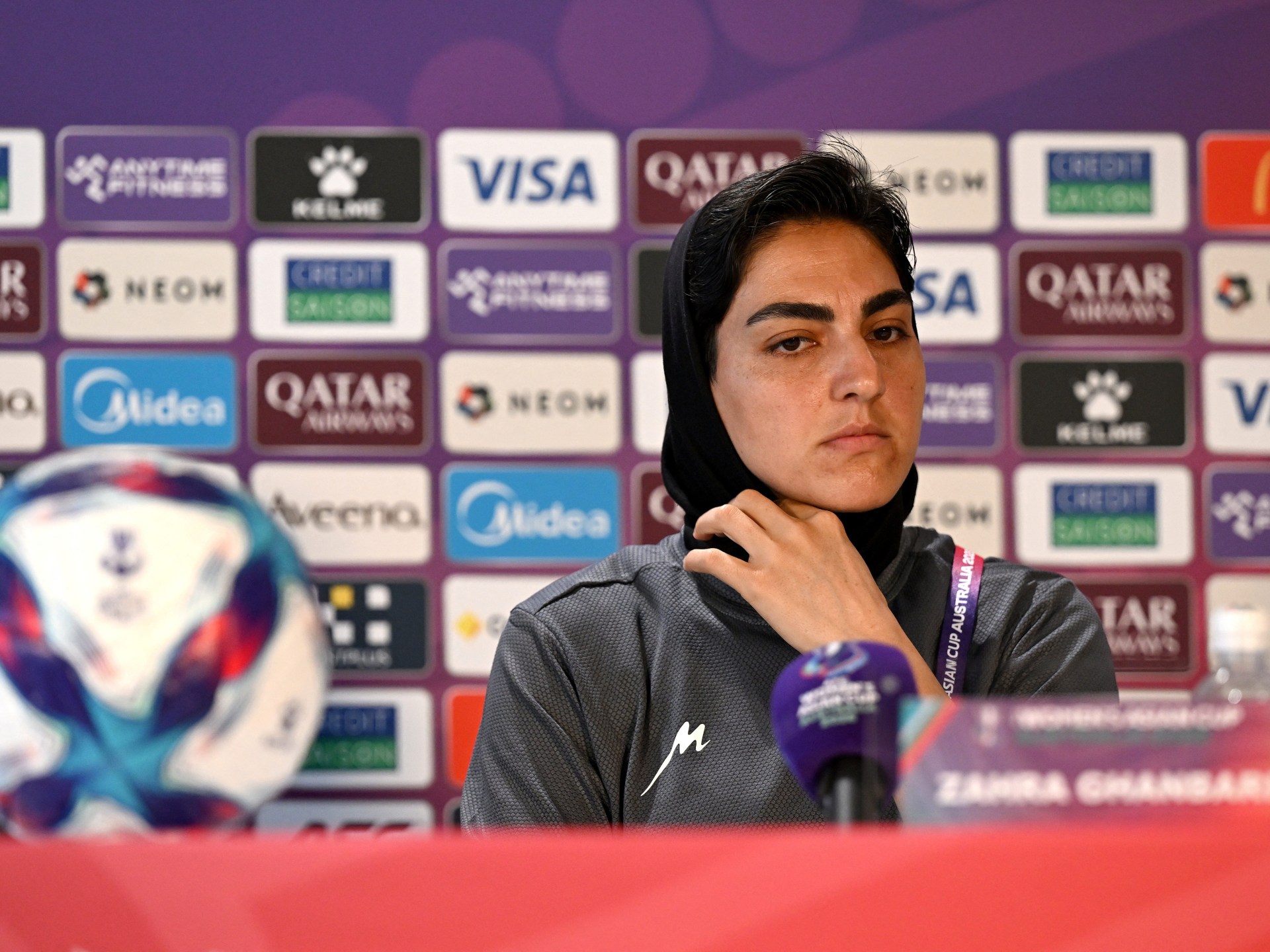
Zahra Gambari, one of six players who sought asylum in Australia, reversed her decision and returned to Iran.
Iran’s judiciary said an earlier decision to seize the assets of the country’s women’s soccer team captain was reversed and local authorities released them after she applied for asylum in Australia last month and later withdrew her claim.
Iran’s Mizan News Agency reported on Monday that “the assets of Iranian women’s national soccer player Zahra Gambari, which had been seized, have been released by a court decision.”
Recommended stories
list of 3 itemsend of list
It added that this step was taken after “a declaration of innocence following a change in her attitude”.
Gambari was among a group of six players and one behind-the-scenes staff who applied for asylum in Australia in March after competing in the Women’s Asian Cup at the start of the US-Israel war against Iran.
At the time, Australia’s Home Secretary Tony Burke said Australia had offered asylum to all players and support staff before departing for Iran, fearing they would be punished upon return for their team’s refusal to sing the Iranian national anthem at the tournament.
However, the five, including Gambari, later changed their minds and returned to Iran with the rest of the team. They received a hero’s welcome at a special ceremony in central Tehran on March 19.
The announcement came two days after Iranian media published a list of people called “traitors” whose assets were frozen by court order after the outbreak of war on February 28.
Gambari’s name was on the list, but it was not immediately clear when the decision to freeze his assets was made.
Two players who applied for asylum in Australia earlier this month before changing their minds told Al Jazeera they faced “tremendous pressure” over their decision.
“I felt that any mistake could become a big problem,” said Mona Hammoudi, one of the players who returned to Iran. “I had to think twice before taking every step.”
Amid stifling pressure and the escalation of war in Iran, a question haunted her. “Should I return to my hometown or seek asylum?”
“This dilemma has caused me constant anxiety because every choice has consequences for my life, my family, and the future of my sport.”
First disrespect of national anthem draws criticism
On March 2nd, 5th, and 8th, immediately after the United States and Israel began their war against Iran, Iran played three group games of the Asia Cup at the Gold Coast Stadium in Queensland.
The first attack killed 168 schoolgirls and teachers, as well as Iran’s supreme leader Ayatollah Khamenei and other leaders. In all, more than 2,000 Iranians have been killed since the war began six weeks ago.
Players of Iran’s women’s soccer team were branded “traitors” by a host on Iranian state broadcaster IRIB after they refused to sing the Iranian national anthem during their first match.
Three days later, in Iran’s second match against Australia, the players not only sang the national anthem but also saluted, raising concerns that the Iranian media backlash may have forced a change in attitude.

Neither players nor team management have explained why they refrained from singing before the first game, but fans and rights activists have speculated that it was an act of defiance against the Iranian government.
Human rights groups have repeatedly accused Iranian authorities of putting pressure on athletes competing abroad by threatening their relatives and seizing their property if they defect or speak out against Iran.
Activists accused the Iranian government of putting pressure on the woman’s family, including summoning her parents for questioning by intelligence services. But Iranian authorities claimed Australia had tried to send the players into exile.
Only two of Iran’s female footballers remain in Australia, continuing to train with club Brisbane Roar.
