

masuria, poland
—
Narrow roads through the Masurian countryside wind along shimmering lakes and moss-covered wetlands. We pass quiet villages with steep-roofed houses that, even on a warm summer day, give the impression that winter is yet to come.
This region of northeastern Poland is known for its outdoor recreation. It’s a place where you can enjoy hiking, horseback riding, and other activities amid clean air and endless countryside. A peaceful escape.
Suddenly the road plunges into a deep forest. Birds sing on the branches of deciduous trees. Although the landscape is idyllic, the setting is deceptive.
First you will see the ruins of the abandoned railway line. Then, ruins begin to appear between the leaves.
These peaceful country roads lead somewhere dark. Wolf’s Lair – A vast, secluded complex where Nazi leader Adolf Hitler planned the major military operations of World War II and where an assassination plot almost changed the course of the war.
The choice of the forests and wetlands of Masuria as the location for their headquarters was a strategic calculation for the Nazis. Germany, which invaded Poland at the start of World War II in September 1939, claimed the area, part of East Prussia, as its own.
As Hitler embarked on an aggressive strategy of moving further east by invading the Soviet Union, he needed a center near the Soviet border. Operation Barbarossa, one of the largest military invasions in history, began in the summer of 1941.
The area east of the small town of Kentshin, then known as Rastenburg, fared well. Railway lines built decades earlier made construction easier, and forests provided natural protection. More importantly, it was only 50 miles, or 80 kilometers, from the Soviet border.
Building on the early momentum of the conflict, the Nazis acted quickly. The Todt Organization, Germany’s Third Reich’s main military technology contractor, sent teams into the forests, assisted by forced labor from prisoners of war, mainly from Poland and France.
In June 1941, just days before the planned invasion, the Wolf Lair was completed and Hitler moved in.

Wolf’s Lair was never intended to be just a military base. It was a well-developed fortress that was also designed as a comfortable place for the top brass of the German war machine. A hideout surrounded by forests.
And it wasn’t just directed at Hitler. Once it was up and running, top Nazi figures moved in to live with the dictator, including Joseph Goebbels, Martin Bormann, Hermann Göring, and Wilhelm Keitel.
“The Wolf Lair became the unofficial capital of the Third Reich,” says history buff Grzegorz Opara, who now shows visitors around the remains of the facility.
Its scale matched Hitler’s ambitions. A total of 50 bunkers and 70 barracks were built. The walls of the bunker were made of concrete and were approximately 20 feet (6 meters) thick. The complex was nearly one square mile in size and included two airfields and a railroad station. Luxury facilities such as tea houses, casinos, and movie theaters were also added.
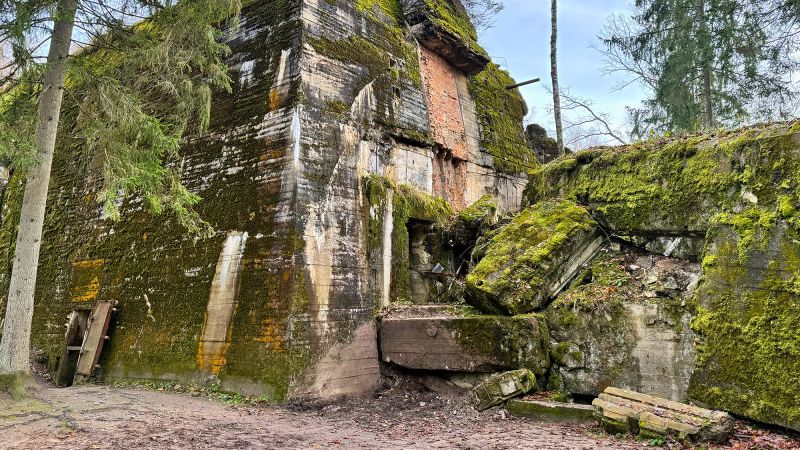
An elaborate natural camouflage system, including masking nets, trees, and moss-covered bunker facades, protected the wolves’ lairs from air raids. More than 50,000 landmines surrounded the facility.
Its history as Hitler’s headquarters ended on January 24, 1945, when German troops exploded in a bunker while retreating from the advancing Red Army. Ironically, many structures survived the blast, testifying to the high quality of construction.
Like many Nazi remnants on Polish territory, the Wolf’s Hideout was left to rot and rot. After the fall of communism, it was developed as a tourist destination. In 2017, the Polish government took control and underwent extensive renovations to preserve it as a site of historical significance.
Today, the Wolf Lair receives about 300,000 visitors a year.

Despite the dappled sunlight filtering through the greenery, it’s hard to ignore the scale of the crime planned and directed from the wolf’s lair. Pivotal events in world history were decided within its concrete walls, including Operation Barbarossa as well as many other major military operations of World War II. Central decisions of the Holocaust were discussed and coordinated here.
That sense of unease lurks along the paved tourist trail that weaves among the cement skeletons of barracks and overgrown bunkers. It lingers in dark hallways, cracks in walls, and reflections in the stagnant water of abandoned fire ponds.
In the wolf’s lair, nature took its course. Stalactites hang from the ceiling of the windowless SS command post. A tree grows straight out of a stone in the ruins of Martin Bormann’s air raid shelter. The giant Hitler bunker, an overgrown ruin made from reclaimed forest, is covered in moss.
Without knowing its gruesome history, it’s easy to imagine that these desolate structures are the remains of an ancient civilization.
Most bunkers are now off-limits to visitors as they are no longer structurally safe. However, access to dimly lit hallways is still restricted in some areas. These include the Bormann Air Raid Shelter and Bunker, which houses small cave-like exhibits. There is also an observation deck at the top where you can view the ruins from above.

Hitler spent a total of about 800 days in the wolf’s lair. A visit here provides an insight into the mundanity of daily life that punctuated the Führer’s life even as war and genocide were being waged across Europe.
“When Hitler came to the Wolf Lair, he was seriously ill, suffering from insomnia, rheumatism and stomach problems,” says tour guide Opara.
The dictator’s days here began with breakfast. He then consulted the German press and read reports about air raids on German cities.
“After the press conference, Hitler spent an hour with his German shepherd, Blondie,” Opara said. The sight of a war criminal responsible for the deaths of millions of people walking their dogs in this forest is unforgettable.
The Wolf’s Lair was also a meeting place for Axis officials, including Italian dictator Benito Mussolini.
“Mussolini visited this complex three times. Many field marshals from Hungary and Bulgaria came here to visit the Fuhrer,” Opara continued. “When the situation on the Eastern Front was good, Hitler would invite guests to his teahouse.”
The dictator’s day usually ends with a late phone call to his longtime friend Eva Braun. Braun was the woman who would share her fate when she committed suicide on April 30, 1945 in another underground bunker, the Führerbunker in Berlin.

Most people who visit the wolf’s lair stay at object number three. Nowadays it is just a collection of stones, but it was once the location of the main conference room. It was here that German military officer Claus von Stauffenberg attempted to kill Hitler with a bomb hidden in his briefcase.
The assassination attempt on Hitler and his inner circle was organized by a group of high-ranking Nazi officials, alarmed by the growing failures of the German military on the front lines and dissatisfied with the tyranny of their leaders.
Operation Valkyrie took place on July 20, 1944, when von Stauffenberg entered the compound with a briefcase of bombs to attend a military conference with Hitler and 20 officers. He placed an explosive under the table, pretended to make a phone call, and left the room.

The bomb exploded at 12:42 p.m., killing three people but only lightly injuring Hitler. More than 5,000 people were executed in the aftermath of the coup, including von Stauffenberg. Hitler’s paranoia also deepened, and the way he held meetings at the Wolf’s Lair changed.
“After the assassination attempt, all the police officers were sitting in chairs, and behind them were SS people with machine guns,” Opara says.
Of the more than 40 failed attempts to kill the dictator, Wolf’s hideout plot was the closest to success. It was depicted in the 2008 film Operation Valkyrie, in which Tom Cruise played von Stauffenberg.

Although essentially a semi-destroyed World War II ruin, Wolf’s Lair is currently undergoing extensive development to turn it into a full-fledged tourist attraction. The walkways are marked and each building is lined with numbers and information boards. For a more immersive experience, you can rent a handy audio guide or hire a tour guide.
At the end of 2024, a hotel and restaurant were added to the complex as part of extensive modernization works. Eating pierogi (traditional Polish dumplings) and spending the night next to a collection of creepy things like an abandoned Nazi bunker is an unusual twist on the concept of dark tourism.
It’s not without controversy. Amid the rise of far-right forces in Europe, historians have voiced concerns about tourism development at Nazi ruins.
But for most visitors, Hitler’s former headquarters is a place of reflection and memory. This book provides valuable insight into the inner workings of the devastating Nazi war machine and the personal lives of its leading ideologues.
Beyond the property there is a wonderful contrast to the surrounding countryside. Here you will find thousands of lakes, which characterize the Warmian and Masurian regions, glistening in the sunlight.
