

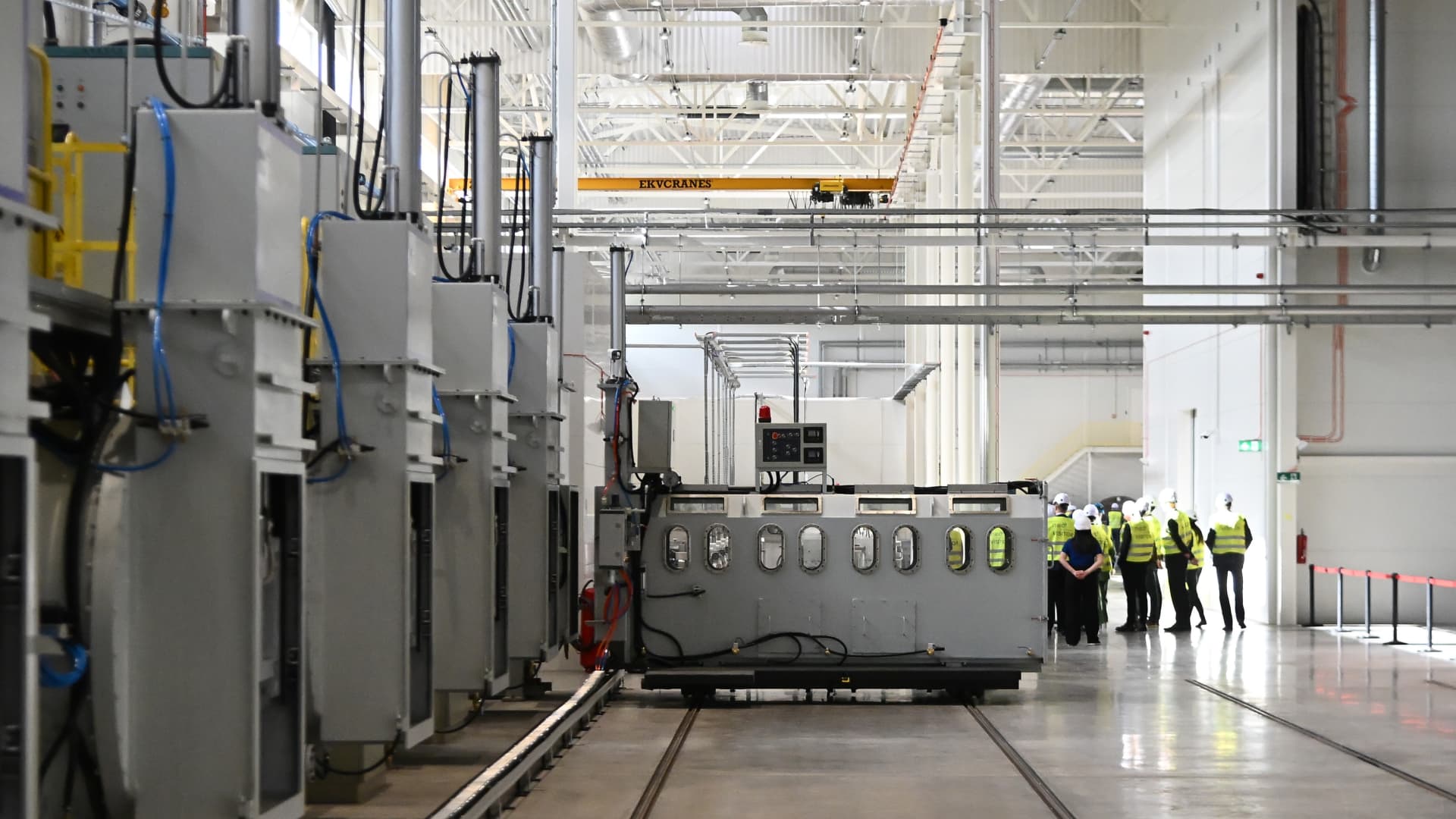
A view of the NEO magnetic plant in Narva, a city in northeastern Estonia. A factory producing rare earth magnets for the electric vehicle and wind energy sectors in Europe.
Xinhua News Agency | Xinhua News Agency | Getty Images
Narva, Estonia — Europe’s big bet to break China’s dominance of rare earths starts right under Russia’s nose.
The continent’s largest rare earths facility, located on the eastern edge of the North Atlantic Treaty Organization (NATO), is ramping up production of magnets as part of a regional effort to reduce import dependence on China.
Developed by Canada’s Neo Performance Materials and opened in mid-September, the magnet factory is located in the small industrial city of Narva. This little-known border city is separated from Russia by the Narva River, which is the external border for both NATO and the European Union.
Analysts expect the facility to play an essential role in Europe’s plans to reduce dependence on China, but warn that the region faces a long and difficult road to achieving the Minerals Strategy’s goals.
Magnets made from rare earths are essential components for the functioning of modern technologies such as electric vehicles, wind turbines, smartphones, medical devices, artificial intelligence applications, and precision weapons.
Neo CEO Rahim Suleman told CNBC in a video call that the facility is scheduled to produce 2,000 tonnes of rare earth magnets this year, with plans to scale up to more than 5,000 tonnes later to keep pace with “a very rapidly growing market.”
Frankly, this is a multi-billion dollar problem that impacts a multi-trillion dollar downstream industry. Therefore, it is worth solving.
ryan castileux
Managing Director of Adamas Intelligence
The European region currently imports almost all of its rare earth magnets from China, and Suleman expects Neo’s Narva facility to be able to meet about 10% of that demand.
“Having said that, our view on that number is around 20,000 tonnes. So I think customers have a real need to diversify their supply chains, so we’ll have a lot more work to do and a lot more to build,” Suleman said.
He added: “We are not talking about independence from any jurisdiction. We are just talking about building a strong and diversified supply chain to reduce concentration risks.”
Neo previously announced initial agreements with Schaeffler and Bosch, major automotive suppliers to German car giants and others. volkswagen and BMW.
European efforts to achieve resource security goals face several obstacles. Analysts cite problems including a lack of funding, onerous regulations, a limited and disconnected EU supply chain and relatively high production costs. All of this raises questions about the feasibility of the EU’s ambitious supply chain targets.
“Europe needs to significantly increase its rare earth magnet production capacity to move closer to automakers’ diversified supply chains,” Fastmarkets analyst Caroline Messeker told CNBC in an email.
“The guillotine is still looming.”
Rare earths, once a nebulous issue, have emerged as an important bargaining chip in the ongoing geopolitical conflict between the United States and China.
China agreed in October to postpone imposing further export controls on rare earth minerals as part of a deal reached between Chinese President Xi Jinping and US President Donald Trump. However, China’s previous rare earth regulations, which transformed global supply chains, remain in place.
“The threat is still there, the guillotine is still looming. So when you put all of this together, I think Western countries, end users and governments have just become more calm about the risks they face,” Ryan Castileux, managing director of critical minerals consultancy Adamas Intelligence, told CNBC by phone.
“Frankly, this is a billion-dollar problem that impacts trillions of dollars of downstream industry, so it’s worth solving,” he added.
European Commission President Ursula von der Leyen speaks during the debate on the new 2028-2034 Multiannual Financial Framework at the European Parliament in Brussels on 12 November 2025.
Nicholas Tucat | AFP | Getty Images
Europe in particular has been a target of tariff chaos. In its economic forecast for autumn 2025, the European Commission, the EU’s executive agency, noted that China’s export restrictions are leading to supply chain disruptions in several sectors, including automobiles and green energy.
A statement from a European Commission spokesperson said the issue of supply diversification has become a focus for European policymakers, especially as demand is projected to increase until 2030 and the EU’s supply remains highly dependent on a single supplier.
In response, European Commission President Ursula von der Leyen announced in October that plans were underway to launch the so-called RESourceEU initiative, which would be aligned with the REPowerEU initiative, which seeks to overcome another supply problem: energy.
The Narva project predates these measures, but with €18.7 million ($21.7 million) of EU funding, it is an example of what the EU wants to achieve. And although the production volumes are modest compared to overall demand, it shows how the EU plans to increase the bloc’s magnet production capacity and reduce dependence on Chinese supplies.
A photo taken on September 19, 2025 shows the inside of the NEO magnetic plant in the northeastern Estonian city of Narva.
Xinhua News Agency | Xinhua News Agency | Getty Images
China is the undisputed leader in critical mineral supply chains, responsible for almost 60% of the world’s rare earth mining and over 90% of magnet manufacturing. Meanwhile, Europe is the world’s largest export market for Chinese rare earths.
gateway to russia
Meanwhile, the location of Neo’s new magnet facility has raised some eyebrows, given the potential security challenges of being so close to Russia.
Shortly after Moscow’s full-scale invasion of Ukraine in early 2022, Russian President Vladimir Putin said Narva was historically part of Russia and needed to be retaken.

Asked why the company chose to locate its new rare earths plant there, Neo’s Suleman said the company already had an existing infrastructure base in the country and “it made sense to put it in Europe.”
“And we are going one step deeper into Estonia. We have a long history in Estonia. We already have a rare separation facility that can do both light rare earths, and we are developing heavy rare earths there,” Suleman said.
“We have been very impressed by the quality, education level and hard work of the Estonian people. In addition to the support we received both in Estonia and the EU, you put all that together, so it was a great choice for us,” he added.
Estonian parliamentarians welcomed the possibility of a Neo magnet factory, saying the facility would benefit the development of both the country and the wider region.
Estonia’s deputy director-general for energy and mineral resources, Janus Uyga, said Neo’s magnet factory started up “very much on schedule”.

Uyga acknowledged economic tensions between the US and China over rare earths on CNBC on October 30, and said Estonia and the EU need to adapt to the evolving situation.
“This is a very unique processing capacity built in Estonia, and we’re very happy because it happens in a region that is transitioning away from fossil fuels,” Wiga said on CNBC’s “Squawk Box Asia.”
