

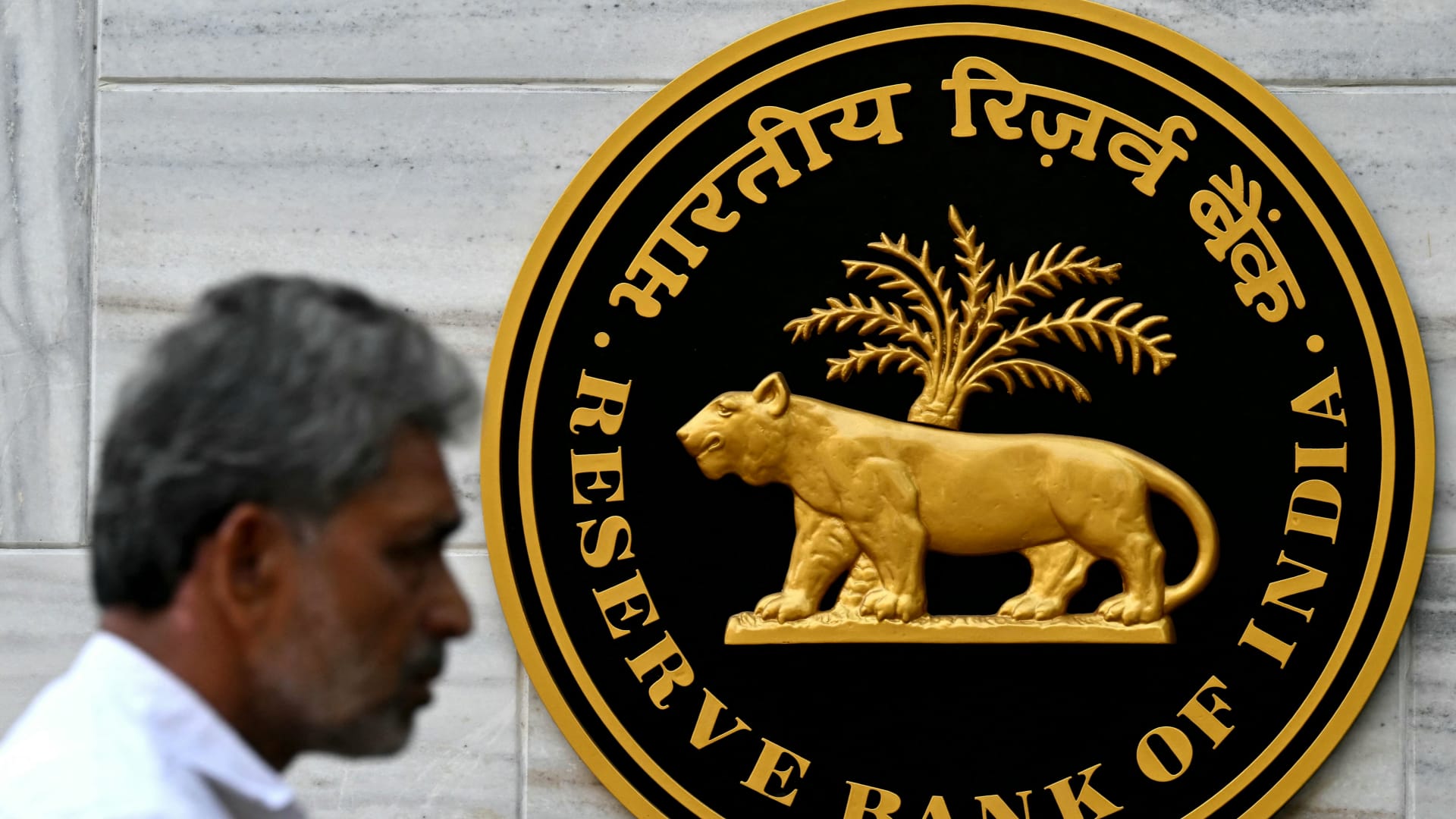
Reserve Bank of India logo outside its headquarters in Mumbai on February 7, 2025.
Indranil Mukherjee | AFP | Getty Images
India’s central bank on Friday cut its policy rate by 25 basis points to 5.25%, in line with economists’ forecasts polled by Reuters.
RBI Governor Sanjay Malhotra said the Monetary Policy Committee unanimously decided on the cut due to “weakness in some key economic indicators” even though headline inflation has eased significantly and is expected to be revised downward in the first quarter of 2025.
The economy expanded by 8.2% from July to September, faster than expected, but inflation remains subdued.
“Despite an unfavorable and difficult external environment, the Indian economy has shown remarkable resilience,” Malhotra said, noting signs of “high growth.”
“The headroom provided by the inflation outlook has allowed us to continue to support growth. We will continue to respond aggressively to the productive requirements of our economy,” he said in his closing remarks.
Rupee depreciation
The central bank said on Friday it would buy 1 trillion rupees ($11 billion) of government bonds in the open market and carry out a $5 billion three-year swap between the U.S. dollar and the Indian rupee this month.
Malhotra said these measures will “ensure sufficient durable liquidity in the system and further facilitate monetary transmission.”
The RBI regularly conducts dollar-rupee swaps to offset the liquidity impact of spot market interventions against the rupee.
The Indian rupee has depreciated against the dollar in recent days, breaking through the crucial 90 rupee level on Wednesday before offsetting losses.

India’s foreign exchange reserves stood at $686.2 billion as of November 28, enough to cover more than 11 months of imports, the central bank said in a statement.
Anubhuti Sahai, head of Indian economic research at Standard Chartered Bank, said today’s rate cut was “timely” given that the economy is doing well, but the outlook remains uncertain. He added that the rate cut is even more important given the weakening rupee.
Given the sharp movements in exchange rates, if the RBI did not cut rates today, “we could not rule out the possibility of a sell-off in the bond market,” Sahai added. This would not have been desirable from RBI’s point of view.
Weak data, strong growth
Central Bank Governor Malhotra explained the rationale for keeping interest rates on hold at the last policy meeting in October, warning that although inflation had slowed significantly in the first quarter, global trade uncertainty could still slow growth in the second half of the fiscal year.
Concerns about slowing growth are reflected in major economic indicators. Industrial activity fell to a 14-month low in October, and indicators such as the HSBC Manufacturing PMI fell to a nine-month low in November, suggesting an economic slowdown.
Exports to the United States, one of India’s major trading partners, fell for the second straight month in October, dropping 8.5% year-on-year to $6.3 billion. Overall overseas shipments in October also decreased by 11.8% to $34.38 billion.
“While external uncertainties continue to pose downside risks to (growth) prospects, the early conclusion of various ongoing trade and investment negotiations points to the possibility of an upside,” he said.

The US government has imposed a 50% tariff on Indian products since August. Trade negotiations between the two countries continue, but no agreement has yet been reached.
To offset the impact of tariffs, New Delhi slashed goods and services tax rates in September ahead of a month-long festive season to boost domestic demand.
GST tax collections showed a sharp improvement in October to 1.95 trillion rupees ($21.7 billion), up 4.6% year-on-year, but growth slowed in November, with total collections increasing 0.7% to 1.7 trillion rupees.
The Indian rupee has depreciated against the dollar in recent days, breaking through the crucial 90 rupee level on Wednesday before offsetting losses.
Sanjay Mathur, ANZ’s chief economist for India and Southeast Asia, said there was no “significant increase in bank lending” despite policy rate cuts earlier this year. He added that while it is unclear whether a US-India trade deal will be concluded, the economic impact of tariffs is visible.
