

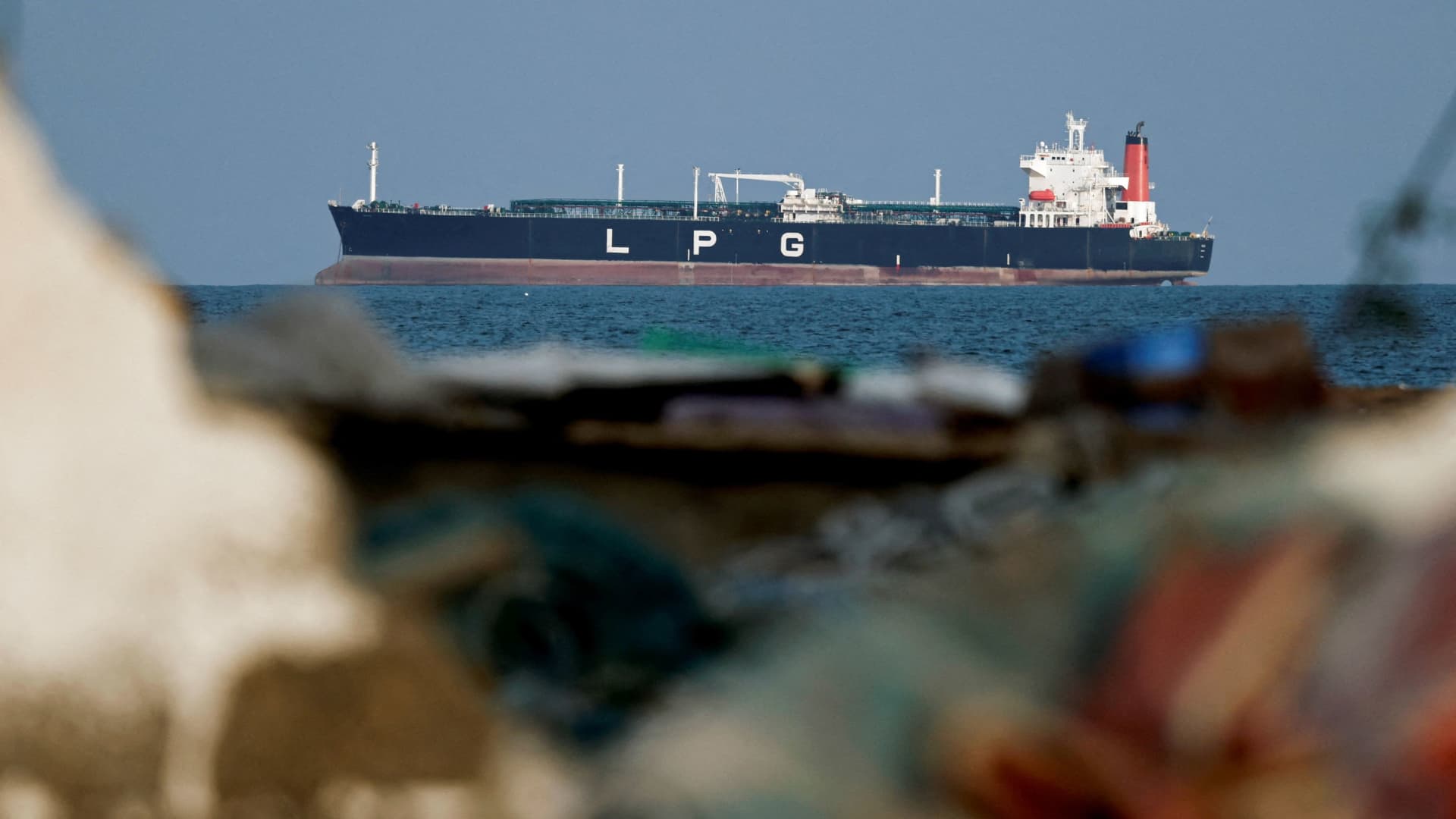
On March 11, 2026, an LPG gas tanker is stuck in the Strait of Hormuz in Sinas, Oman, amid the conflict between the United States, Israel, and Iran.
Benoît Tessier | Reuters
Indian Prime Minister Narendra Modi called Iranian President Masoud Pezeshkian within hours of Tehran’s new supreme leader vowing to keep the Strait of Hormuz closed as New Delhi scrambles to reduce energy supply risks.
This is Prime Minister Modi’s first call to Iran since the outbreak of war, as the world’s third-largest oil importer and second-largest liquefied petroleum gas consumer grapples with rising energy costs and panic buying amid a supply crunch due to the closure of a vital waterway.
According to Citi, India relies on supplies from the Strait of Hormuz for about 50% of its crude oil needs, and imports most of its LPG, the main cooking fuel used by commercial establishments and households, through this route.
“The safety and security of the people of India, along with the need for unhindered movement of goods and energy, remains India’s top priority,” PM Modi said in a post on X, sharing details of his conversations with Iranian leadership.
Government officials said at a press conference on Thursday that although there was “adequate stock” at petrol pumps, panic buying of LPG was leading to supply constraints.
The government has even directed the Pollution Control Board to allow the hospitality sector to use fuels such as kerosene, biomass and coal, as the world’s most populous country prioritizes LPG supplies to households.
Around 330 million households and over 3 million businesses use LPG cylinders in India. A statement from the National Restaurant Association of India shared with CNBC said the lack of commercially available LPG cylinders has caused many restaurants to close or reduce their menus.
“India needs more oil and gas,” Goldman Sachs’ Nikhil Bhandari said on CNBC’s “Squawk Box Asia,” adding that the country is heavily reliant on supplies from the Strait of Hormuz and has a “much lower” inventory cushion than other North Asian markets.
rising costs
Citi estimates there is an “upside risk” of 50 to 75 basis points to India’s consumer inflation forecast of 4% for the fiscal year ending March 2027.
The brokerage said in a note on Thursday that if crude oil prices remain around $90 to $100 per barrel, fuel prices could rise by Rs 5 to Rs 10 per liter, which alone could impact consumer inflation by up to 50 basis points (bp).

Subscribe now
Meanwhile, global brokerage firm Nomura raised its consumer inflation forecast for India’s fiscal year ending March 2027 to 4.5% from 3.8%, citing the risk of rising restaurant prices due to tight commercial LPG supplies.
India faces rising energy costs and energy shortages, which could lead to “multiple sources of inflationary pressures” if supply chain disruptions persist for more than a month, Nomura said in a note on Thursday.
The government has prioritized supply for consumers, but regulations introduced after the outbreak of war have also limited access for households. Consumers in urban areas will now have to wait 25 days to book LPG, compared to 21 days earlier, while households in rural areas will have to wait 45 days.
Amid supply constraints, the government has already increased the price of edible fuel by Rs 60 per cylinder, or about 6.5% for most consumers, but experts have warned that ongoing election campaigns in five key states will limit the government’s ability to pass on the costs of higher fuel prices to consumers.
Meanwhile, the rupee hovered near a record low of 92.48 rupees against the US dollar on Friday, with traders pricing in the risk that oil prices will remain high for an extended period.
Radhika Rao, senior economist and executive director at DBS Bank Singapore, told CNBC that India’s current account gap could widen by 70 basis points if oil prices rise and average above $100 per barrel.
India’s current account deficit will be 1.3% of gross domestic product (GDP) as of the end of December 2025, but if the gap widens due to pressure from rising oil prices, it could lead to a devaluation of the currency.

no safe passage
At least 130 million barrels of oil were stranded in the Middle East Gulf as of Thursday, according to data from energy information firm Kpler, but India has been unable to access the oil because Iran has blocked trade through the Strait of Hormuz.
The country is trying to find safe passage for its ships, with 28 of them and about 800 Indian sailors stranded in the strait. India’s Foreign Minister S. Jaishankar has held several talks with Iranian Foreign Minister Seyed Abbas Araghchi in recent days, the country’s Ministry of External Affairs said.
“At the last meeting, issues related to maritime safety and India’s energy security were discussed,” a ministry spokesperson said, adding that it was “premature” to share more, suggesting it was unlikely that Indian ships would receive a reprieve from the blockade.
“If Hormuz remains closed in the short term, India will be forced to restructure for a time for which it was not fully prepared, and it may not be able to pay the price,” said Reema Bhattacharya, head of Asia risk insights, corporate risk and sustainability at business advisory firm Verisk Maplecroft.
India currently sources crude oil from more than 40 countries, with purchases from Russia reaching 1.46 million barrels per day in March, up from 1 million barrels per day in February, according to Kpler data.
Muyu Shu, a senior analyst at the company, said the market buzz showed India had recently bought Russian Urals for March and April delivery at a premium of $5 a barrel to dated Brent.
Bhattacharya said India cannot realistically rewire its energy supply chain in one to two months due to global constraints and high costs.
