

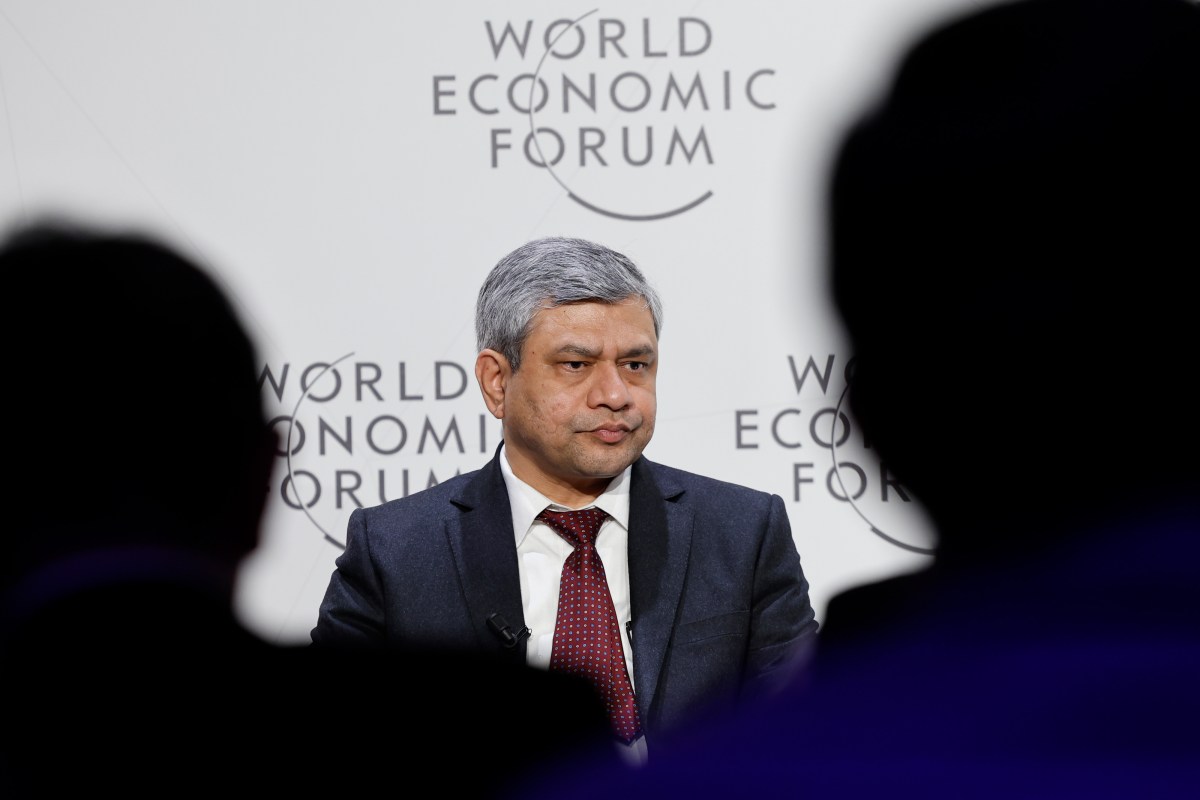
India is embarking on an aggressive push to attract over $200 billion in artificial intelligence infrastructure investment over the next two years as it seeks to position itself as a global hub for AI computing and applications, with capacity, capital and regulation becoming strategic assets.
The plan was outlined by India’s IT Minister Ashwini Vaishnau (pictured above) on Tuesday at the Indian government-sponsored five-day AI Impact Summit in New Delhi. The summit was attended by senior executives from OpenAI, Google, Anthropic, and other global technology companies. To attract investment, the government is deploying a combination of tax incentives, state-backed venture capital, and policy support aimed at drawing more of the global AI value chain into the South Asian country.
India’s pitch comes as major US technology companies including Amazon, Google and Microsoft have already committed about $70 billion to expand AI and cloud infrastructure in the country, giving New Delhi the basis to argue it can combine scale, cost advantages and policy incentives to attract the next wave of global AI computing investment.
The bulk of the projected $200 billion is expected to go into AI infrastructure, including data centres, chips and support systems, including the roughly $70 billion already pledged by Big Tech companies, Vaishnau said.The Indian government also expects to invest $17 billion in additional deep tech and AI applications, underscoring the move beyond infrastructure to capture more of the value chain.
This commitment is supported by recent policy decisions Aimed at making India a more attractive base for AI computing, it includes long-term tax breaks on export-oriented cloud services and a Rs 1,000-crore (approx. $1.1 billion) Government-backed venture programs targeting high-risk areas such as AI and advanced manufacturing. Earlier this month, New Delhi extended the period for deep tech companies to qualify as startups to 20 years and raised the revenue threshold for startup-specific benefits to 3 billion rupees (about $33.08 million).
“We’ve seen venture capitalists pouring money into dtech startups,” Vaishnau said at a press conference on the sidelines of the AI Impact Summit in New Delhi. “We’ve seen VCs and other players putting money into big solutions and big applications. We’ve seen VCs putting money into further research into cutting-edge models.”
The minister said India plans to expand its shared computing capacity under the IndiaAI mission beyond the existing 38,000 GPUs, with another 20,000 to be added in the coming weeks, signaling the next phase of the country’s AI strategy.
Looking ahead, the Indian government is preparing the second phase of its AI mission, with India aiming to expand access to AI infrastructure beyond a small group of companies, with a focus on research and development, innovation, and widespread adoption of AI tools, alongside further expansion of shared computing capacity, Vaishnow said.
The push also faces structural challenges, including access to reliable power and water for energy-intensive data centers, highlighting implementation risks as India seeks to compress years of AI infrastructure build-out into a much shorter period of time.
Acknowledging these challenges, Vaishnaud said the government is aware of the pressure AI infrastructure will place on power and water resources, and pointed to India’s energy mix, where more than half of its installed power generation capacity comes from clean sources, as an advantage amid rising demand from data centres.
As companies seek new homes for AI computing amid rising costs, capacity constraints, and increasing global competition, whether India can achieve its vision has implications far beyond its borders.
