

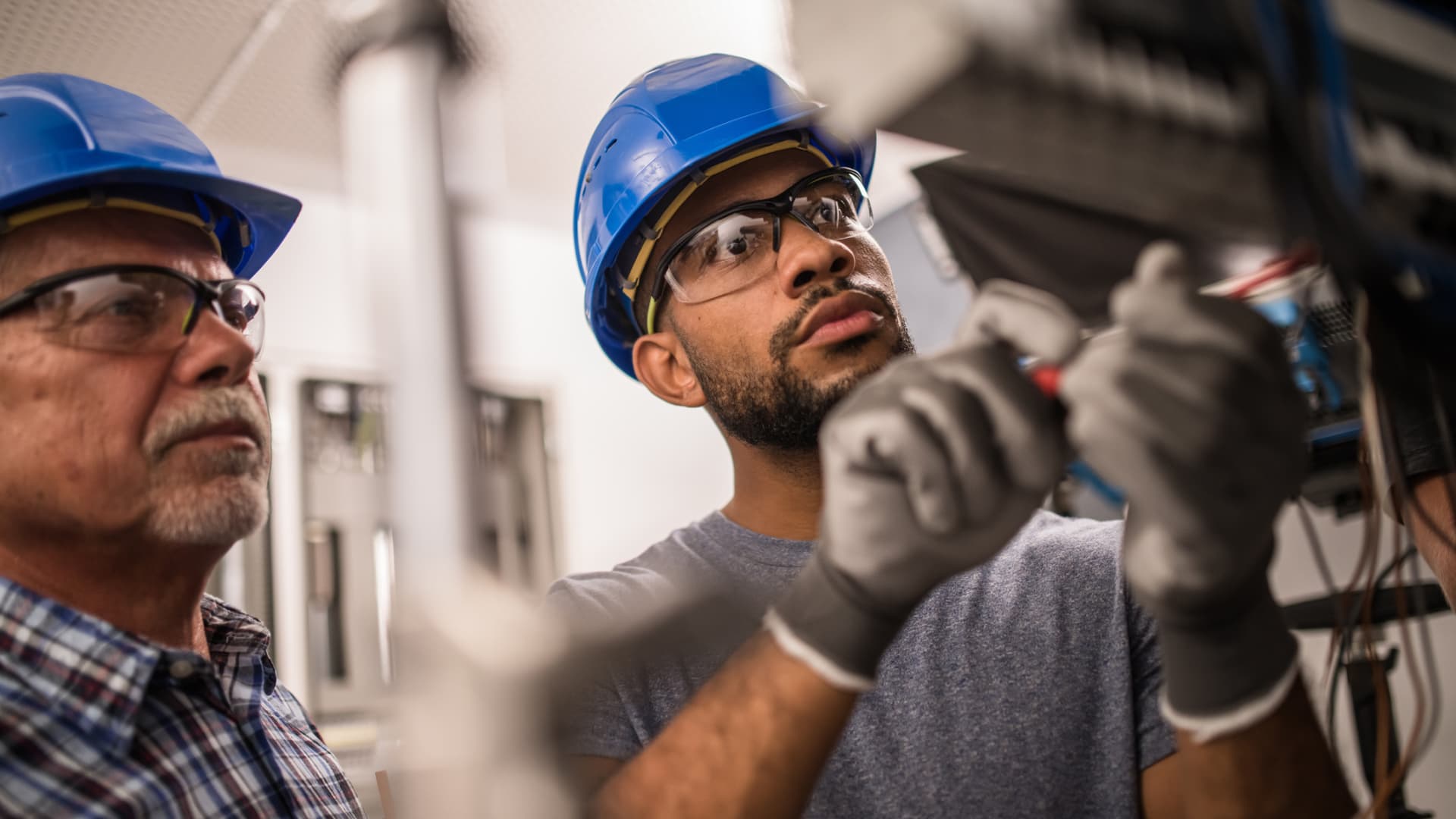

James Vandal, 25, said his interest in becoming an electrician first sparked recently when a crew was redoing the wiring on the third floor of his home. “I asked them how I could get into that industry,” he said.
Part of the appeal is working with your hands, he said. “At first I didn’t really know what I wanted to do. I went to college and then dropped out,” he said. “I bounced around from job to job for years until I finally landed a trade.”
Vandal is currently enrolled at Rosedale Institute of Technology in Pittsburgh. After a 16-month program, schools’ job placement programs typically place students directly into positions in the field, an increasingly rare feat in today’s job market.
Potential employment apocalypse
As advances in artificial intelligence reshape the workforce, fewer entry-level positions are available to college graduates. Larger employers are also announcing large-scale layoffs, with some experts claiming this is the beginning of an AI-driven white-collar recession or employment apocalypse.
There are concerns that as AI capabilities improve, companies will need fewer workers and white-collar layoffs will increase, creating a “negative feedback loop with no natural brakes,” according to a recent report from Citorini Research.
At the same time, there is a shortage of skilled craftsmen, mainly due to experienced workers leaving the field and aging, and in some industries not only the number of employment opportunities is increasing, but also wages are increasing.
Monster Careers expert Vicki Salemi said skilled trade jobs are “less susceptible to AI because they are vulnerable”. “They require a physical presence and are unlikely to be fully automated or offshored,” she said. Additionally, “many people are union members, so their jobs are protected.”

For example, electrician ranks as one of the most in-demand trade jobs, according to job site Indeed. “There are jobs here and the salaries are good,” Salemi said.
The median annual salary for electricians in the U.S. will be $62,350 in 2024, and employment in the profession is expected to grow 9% over 10 years, much faster than the average for all occupations, according to the U.S. Bureau of Labor Statistics’ latest Occupational Handbook.
The latest BLS data for 2025 shows that the median weekly income for electricians is $1,376, 14% higher than the national median.
“The Cliff of Retirement”
Each year, more electricians retire than new electricians enter the field.
“There’s a massive retirement cliff happening,” said Ian Andrews, vice president of labor relations at the National Electrical Contractors Association, a trade group representing the electrical contracting industry. “On the union side, we lose about 20,000 electricians every year and there are 80,000 job openings,” he said. “The demand for skilled workers has never been greater.”
Rahm Emanuel, a longtime politician and former Chicago mayor, said during a discussion on career-driven pathways at the Brookings Institution in February that the country’s major industries “can’t find the people” to fill the roles. “Live a productive life in an industry that AI cannot disrupt.”
According to Andrews, “You’re working with your hands…There’s a long-term stability that office jobs don’t have because it’s not something a computer can replace manually.”
Cadmy | iStock | Getty Images
Many young employees have already joined the company. Andrews said applications for apprenticeship programs have jumped 70% since 2022.
Rosedale Technical College also offers opportunities to study automotive technology, diesel mechanics, carpentry, welding and other skilled trades, and enrollment has increased 36% over the past five years, the school said.
“I think this is a great opportunity and a great way to get your foot in the door, get started, get an education and feel completely prepared for whatever you’re going to be doing, especially electrical and stuff like that…You really have to know what you’re doing,” Vandal said of his trade school experience.
College costs are a big factor
In addition to providing students with career paths to address workforce shortages, vocational training programs are also much cheaper than four-year colleges.
Research shows that the rising cost of higher education and associated student loan debt are important factors driving more students into short-term programs.
In-state tuition and fees at four-year public universities averaged $11,950 for the 2025-2026 academic year, compared to $45,000 at private four-year schools. Tuition and fees at two-year public schools also average $4,150, according to the College Board.
Additionally, a growing number of states are implementing so-called promise programs, which typically offer college students two years of free tuition at participating state community colleges and other associate degree programs or trade schools.

While it is true that college enrollment is still on the rise, other data shows that this is largely due to community colleges and short-term certificate programs.
According to the National Student Clearinghouse Research Center, enrollment in both baccalaureate certificate and associate degree programs increased by about 2% in fall 2025, while enrollment in baccalaureate degree programs increased by less than 1%.
Currently, community colleges have 752,000 students enrolled in undergraduate certificate programs. This is a 28% increase from just four years ago.
Subscribe to CNBC on YouTube.
