

new delhi and mumbai
—
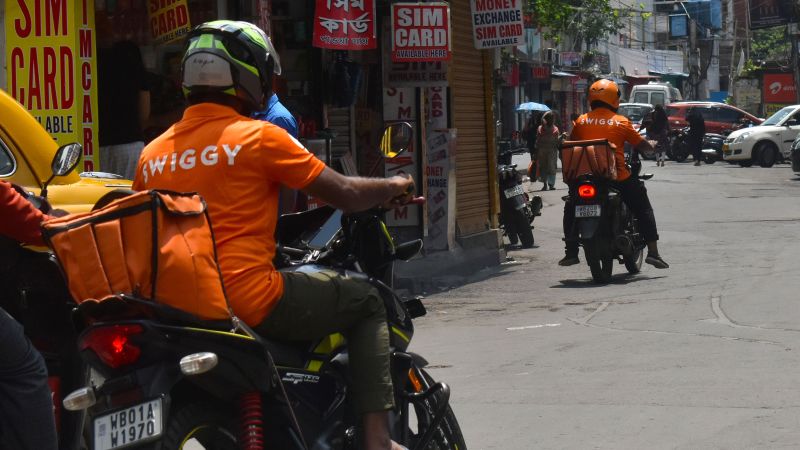
Tens of thousands of app-based delivery workers in India went on strike on New Year’s Eve to protest a system defined by relentless pressure, including a requirement to deliver goods within 10 minutes.
The workers are demanding “fair wages, dignity and safety” and an immediate ban on marketing hooks that deliver groceries within 10 minutes to addresses within a radius of about 3 kilometers (1.8 miles), a challenge in India’s notoriously traffic-choked cities.
They are also protesting automated systems used on the platform to penalize and downgrade delivery drivers in case of delays, and are calling for comprehensive social security, including health insurance and pensions. More than 200,000 workers took part in the strike, according to the Indian App-based Transport Workers’ Federation, which organized the strike.
Quick commerce is a global phenomenon, but it’s a tough battleground in India, where around 1 million new job seekers enter the market every month in a country of 1.4 billion people.
Fueled by a growing middle class with money at their disposal, speed has become an essential weapon in companies’ battle for market share.
The market is huge. Major company Swiggy has a market capitalization of around $11 billion. Rival Zomato is worth about $28 billion.
Some companies, such as Swiggy’s Instamart, Blinkit and Zepto, have made the promise of 10-minute delivery a signature marketing hook, a strategy that workers argue can come at the expense of safety and well-being.
Additionally, many platforms do not classify passengers as employees, which legally exempts companies from providing many of the benefits employees seek.

A 41-year-old Swiggy delivery driver from the city of Hyderabad told CNN that the basic fee per order is 5 rupees (less than 10 cents), with the potential to earn more depending on the number of orders and distance traveled. He works from 7pm to 5am every day, he said.
“We have to pay for gas and bike maintenance ourselves,” he said, requesting anonymity for fear of retaliation.
“And at least 50 rupees (56 cents) a day is spent on buying something to eat. I never thought I would be doing this in my 40s, but what other choice do I have?” he said.
After his bookstore went bankrupt due to the coronavirus pandemic, he became a delivery driver and earns about 20,000 rupees ($222) a month. More than half of that money goes toward rent and school fees for all five children, forcing the family to live paycheck to paycheck.
CNN has reached out to Swiggy, Zomato, Blinkit, Zepto and India’s Ministry of Labor for answers.
Zomato co-founder Deepender Goyal said in a post on X that both Zomato and Brinkit performed at a “record pace” on Wednesday “unaffected by strike demands”.
“With the help of local law enforcement, we have been able to rein in a small number of criminals,” he wrote, adding that “if a system is fundamentally unfair, it cannot continue to attract and retain so many people who choose to work within it.”
In response, the Telangana Gig and Platform Workers Union said in a post on X that around 7.5 million orders were “delivered because workers could not afford to log out, not because the system treated them fairly.”
Wednesday’s strike spotlighted the deep gulf between the conveniences offered to urban consumers and the livelihoods of the people who provide them.
On the other hand, in countries with large working-age populations, platforms like Swiggy and Zomato provide vital employment to millions of people and are praised for their efficiency. India’s gig workforce is expected to grow to 23.5 million people by 2030, according to a 2023 report by government research agency Niti Ayog.

But critics argue that this model creates new forms of exploitation.
“When it first started, the idea of being your own boss and making your own money was appealing,” said Leah Kasliwal, an independent policy consultant whose research focuses on South Asia’s gig economy.
“But all it essentially did was formalize the informalization of workers in most cases.”
In other words, the system takes the precarity of informal work, which lacks job security, fixed pay, and benefits, and incorporates it into controlled corporate structures.
Mohammad Nouman, a 30-year-old Swiggy rider in India’s financial capital, Mumbai, was so financially insecure that he felt he couldn’t afford to lose a day’s pay to take part in the strike.
“The work is hard, but I have no other choice. I have to do it to make money,” he said.
He described a grueling daily job where he could work up to 16 hours a day to complete the 35-40 orders needed to meet Swiggy’s goals. After paying for fuel and other expenses, they are left with about 700 rupees (about 770 yen) a day.
There is also pressure to deliver quickly. “We expect to be able to deliver one kilometer in three to four minutes and four kilometers in about 10 minutes,” Newman said.

“We have to be fast to meet these schedules. If we aren’t fast, we won’t be able to reach our goals. Once the orders come in, we just want to get them out fast so we can take more orders.”
Another rider, also based in Mumbai, said he had to “jump red lights most of the time” to deliver on time.
“If you don’t comply, there are penalties, and if you get caught, you have to pay those fines out of pocket, so you’re stuck either way,” said a Zept employee who did not want to be named for fear of retaliation.
In a post to
“When you order on Blinkit, your items are picked and packed within 2.5 minutes. Riders then drive an average of less than 2km in about 8 minutes, which equates to an average speed of 15km/h,” he wrote.
India’s central government introduced labor reforms in 2020 that promised social security for all gig workers, but nationwide implementation of these protections has been slow.
In 2023, Rajasthan became the first state to pass legislation regulating the gig economy, establishing a social security fund and creating a dedicated welfare board to address complaints.
Karnataka and Jharkhand, home to the country’s tech hub Bengaluru, passed their own laws last year, and Telangana is considering similar measures.
The gig economy has also been credited with bringing more women into the workforce, and in the face of public pressure, some platforms have also introduced various benefits such as accident insurance and basic health insurance plans.

But some gig workers say these are often difficult to access, and protests in recent years have highlighted the need for greater transparency and expanded benefits.
Manoj Karade, who works for an app that provides home-based salon services, said he went on strike to demand fixed wages and social security.
He said if he fails to meet the company’s goals, his account will be blocked and his income will be affected. Kalde said he earns about 25,000 rupees (about 27,000 yen) a month, working up to 15 hours a day.
“We work in fear because if we don’t reach our goals, it will affect our families. And without income, we will be ruined.”
