

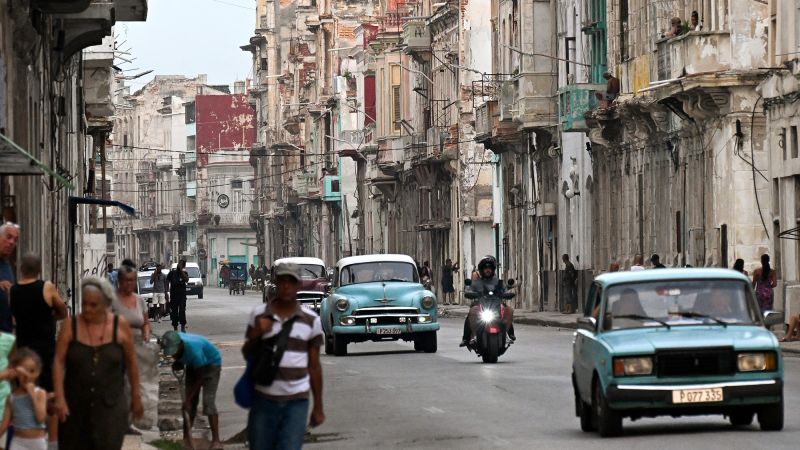
Havana, Cuba
—
A Cuban man snuggled up next to me on the street and whispered to me, as if we were sharing a long-held secret.
“Come on Americans, let Trump come on. It’s time to end this problem,” he said in a barely audible voice.
This is dangerous for Cuba, especially now that the U.S. president is threatening Cuba in ways not seen since the Cold War.
I looked around to see if anyone was hearing these inflammatory comments and if the cameraman who was filming with me about the ongoing traffic crisis was nearby and was recording what the man (the bike taxi driver) was saying to me.
“I can’t take it anymore,” he continued. “People can’t feed their families.”
More than 60 years after Fidel Castro entered Havana and the history books with a column of bearded revolutionaries, the island has been in a state of constant crisis. A failed CIA invasion, a nuclear missile stalemate, and a mass exodus. And now it’s Donald Trump.
“Cuba is going to collapse soon,” President Trump told CNN’s Dana Bash on Friday. It’s a statement that seems to be a rehash of many past U.S. presidents’ rants, except for how swiftly and surgically President Trump’s oil embargo was implemented, and how it brought Cuba’s struggling economy to its knees.

President Trump: Cuba will collapse ‘soon’

President Trump, already in his second term, has ordered unprecedented strikes to remove the leaders of Venezuela and Iran from power. By his own admission, Cuba, which has endured decades of U.S. economic sanctions and its own government’s policy failures, will be next.
Unlike the 1962 missile crisis, there is no U.S. naval blockade to prevent ships from accessing communist-controlled islands, but the net effect is the same. After the US attack on Venezuela and pressure campaign against the Mexican government, the flow of oil from the remaining staunch allies in Havana was cut off.
Many of the brand new hotels built by the Cuban government with public funds are either vacant or closed. Employees were sent home. There are almost no tourists anymore. There is no more jet fuel to bring them home.
“Cuba is not alone” is the slogan of the Cuban government. But the island looks more desolate and abandoned than ever since the collapse of the Soviet Union. Power outages that once lasted hours can now last for days. For those precious few hours in the middle of the night, when the electricity flickers on, Cubans now stand up exhausted to cook or iron their clothes.

During a recent 36-hour power outage, a group of men cooked in large pots on burning tree branches on the sidewalk of Havana’s stately boulevard.
“We are back in the Stone Age,” someone called out to me in a disturbingly cheerful voice.
There are very few cars on the road because there is no fuel. Because government-rented cars for tourists are the only cars that can be regularly filled up at state-run gas stations, Cubans have turned to renting so-called T-plate cars, from which they siphon precious fuel and resell it on the black market. Tanks of gas now sell for more than $300 on the black market, more than the annual income of most Cubans.
The sight of people searching for food among piles of garbage has become a common sight. Sometimes children.
Although President Trump insists the Cuban government is desperate to strike a deal to resolve the crisis, officials I spoke to say the United States will never again dictate terms on the island. This is still a country where every speech ends with the cry, “Homeland or death. We will win!”
Still other Cubans I spoke to are tired and want change, no matter what that change looks like.
When the cameraman finally showed up again, I asked the taxi driver if he wanted to share his thoughts on the story we were filming. He hurried away, not complaining under his breath, at least not yet.
