

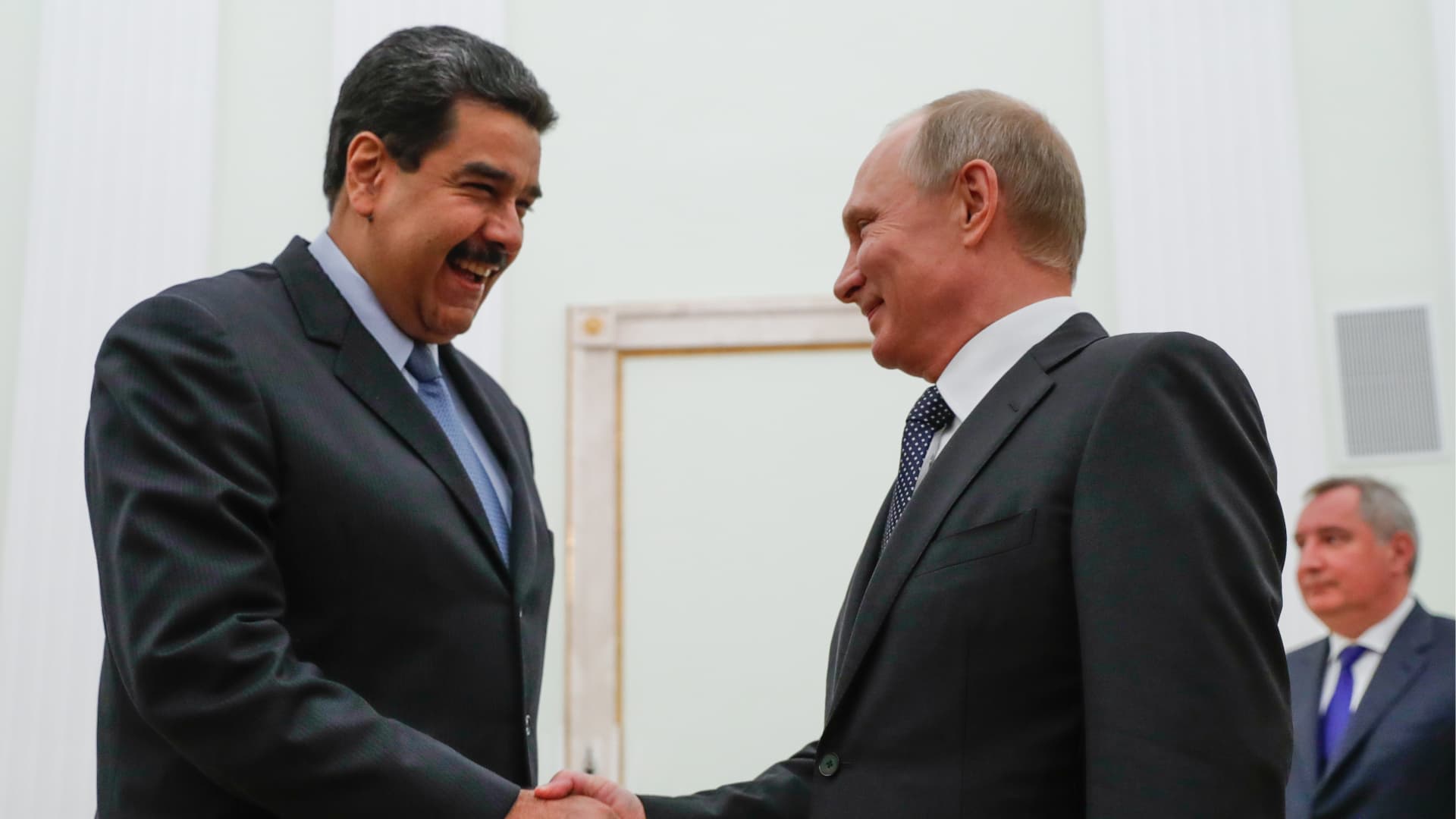
Venezuelan President Nicolas Maduro shakes hands with Russian President Vladimir Putin during a meeting at the Moscow Kremlin.
Mikhail Metzel | Tas | Getty Images
Russia’s reaction to the ouster of Venezuelan President Nicolás Maduro has been cautious, with Moscow considering the potential geopolitical benefits and opportunities of unilateral US action against the loss of a key regional ally in Latin America.
The Russian government initially condemned the U.S. attack on Venezuela on Saturday and the subsequent detention of Mr. Maduro and his wife, Syria Flores.
Russia’s Foreign Ministry condemned the US’s “aggressive actions” and called them “unacceptable violations of the sovereignty of an independent state.” However, the Kremlin has not issued an official response to the expulsion, nor has Russian President Vladimir Putin.
President Maduro is an ally of President Putin, and Venezuela has long-standing ties with Russia. Caracas supported Russia’s invasion of Ukraine, and the two countries shared energy ties and military cooperation. The allies also had a common interest in countering U.S. geopolitical, military, and economic influence in the region.
Still, Maduro’s ouster is not all bad news for Russia, which is likely considering ways to use the Venezuelan crisis to its advantage.
Ukrainian pastime
First, the Venezuelan crisis occurred at a delicate time in Moscow’s own relations with Washington. He is likely to be cautious in building bridges with the White House as he seeks to curry favor with the administration to get the most favorable terms from an anticipated Ukraine peace deal.
However, events in Venezuela have provided a welcome distraction on this front, with Russia benefiting from easing pressure and efforts to reach a peace deal with Ukraine, or a ceasefire as part of the deal.
Although Russian forces are seen as having an advantage on the battlefield, particularly in terms of manpower, and are making gradual advances in eastern Ukraine, a ceasefire is not seen to be in Russia’s interests.
Analysts at the Institute for the Study of War noted on Sunday that “the Kremlin’s response to the U.S. operation in Venezuela has so far been routine,” adding that the Kremlin “will need to balance its response between maintaining credibility as a partner with other countries and continued efforts to pander to the Trump administration.”
Dangerous for Zelenskiy?
Analysts have also expressed concern that Trump’s detention of Maduro and criminal charges against him could prompt Russia to take similar action against Ukrainian President Volodymyr Zelenskiy without providing evidence to support the charges.
“He (President Trump) has given President Putin permission to do whatever he wants with President Zelensky,” Sara Lenti, a political consultant and former White House National Security Council director, told CNBC on Monday.

“The president had the right to take Mr. Maduro away because he said Mr. Maduro was a criminal. And we know that President Putin has often incorrectly called Mr. Zelensky a criminal. So he’s setting a precedent and saying it’s OK for countries to defy the political sovereignty of other countries,” she said in comments on CNBC’s “Europe Early Edition.”
“I think this sets a very bad precedent for the countries that China and Russia are trying to violate, whether it’s Taiwan or Ukraine,” Lenti added.
Ideological support?
On an ideological level, President Trump’s intervention in Venezuela and the foreign policy stance that underpins it, a desire to reaffirm US power and supremacy in the Western Hemisphere, aligns with Russia.
Putin is also widely seen as wanting to reestablish Russia’s spheres of influence in Europe and Central Asia, which it lost with the collapse of the Soviet Union in 1991, the biggest geopolitical disaster of the 20th century.
There is speculation that President Trump’s renewed focus on reestablishing American hegemony in the West could allow Russia to do the same in its own backyard. But several analysts told CNBC that the U.S. intervention in Venezuela showed countries like Russia and Iran that Trump is ready to act if he deems it to be in U.S. interests.
“What he’s doing in Venezuela will definitely be clearly seen and heard in Iran and Russia,” Energy Aspects founder Amrita Sen told CNBC on Monday.
“I think that’s something that world leaders are very mindful of, whether it’s the need to take President Trump seriously or ‘don’t ignore him when he says, ‘I’m going to do X,'” she said on CNBC’s “Squawk Box Europe.”

Meanwhile, BCA Research strategist Marko Papic argued that Russia does not have the power to negotiate with the United States when it comes to allies like Venezuela.
“If the United States gets free rein in its sphere of influence, can other powers also get free rein in their spheres of influence? The answer is ‘no’. There is nothing that Russia could have given America in Venezuela… America is free to act in the Western Hemisphere, so there was no need for any deal between Russia and America,” he said.
loss of allies
Analysts stress that expelling Maduro would remove a key ally and bulwark against U.S. influence and ambitions in Latin America and would not be welcomed positively in Moscow.
“The fall of Maduro has hurt another Russian client state, and the value of the Kremlin’s security guarantees has fallen to just better than zero,” Tina Fordham, founder of Fordham Global Insights, said in an analysis Monday.
Russian President Vladimir Putin and Venezuelan President Nicolas Maduro shake hands during a ceremony at the Kremlin in Moscow on July 2, 2013.
Maxim Shemetov | AFP | Getty Images
“Even worse from the Kremlin’s point of view, the US operation easily penetrated the vaunted S-300 Russian air defense system installed in Venezuela, after Syria and Iran also failed to provide air defense,” she noted.
