

CNN’s Isobel Yeung traveled to Libya to investigate refugees being tortured for ransom. Subscribe to watch the full report.
From the living room of her third-floor apartment in rural Germany, Abeba winces as she stares at her phone.
“This will be my final message,” her younger brother Daniel says in an audio message. “I understand that you may not have the financial means to assist me directly, and I never expected that from you. Please, just make sure my message reaches those who might be able to help.”
She and her husband don’t know exactly where her brother is. Somewhere in southern Libya. They’ve heard it’s an area called Kufra. What they do know is that every time he calls, or they receive a video, he’s being mercilessly tortured by men who remain off camera. Videos seen by CNN show Daniel being tied up, urinated on, kicked, and beaten with a metal pole. CNN is using pseudonyms for Daniel and Abeba because they fear retribution.
If his family doesn’t manage to gather the $10,000 being demanded by his captors, he may soon be dead.
CNN has spoken to dozens of individuals and families in their situation. Daniel is just one of an unknown number of migrants who are currently being tortured on a near daily basis, somewhere in Libya’s Sahara Desert.
Libya, in North Africa, has long been the transit country of choice for those hoping to travel across the Mediterranean Sea to reach Europe. At the northeast corner of the Sahara Desert, its vast wilderness marks the final leg on the African continent for those fleeing war, persecution, and lack of opportunity in search of a better life.
The passengers on this dangerous route change over time as conflicts ebb and flow. Recently, the vast majority have been coming from Sudan, embroiled in a brutal civil war which has displaced millions.
Inevitably, human smuggling is big business.
Much of it is relatively functional – insofar as clients pay several hundred dollars to be transported in bare-bones conditions to Libya’s coast, and onto an overcrowded inflatable dingy bound for Italy or Greece.
But if someone is unlucky enough to come from a country perceived to have a large diaspora – wealthy, at least compared to everyone else – then they stand a good chance of falling into the hands not of smugglers, but of traffickers, who coerce and exploit those in their control.
Eritreans, who make up the second largest share of refugees recorded in Libya according to the United Nations, fall into this group. Their dictatorial hermit nation is often called Africa’s North Korea. Many thousands flee its mandatory, indefinite military service – and some fall prey to exploitative trafficking gangs.
This is what happened to Abeba’s brother.
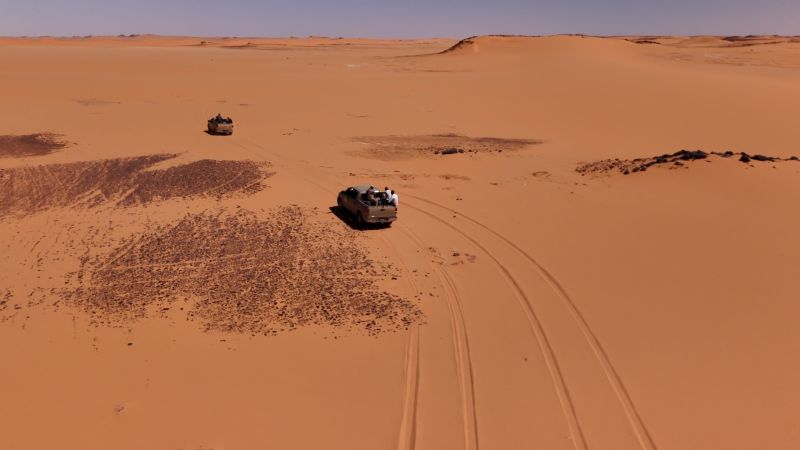
Flying over the Sahara in the back of a Soviet-era Mi-17 twin-turbo helicopter, it’s clear to see how the traffickers operate with such impunity.
The desert is vast. The barren Martian landscape stretches as far as the eye can see, interrupted only occasionally by the faintest of tire tracks marking the unpaved road on Libya’s north-south route.
“We are doing our best with the capabilities that we have,” Col. Mohammad Hassan Rahil says from the desert hilltop post he commands near the Sudanese border.
His forces are part of the Libyan National Army and live in a small, air-conditioned compound, surrounded by hundreds of miles of desert on all sides. They drive up and down the sandy tracks and stop any suspicious vehicles. But the traffickers know this terrain far better than they do. To an observer, their efforts appear futile in the extreme.
That’s plain to see in Al Jawf, the first major settlement migrants encounter as they transit Libya’s vast Kufra province from south to north.
From the fetid and overcrowded cells of the town’s migrant detention center, officers pick out a Sudanese man who had been arrested the day before.
They believe him to be “a money man” – helping to transfer money between relatives of trafficking victims who live abroad, like Abeba, and the traffickers both in Libya and in foreign safe havens who profit from the industry.
“I receive them, then deduct my commission,” he readily tells the interrogator of the payments. CNN is not identifying him because he was not formally charged.
The industry is highly compartmentalized. Many of the payments are sent through an informal money transfer system known as “hawala.” Because it is widely used to send legitimate remittances and operates entirely on a human-to-human level via text messages and phone calls, it is nearly impossible to track.
It is entirely feasible that this man has no idea the extent of the sordid industry he is facilitating.
“Does he torture them?” the interrogator asks the Sudanese man of the trafficker to whom he allegedly transfers money.
“Only God knows,” the Sudanese man replies.
But he does have some useful information. The trafficker and his “passengers” were operating from a farm not even a kilometer from the police base.
The police set off to raid the premises. But by the time the convoy of pickup trucks arrives there, it’s too late. Foreign passports and bedding are strewn across the rooms, but both captors and victims are long gone.
When the traffickers are stopped, it’s usually because of luck, not advanced police work. Three years ago, two Sudanese men stumbled into a police station in the desert town of Tazirbu.
They explained that they’d just escaped from a nearby farm, where hundreds of other men were being held for ransom – beaten as their families were extorted for money.
Police geared up and stormed the compound, using a hoe to knock the padlock off a door inside. In grainy footage taken that August day, dozens of men streamed out of the cramped room in which they were confined and yelled “Allahu Akbar!” as they walked into the sunlight, their arms held to the sky.
As the police gathered them in the courtyard, they began yelling and pointing at one man who had not been in the room with them: their captor.
His name is Tsinat Tesfay – an Eritrean man in his mid 30s. Convicted last year of “forced disappearance,” he is now serving a life sentence at Benghazi Central Prison, where CNN was granted extraordinary access to speak with him. Benghazi is controlled by the Libyan National Army, under commander Khalifa Haftar, rather than the divided country’s internationally recognized Government of National Unity.
“I didn’t do anything,” Tesfay told CNN. “I only say that it was a mistake that I came to Libya. Just that.”
The trafficker groups are often an eclectic mix – Libyans alongside nationals from the migrants’ native lands, who translate on the ransom calls to families, and are often the enforcers for payments.
The money rarely stays in Libya. In 2023, Emirati forces operating in Sudan arrested Kidane Zekarias Habtemariam, an alleged Eritrean trafficking kingpin, and rendered him to the UAE. He is awaiting extradition to the Netherlands, where prosecutors are planning to try him. He has not yet entered a plea, according to prosecutors.
A Dutch court is already set to hear a case this month against another Eritrean man, who has been charged with allegedly being part of a criminal organization that specializes in human smuggling, taking hostages, extortion, and violence including sexual violence.
Tesfay claims that he himself was trafficked by Kidane’s network – a victim, not a perpetrator. He denies seeing anyone tortured.
“I haven’t seen or heard anything,” he said. “I haven’t seen anything in front of me. I am in a warehouse, I eat, I drink, paid my money (to be smuggled through Libya), then I was taken out.”
There is nothing, he said, to read into the fact that he was free to roam the compound when police arrived on the scene. And yet, when questioned on why so many Eritreans join the trafficking networks in Libya, the explanation he gives is clear.
“They want money,” Tesfay said. “They want money, so they work in trafficking. They want to change their lives.”
It’s a simple explanation with profound consequences.
In Benghazi’s Ganfuda Detention Center, dozens of young women and girls crowd the floor of a warehouse strewn with foam mattresses and the plastic-bag detritus of an itinerant life.
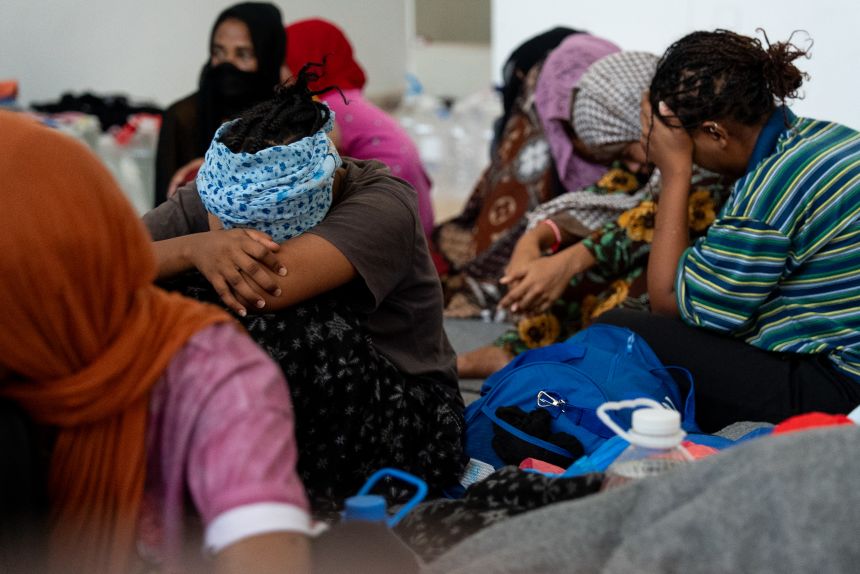
Most of the people here have already paid the ransoms demanded and been released from captivity in the Sahara. They’ve since been picked up by local authorities and detained for illegal entry into Libya. Now they await help from the United Nations or non-governmental organizations – help that often takes months to arrive.
Among them is a 16-year-old Eritrean teenager, whom CNN is calling Abrihet because she is a minor.
“These guys, they touched me,” she says of her former captors. “They touch you. Your hand. Your leg. I can’t explain it.”
A government-provided doctor in Benghazi has confirmed she’s not pregnant, but that’s the extent of the help she’s received so far. Every day, the women and girls around her sob in traumatic memory of what happened to them. Each has their own heart-wrenching story of abuse and misery.
Abrihet looks down at her forearms, which are criss-crossed with the scars of self-harm.
“I want to die too much. I want. But I can’t… I want to die, but I cannot do it.”
For girls like Abrihet, it is impossible to contemplate how this network of abuse is allowed to continue, year after year.
Responsibility for stopping it falls on Col. Mohammed Al-Fadhil, from Libya’s Department for Combating Illegal Migration (DCIM). In a divided country, with rival governments, the agency is an oddity in operating nationwide, in both the internationally recognized west and the Haftar-controlled east and south.
The situation, he insists, is much better than it once was. But the international community needs to step up.
“Look, this matter requires participation by states,” he said. “It’s a partnership issue. All countries should share it. The whole European Union, the countries impacted by illegal migration. They should all be partners to eradicate the phenomenon.”
In 2016, the European Union struck a deal with Libya’s internationally recognized government in Tripoli that funded Libyan forces to prevent migrants from crossing the Mediterranean. It resulted in a sharp drop in people taking what is known as the Central Mediterranean route from North Africa to Europe over the next few years, but also meant they were often held in squalid Libyan detention centers.
The number of migrants braving the dangerous crossing has been rising in recent months, particularly between eastern Libya and Greece, where it is up more than three-fold in a year. And Eritreans are among those most likely to take the risk – they are now the second-largest national group arriving in Italy, after Bangladeshis.
Human rights groups have accused DCIM of maintaining inhumane conditions and using violence against migrants. A UN experts panel alleged that those migrants freed during the Tazirbu raid were subject to further abuses at the hands of DCIM. Al-Fadhil said that the accusation was “useless if it is not accompanied by clear evidence.”
There were just over 100,000 refugees and asylum-seekers registered in Libya as of October. But the true number of those in Libya fleeing conflict is undoubtedly much larger, because the UN – which registers refugees – only operates in areas controlled by the internationally recognized government in western Libya. UN officials have appealed for help in expanding their efforts to help the influx of Sudanese refugees in Libya.
Haftar, who controls eastern and southern Libya, runs a government unrecognized by the United States or European powers. It is just one of the many reasons why increasingly heightened anti-immigration sentiment in Europe has not translated into more cooperation to stop southern Libya’s smugglers and traffickers.
Following months of agony and fundraising, Abeba was eventually able to send enough money to pay for her brother Daniel’s release. He is now in Libya’s western city of Tripoli: still far from being reunited with his family.
But her distress over seeing him so brutally abused – and losing her entire family’s life savings to secure his freedom – has broken her.
“May God punish them for what they did,” she cried. “How many mothers are crying blood and tears for their children and loved ones? I beg you, tell this story to the world.”
