

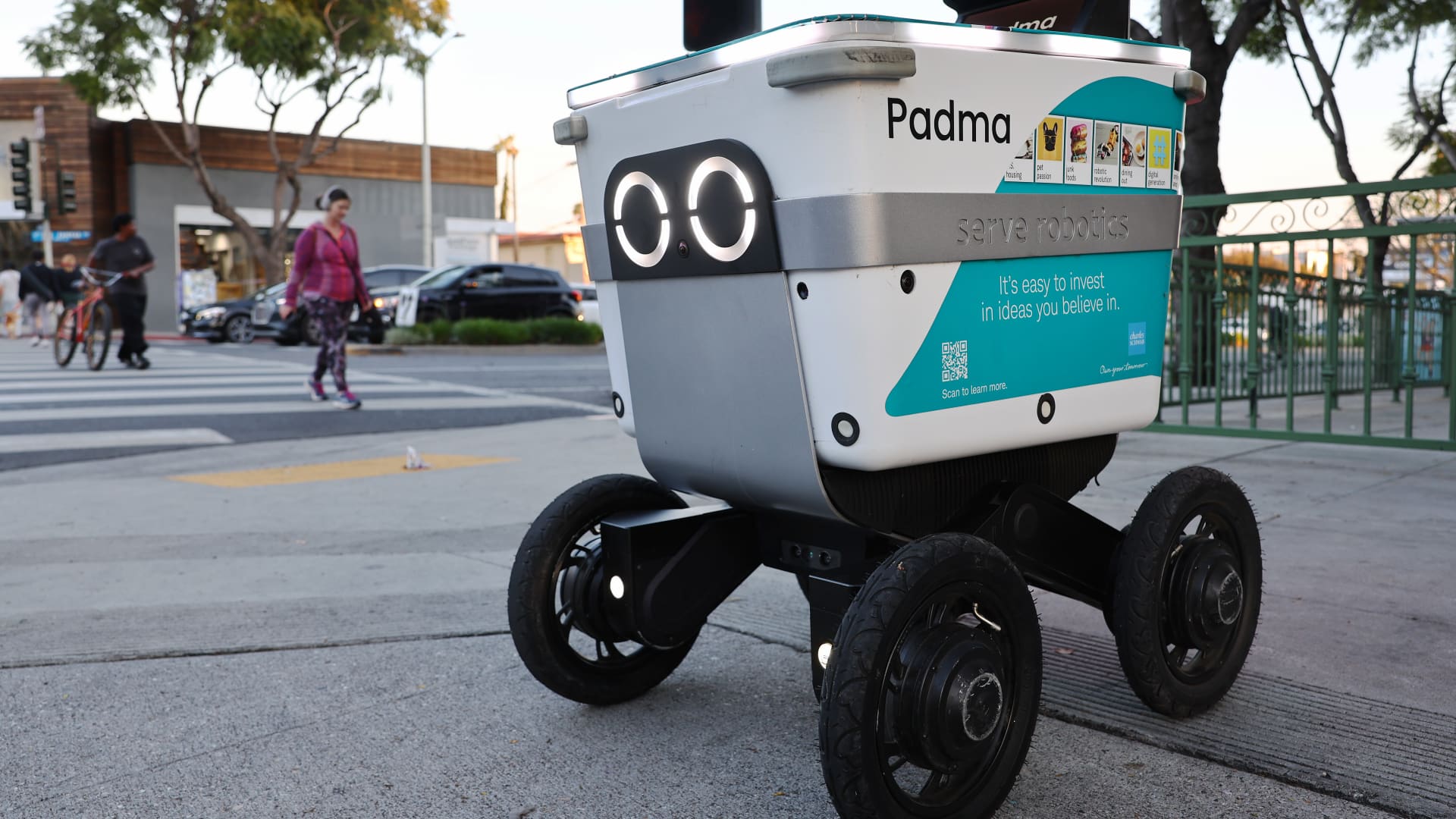
Amid concerns that artificial intelligence will take over the white-collar world, Oppenheimer believes the technology could spark a “blue-collar renaissance” by increasing demand for the electricity and machinery that powers new technologies. Concerns about AI disruption have gripped markets this year, leading to heightened concerns about unemployment. Software, in particular, is an industry that investors worry will be hurt by advances in AI. The sector has been on a sell-off this year, with the iShares Expanded Technology Software Sector ETF (IGV) down 20% since the beginning of the year. Just last month, fintech provider Block announced it would lay off more than 4,000 employees, nearly half of its workforce. Recent economic data has shown similar weakness, with nonfarm payrolls falling by 92,000 in February. The unemployment rate rose slightly to 4.4%. But Oppenheimer is hopeful that even if the surge in AI adoption disrupts office jobs, it could open doors in other areas of the skilled trades. U.S. manufacturing employment declined sharply last year, and the National Association of Manufacturers estimates that employment in the sector remains below pre-pandemic levels as of January 2026. “If one side of the AI and workforce replacement debate is the rapid normalization of certain categories of white-collar office jobs, the other side is the resurgence of traditional ‘blue-collar’ jobs that produce goods and services that cannot be easily replaced by automated code and text generation,” a team of Oppenheimer analysts led by Colin Rush wrote in a recent report. “Yes, we believe robots will help them, but the world still needs a skilled workforce to build machines and provide services.” Rush called the phenomenon “a subtle reshaping of the labor market.” “Demand for more traditional ‘blue-collar’ jobs producing goods and services is out of sync with available supply, increasing the need for progressive productivity technologies,” he wrote. “Across our industrial innovation coverage, we see a multi-year supportive backdrop of being selective about the next wave of the industrial revolution, including physical AI, power, and the machines that build the machines that power, build, and supply the world.” There is one big caveat. Some of the trends highlighted in the report may depend on stable long-term energy and agricultural prices, and short-term higher prices may not suppress demand for companies like Caterpillar and Deere. Five Investment Themes Oppenheimer analysts have shared five investable themes to consider. The first is investment in physical and digital connectivity, including “sensors and data pipelines into the ecosystem.” This is now a “more valuable moat than ever,” Rush said. “We see physical digital connectivity as a structurally under-invested area, and we see the perception and data processing companies we cover as key beneficiaries of automation trends,” the analyst said. “We believe LiDAR is a necessary component as a ground truth sensor for camera and radar-based solutions to enable advanced AI models to accurately capture and analyze real-world data streams.” Stocks that fall under this theme include Aeva Technologies , Aptiv , Bentley Systems , Itron , Johnson Controls International , Mobileye Global , Ouster , Serve Robotics , Trimble , and Tesla . Automation Tools Rusch also identified opportunities for automation tools to reskill or upskill the transitioning workforce. Companies working on this topic include Caterpillar, Deere, Rockwell Automation, and Trimble. “Throughout our coverage, we see multi-step workflows that we believe are more defensible against AI-induced labor disruption and support the reskilling and upskilling of an increasingly blue-collar workforce,” Oppenheimer said in the 10-page report. “We believe the technology offered by DE, CAT, and TRMB will transform the field experience through guidance, task automation, and AI agents, while South Korea is integrating AI across its portfolio with a focus on cloud-native design, production optimization, and agent-based plant information systems.” Augmenting the field workforce is a third area where opportunities may lie ahead. lie down Rusch cited Vertiv, Forgent Power Solutions, and Shoals Technologies Group as leaders, and noted that Johnson Controls International, Trane Technologies, and Lennox International also have the potential to improve frontline labor productivity and drive service growth through AI-powered innovation. “In our view, given the limited availability of skilled labor in the industry, solutions that can optimize the turnaround time of skilled field workers will continue to outperform. Within our power and HVAC range, we believe modularization of solutions and off-site manufacturing/testing will result in productivity gains,” the analyst said. Autonomous Systems Companies such as Aurora Innovation, Mobileye Global, Serve Robotics, and Symbotic support a fourth area: autonomous physical systems. “As we see a large number of companies reaching commercialization of fully autonomous solutions, we expect humans to stay informed in several ways: remote monitoring for safety and problem resolution purposes, evolving maintenance and repair roles as fleet size increases, and bot evaluation/redesign and duty cycle optimization to increase in relation to fleet deployment,” the analysts wrote. The final area of investment for Rush is in low-impact areas of the market. AI primarily threatens white-collar office jobs, but other industries are less likely to be disrupted and “more likely to absorb innovation.” “This is especially true in our (agriculture) coverage, where we see AI enabling innovation to meet evolving consumer demands,” which should benefit International Flavors and Fragrances and Ingredion, and “AI is an accelerator” of Corteva’s “novel trait development for seed genetics and bioengineering,” he said.
