

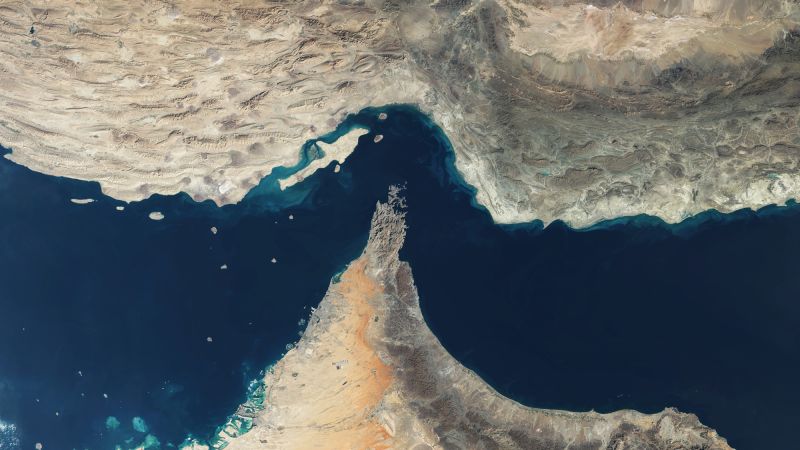
Iran may have superior weapons and spending to the United States and Israel, but it has one major advantage: control of the Strait of Hormuz.
By attacking ships navigating the narrow waterway, Iran has effectively shut down the shipping route through which a fifth of the world’s oil supplies pass.
Iran’s new supreme leader Mojtaba Khamenei showed no signs of letting up, warning in what was said to be his first message that the strait would remain closed as a “means of pressure.”
The strait remains almost completely closed to Western and allied shipping, according to maritime intelligence trackers, while Iranian oil continues to pass through, underscoring Iran’s control of the strait.
Here’s what you need to know:
Iran’s activities near the strait have become even more aggressive as it seeks to cut off one of the world’s key arteries of the world economy. More than a dozen ships have been attacked since the war began.
Even in peacetime, navigating the strait’s narrow channels and congested traffic requires advanced technology. Now, once crossed, they risk shelling from the sea or the nearby Iranian coast.
Two U.S. intelligence officials familiar with the matter said on Tuesday that Iran had begun laying mines in the strait.
Although mining is not extensive, Iran still maintains more than 80% to 90% of its fleet of small boats and minelayers, one official told CNN. This contradicts US President Donald Trump’s claim that Iran “doesn’t have a navy.”
Such moves highlight Iran’s reliance on asymmetric warfare and the havoc these tactics can wreak, even as the country has been battered by U.S. and Israeli airstrikes.
President Trump later sowed confusion on the issue, saying he did not believe Iran had successfully laid the mines and that the United States had removed “almost all” of its mine-laying vessels.
A U.S. Congressional report last year estimated that Iran has about 5,000 to 6,000 sea mines. This total includes different types of landmines, the report said. Some are limpet mines, usually manually attached to the hull by divers. There are also tethered mines, which float just below the water’s surface and explode on contact with a ship. Some are “bottom” mines, which are placed on the ocean floor before detonating when they detect nearby ships.
Still, mines are only part of the threat Iran poses to the Strait.
The Islamic Revolutionary Guards Corps (IRGC), a military force with its own navy, remains capable of deploying land mines, explosive-laden suicide boats, and a “gauntlet” of land-based missile batteries, leading one U.S. intelligence source to describe the strait as a “valley of death.”
Despite nearly two weeks of airstrikes, the Revolutionary Guard’s “main small ship fleet remains largely intact,” said Farzin Nadimi, a senior fellow at the Washington Institute who has written about Iranian naval strategy.

Securing the strait for commercial shipping has become a new headache for the United States.
President Trump called on the oil tanker’s crew to “show courage” and said the U.S. Navy would provide escort if necessary, but that this would have no clear strategic benefit to the war itself and would endanger naval vessels.
But his administration sent mixed messages. U.S. Gen. Dan Cain on Tuesday rejected involvement in such an operation, saying the United States would consider a “wide range of options” if tasked with ship escort. Energy Secretary Chris Wright also noted that the Navy does not yet have the ability to escort ships, and likely will only be able to do so until the end of the month.
Analyst Nadimi said it was technically possible to create conditions that would allow some ships to pass through the strait within days or weeks, but restoring long-term, sustainable security to the strait could take months. “It can’t be done quickly and it can’t be done under enemy fire,” he said.
Even if escorts can be managed, oil tanker flows are likely to remain at least 10% lower than normal, according to Lloyd’s List Intelligence. The report said this figure “could be significantly lower depending on Iran’s response and possible minesweeping operations.”
U.S. Central Command said on Tuesday that it had destroyed several Iranian naval vessels near the strait, including 16 minelayers, but did not mention the destruction of the mines.

The longer the Strait of Hormuz remains impassable, the more severe the impact on the global economy will be.
With the strait effectively closed, 15 million barrels of crude oil and 5 million barrels of other oil production remain stranded in the Gulf each day, according to the head of the International Energy Agency.
“They are trying to cause pain,” Nadimi told CNN. “The strategic goal is to inflict as much punitive pain as necessary on U.S. military bases in the region, on mainland Israel, on the Persian Gulf states, and indirectly on the U.S. mainland.”
There are several other options for exporting crude via pipelines, but Saudi Aramco, the world’s biggest oil exporter, warned on Tuesday that there could be “catastrophic consequences” for the oil market if the flow of crude through the strait does not resume.
Even the IEA’s announcement that it had agreed to release 400 million barrels of oil into the global market, the largest emergency release ever, did little to calm the volatility in the oil market. And that 400 million barrels will only cover the shortfall for 26 days.
In Asia, which already imports 60% of its oil from the Middle East, some countries are taking drastic measures to reduce energy consumption. Schools have been closed in Pakistan, fuel prices have been capped in South Korea for the first time in 30 years, and government workers in Thailand have been ordered to work remotely.
yes. During the Iran-Iraq war in the 1980s, both countries targeted each other’s oil tankers in the Persian Gulf. The Iranian Navy had laid mines near the Strait of Hormuz, and one of the mines attacked the American warship, USS Samuel B. Roberts.
The ship suffered heavy damage, and the Reagan administration retaliated by damaging or sinking three Iranian warships and three oil platforms, greatly reducing Iran’s ability to engage in the Gulf.
