

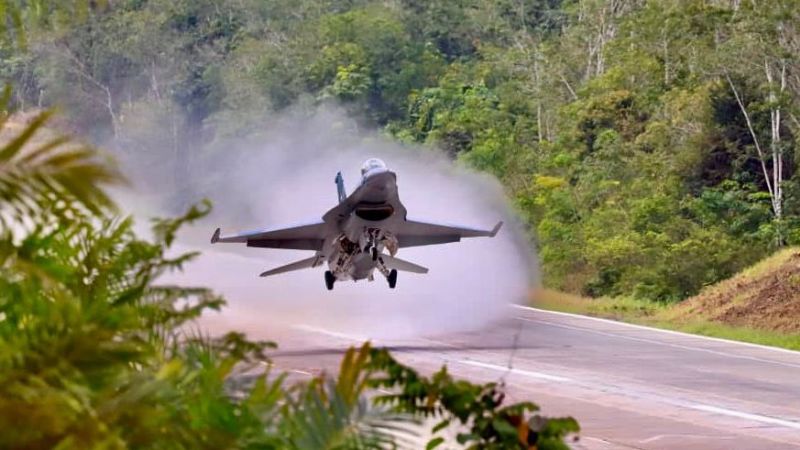
Indonesia is turning toll roads across the country into emergency runways for fighter jets and embarking on the equivalent of deploying multiple aircraft carriers across its vast archipelago.
Indonesian Air Force Chief of Staff Gen. Tony Harjono said Wednesday that he hopes to eventually have at least one toll road section in each of the country’s 38 provinces available for use as an emergency runway, but no timeline has been given.
In Wednesday’s demonstration, Indonesian Air Force F-16 fighter jets and Super Tucano attack aircraft successfully took off and landed on a toll road in Lampung province on the southern tip of Sumatra.
“This success marks an important milestone in strengthening the universal defense system,” said Deputy Defense Minister Donny Elmawan Taufant.
Using highways as military airstrips is not a new concept. This is demonstrated by the militaries of the United States, Finland, and Sweden, among others.
And distributing fighter jets across Pacific islands is something the U.S. military is pursuing, with the aim of making targeting more difficult for air forces in the event of a potential conflict with China.

Indonesia has a dispute with China in the South China Sea, but the new plan to install airstrips on roads is not believed to be directed at any one country.
“The use of the toll road as an alternative runway depending on the situation is expected to enhance the operational readiness of the Indonesian Air Force in the face of a variety of potential threats, without compromising the main function of the toll road as a public transportation infrastructure,” a statement from the Indonesian Air Force said.
Analysts say it’s also a cost-effective way to cover vast areas of the country.
Indonesia is the world’s largest archipelago, with more than 6,000 inhabited islands along a 3,100-mile (5,000-kilometer) east-west axis.
This would be an enormous amount of territory to cover with an aircraft carrier, something the Indonesian Navy does not have and would be expensive to acquire and maintain.
Aircraft carriers can cost billions of dollars.
“Aircraft carriers don’t seem very attractive as a cost-effective platform,” said Colin Koh, a research fellow at the S. Rajaratnam School of International Studies in Singapore.
“It makes more strategic and operational sense to designate countless toll roads and highways throughout the archipelago as emergency military airstrips,” Coe said.
“The risk margin is lower than on an aircraft carrier,” Coe told CNN. “One attack with an aircraft carrier and you’re done.”
With multiple roads acting as airstrips, if one is lost, several others will make up for it, he said.
Roads can handle more aircraft and cheaper aircraft than needed to operate an aircraft carrier.
The aircraft used in Wednesday’s demonstration, the F-16 and Super Tucano, cannot fly from aircraft carriers.
Air Force Chief of Staff Harjono said the plan is to create a 3,000 meter (about 2 mile) stretch of road where military aircraft can take off and land.
Donny praised the skill of the Indonesian pilot who landed on a road that is only half the size of the airport’s runway.
“The toll road is only about 24 meters (79 feet) wide, narrower than the 45 to 60 meters (45 to 60 meters) of an airport runway. It is dangerous, but air force pilots are trained for such situations,” he said, according to the state-run Antara news agency.
