

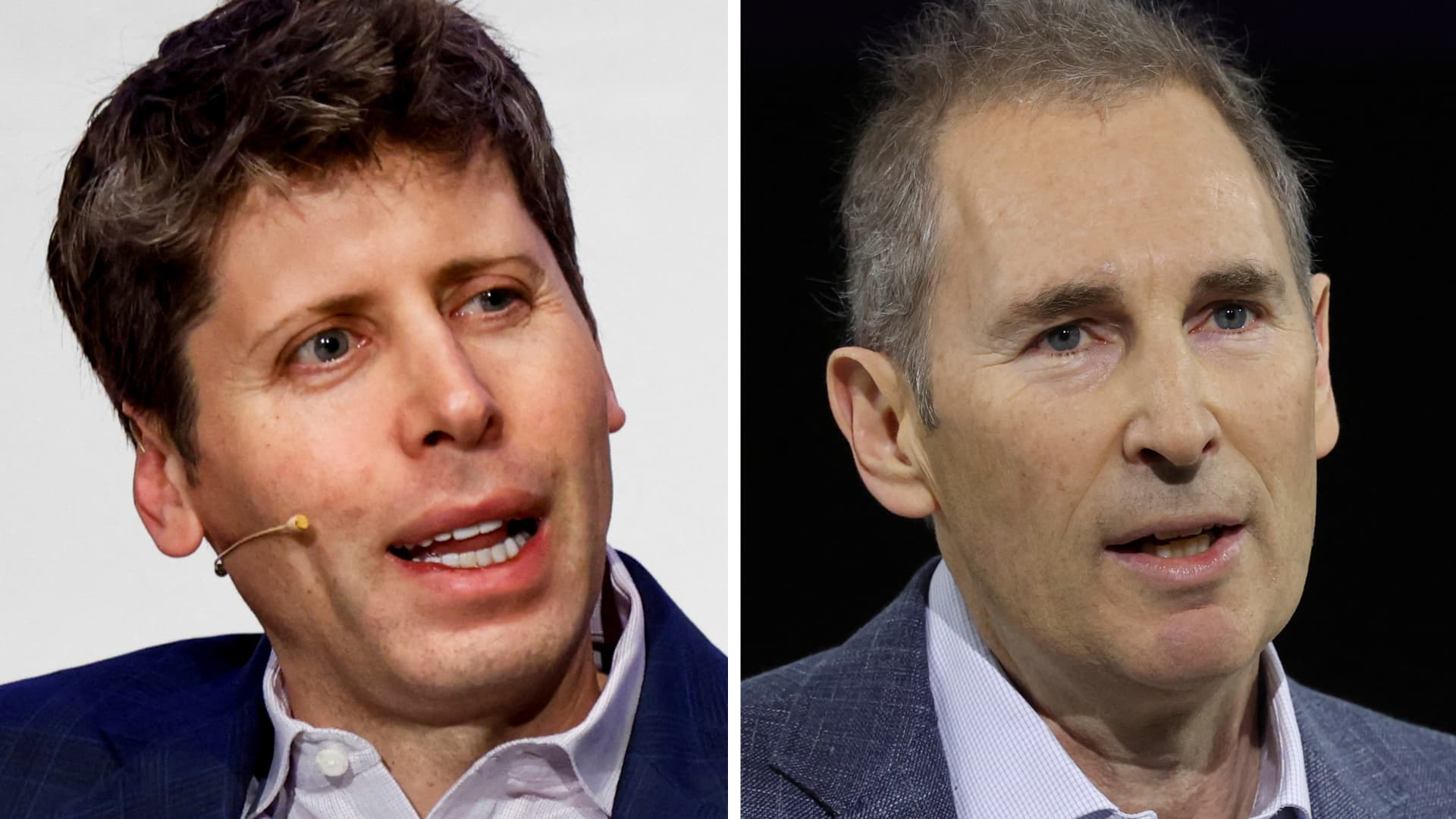
Stocks fell on Friday after a key inflation measure came in much better than expected, continuing to raise concerns about AI disruption. But CNBC’s Jim Cramer said there are four reasons to remain bullish for now. “I’m not going to be pessimistic if the 10-year (U.S. Treasury) yield goes down,” he said on “Squawk on the Street” on Friday. “I’m not going to be pessimistic if OpenAI gets funding, which at one time I thought it wouldn’t get. I’m not going to be negative when I look at Dell’s performance. I’m not going to be negative because of how much business CoreWeave has.” Instead, Cramer said the recent wave of large AI investments signals economic expansion. AI startup OpenAI announced Friday that it has secured a total of $110 billion in new investments from Amazon ($50 billion), Nvidia ($30 billion), and SoftBank ($30 billion), valuing the ChatGPT maker at $730 billion. Amazon’s share is tied to a new multi-year partnership with an upfront investment of $15 billion, with an additional $35 billion expected if certain conditions are met. “This is great for the economy,” Jim Cramer said. “We’re in a new industrial revolution, but you’re not in the winning part yet. You’re in the spending part.” “We’re going to regret our view” that AI is negative because it takes away jobs, he added. Despite Friday’s announcement, all three major indexes were in the red, with core wholesale prices rising 0.8% in January, much better than expected. The Dow Jones Industrial Average fell 1.1%, the S&P 500 fell 0.6% and the Nasdaq Composite Index fell 0.9%. Investors remain concerned that the rapid adoption of AI could displace workers across software, finance and white-collar industries. This could mean job losses and slower wage growth, with ripples throughout the economy. There is also a big concern that giants like Amazon, Meta, Microsoft, and Oracle are investing heavily in AI at the expense of profitability. But for Cramer, the OpenAI deal confirms that the continued flow of capital into building AI infrastructure is a win for the economy and the stock market. New investment creates new jobs, new companies, and increases productivity, allowing companies to accelerate profits. Additionally, Cramer said the 10-year Treasury yield, which fell on Friday, is generally supporting stocks. Lower yields reduce borrowing costs for companies and make future profits more valuable when discounted to today’s dollars. In particular, growth stocks and AI-related stocks tend to benefit from lower interest rates. Dell’s strong fourth-quarter results and strong guidance on Thursday with accelerating AI server revenue is another reason to remain positive. Dell stock rose more than 18% on Friday. CoreWeave, an AI cloud provider, supports Cramer’s view that the economy is strong. “Demand for infrastructure has been relentless for three years,” CEO Michael Intrator said on Friday’s “Squawk on the Street,” adding that customers “demand signals are increasing… They’re spreading across the economy, moving from just AI labs and clouds to enterprises and sovereigns. The business signals are overwhelming.” Coreweave’s stock price fell 11% on Friday, but Intrater emphasized that the company is intentionally scaling aggressively during what he calls a “once-in-a-generation moment” for AI enhancement. He acknowledged that the expansion would come at a cost to profits in the short term, but said the goal is to have enough capacity to meet surging computing demand. Essentially, OpenAI requires more computing power and faster speeds. The explosive adoption of generative AI tools has put a strain on the available infrastructure. Training and running advanced AI models required vast amounts of specialized chips, data center capacity, and energy. OpenAI currently does not have enough computing power to fully support the growing demand for its models. The funding announced Friday should help OpenAI secure long-term computing access.
