

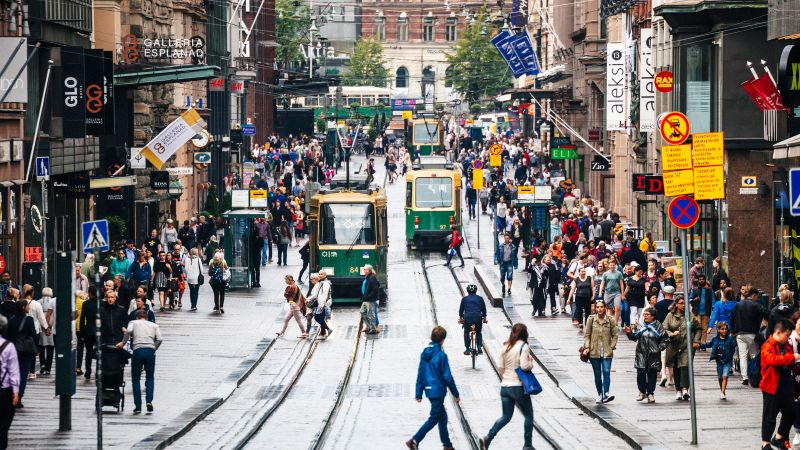
If happiness were an Olympic event, the Nordic countries would be guaranteed a spot on the podium.
In fact, all three spots on the podium.
According to the latest edition of the World Happiness Report, the three happiest countries in the world are Finland, Iceland and Denmark.
Finland has been named the world’s happiest country for a record ninth time in a row, with Iceland in second place and Denmark in third place, in the annual report on world happiness compiled by Oxford University’s Center for Wellbeing Research.
Costa Rica did well in fourth place, the highest ever for a Latin American country, but then returned to the Nordic countries, with Sweden and Norway in fifth and sixth respectively. Three other European countries are in the top ten. The Netherlands is in 7th place, Luxembourg in 9th place and Switzerland in 10th place.
Israel, the only Middle Eastern country in the top 20, came in 8th place.
This year, the US ranked 23rd, Canada 25th and the UK 29th. This is the second year in a row that English-speaking countries such as the United States, New Zealand, Ireland, Australia, Canada and the United Kingdom are not in the top 10.
To determine the rankings, the Gallup World Poll asks respondents in 147 countries to rate their lives using an image of a ladder. Rate your best life as 10 and your worst life as 0. Each respondent provides a numerical answer on this scale, called the Cantril ladder.
Researchers are looking at six factors to explain variation across countries, including GDP per capita, life expectancy, generosity, and perceptions of freedom and corruption. The rankings are based on three-year averages, smoothing out spikes and dips caused by major events such as wars or financial recessions.
Finns reported an average score of 7.764 assessing life satisfaction.
John F. Helliwell, professor emeritus of economics at the University of British Columbia and founding editor of the World Happiness Report, said in an interview that Finland’s deep commitment to cooperation helps explain its ability to remain at the top of the rankings.

“Successful societies cooperate in the face of adversity,” he said. “Finnish people know that. And once you feel like you’re all in this together, there’s no limit to what you can do.”
By comparison, U.S. respondents had an average life evaluation rating of 6.816.
The report’s authors are beginning to pay attention to what they consider to be a crisis in youth well-being, mentioned for the first time in the 2024 rankings.
The latest edition of the survey found that the life evaluations of respondents under 25 in the United States, Canada, Australia and New Zealand have fallen by almost one point on a scale of 0 to 10 over the past decade, a significant drop, especially as average satisfaction among young people in other parts of the world has risen, according to Gallup World Poll data.
“This is a significant decline in young people’s well-being,” Helliwell said. “One of the culprits, especially in the United States, is the extent and nature of social media use.”
However, the study warns that “negative sentiment is becoming more prevalent in all regions of the world.”
Despite being one of the world’s richest countries, only three of the six English-speaking countries made it into the top 20. New Zealand was the best performing country in 11th place, followed by Ireland in 13th place and Australia in 15th place.

Internet consumption is high virtually everywhere, and that includes social media, the study found.
But researchers say a key factor in the sharp decline in young people’s happiness is the amount of time they spend on social media and gaming. And while experts say it’s important to limit the amount of time you spend on the internet overall, some ways to spend time online are healthier than others, such as communicating with loved ones or learning new skills.
In short, Helliwell said social media usage is high among young people in Latin America, but their sense of well-being is strong and growing.
He pointed to “the way they use social media,” adding that the important question is “are they really social media or anti-social media?”
He said a certain amount of internet and social media consumption isn’t necessarily a negative, and “there seems to be a sweet spot.”
“You don’t want to be unconnected, but you don’t want to be too connected either,” he says. “On the Internet, too much is bad.”
Regardless of the influence of social media, some trends aren’t necessarily surprising or new. For example, countries at the bottom of the rankings often have significant geopolitical conflicts. For example, Afghanistan came in last place at 147th place, followed by Sierra Leone.
And even if some of the richest countries didn’t make the top 20, rich countries tended to continue to do well. The United Arab Emirates appeared in 21st place, while Saudi Arabia took 22nd place, behind the United States.

Nevertheless, the picture of new well-being is a complex one, with many factors to consider, but a shift to digital means of information production and consumption is key.
“The digital age is reshaping the social and emotional foundations of European well-being,” Zeynep Ozkok, an economist at St. Francis Xavier University, said in a statement accompanying the ranking.
“Their effects are neither uniform nor inevitable; they vary depending on who you are, the social world you live in, and the digital environment that surrounds you. Understanding these interactions is essential to developing policies that support well-being in an increasingly online society.”
Despite creeping fears of social media overuse, the study’s authors are not pessimistic. Part of the reason is that countries around the world are beginning to enact measures aimed at protecting youth from the dangers of social media.
Helliwell also draws hope from researchers’ ability to identify trends shaping global well-being, which emphasizes the fundamentals. In the happiest countries, people have not lost sight of what is important.

Think about things like finding the best place to lose your wallet. Of course, it’s Finland.
“Everyone likes to live in a place where they can expect their wallet back in full,” says Helliwell.
It is no surprise that the Nordic countries continue to dominate the survey, now in its 14th year. Located in Northern Europe, these countries have strong health and education systems that provide important safeguards in our turbulent modern lives.
But Helliwell said it was important not to lose sight of the goodness in most people, even outside the top-ranked countries.
“The world is full of kind strangers,” he said. “Knowing that will affect you in every way.”
(1) Finland
(2) Iceland
(3) Denmark
(4) Costa Rica
(5) Sweden
(6) Norway
(7) Netherlands
(8) Israel
(9) Luxembourg
(10) Switzerland
Afghanistan remains the world’s unhappiest country, ranking 147th, according to the ranking. Other countries lower on the list are: Botswana (143rd), Zimbabwe (144th), Malawi (145th) and Sierra Leone (146th).
