

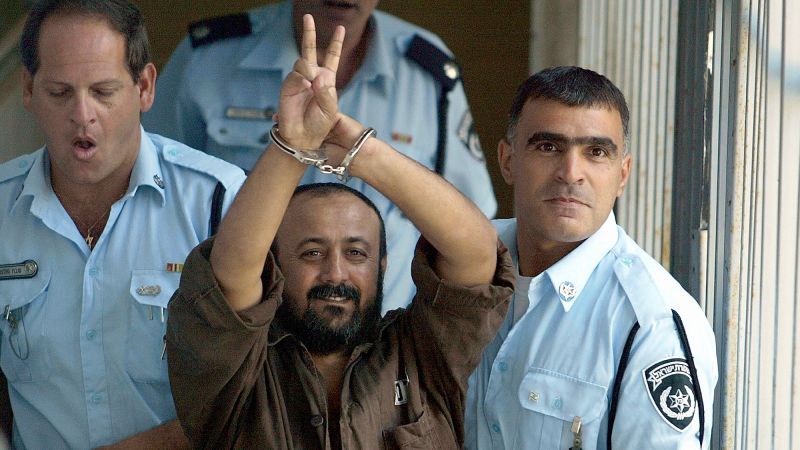
When it comes to politicians, few command as much respect among Palestinians as Marwan Barghouti, the most prominent Palestinian prisoner serving five life sentences in Israeli prisons.
The former West Bank Fatah party leader is by far the most popular politician in the occupied Palestinian territories, even though an entire generation of Palestinians was born after his imprisonment more than two decades ago.
Some have described him as the Nelson Mandela of the Palestinians, believing that their long-imprisoned leader will lead them to freedom.
For Israel, he is one of the highest profile terrorists. The 66-year-old was jailed in 2002 for planning an attack that killed five civilians during the second Palestinian intifada. He denied the charges at the time and rejected the jurisdiction and legitimacy of the court that sentenced him.
Hamas is now demanding Barghouti’s release as part of a potential Gaza ceasefire deal, a move that could change the political landscape in Palestine. It is highly unlikely that Israel would agree to release him, given his prominence among Palestinians and his perceived ability to lead them to statehood.
Palestinian factions have tried numerous times to secure his release, including through previous ceasefire negotiations during the current war. However, Israel has refused to consider releasing Barghouti.
Barghouti’s son, Arab Barghouti, told CNN’s Becky Anderson in August that Israel does not want his father released because Prime Minister Benjamin Netanyahu “doesn’t want a partner for peace.”
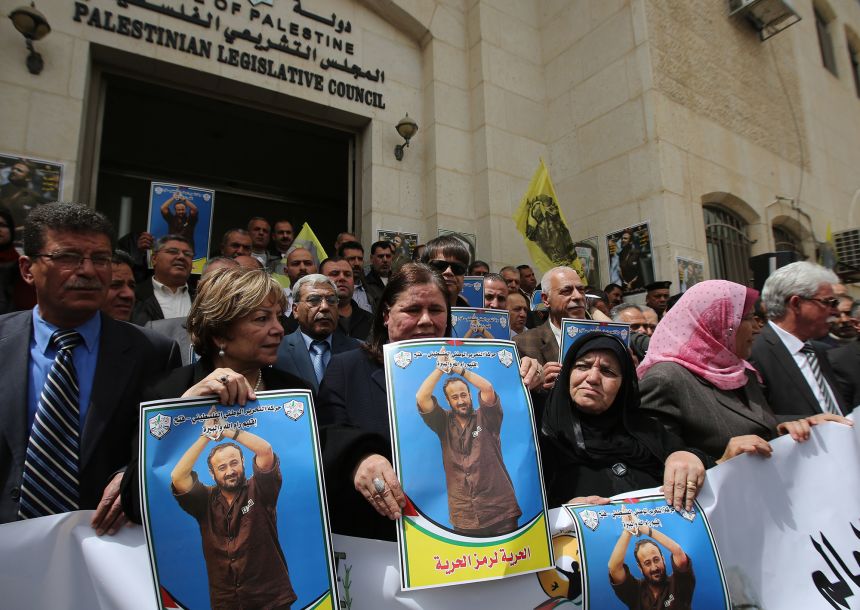
Hugely popular since his incarceration more than two decades ago, Barghouti is still seen as the leader, perhaps the only one, who can unite Palestinians. The West Bank-based Palestinian Authority (PA) is plagued by corruption and severe Israeli restrictions, leaving it weakened and under severe financial strain.
“He is seen by the people as a national hero, a man of integrity and integrity. He is a unifier who can make peace with Hamas and unify the entire Palestinian class,” Khalil Shikaki, director of the Palestine Center for Policy and Research, told CNN.
Shikaki, who has tracked Palestinian public opinion for decades, said Barghouti is by far the most popular Palestinian leader and the only secular nationalist capable of winning elections.
“All the other presidential candidates, including Islamists and nationalists, cannot defeat him,” he said, adding that Barghouti was likely to win at least 60% of the popular vote in the election.
Shikaki said Barghouti is seen as a “realist” but is “a tough negotiator who will reach a credible peace with Israel based on a two-state solution that has the support of the majority of Palestinians.”
Shikaki said his release represents a major victory for Hamas and is likely to change the mood among the Palestinians to one of optimism, leading to increased activity.
“He will be seen as Mr. Abbas’s successor,” he added, referring to PA President Mahmoud Abbas, who has clung to power for two decades and is seen by critics as lacking democratic legitimacy. “The calls for Mr. Abbas’ resignation will increase significantly.”
This is why Israel is likely to strongly oppose his release. Prime Minister Benjamin Netanyahu has steadfastly rejected the idea of an independent Palestinian state, and his policies over the years have often worked to weaken the Palestinian Authority, which aims to govern a future Palestinian state.
Barghouti’s activist career began when he was a teenager. He spent four years in prison for joining Fatah (banned by Israel at the time) at the age of 15, and continued to study history and political science after his release.
He rose through the ranks, eventually becoming secretary-general of Fatah in the occupied West Bank and a member of the Palestinian Legislative Council, the Palestinian parliament.
His current popularity and influence is due, in part, to his reputation as a charismatic politician who was able and willing to work with various Palestinian factions.
For years he was barred by Israel from entering Ramallah, where he was born and raised, and was only able to return in 1994 after the Oslo Accords, a peace deal between Israel and the Palestinians.
However, his time in prison only increased his popularity. Israel has virtually cut Barghouti off from the outside world, with photos and videos of him surfacing only every few years.
According to his family and the Palestinian Prisoners of War Association, he has been held in solitary confinement since the start of the current Gaza war.
His last public appearance was in a short video released by Israel’s far-right Security Minister Itamar Ben Gvir, in which he was filmed mocking Barghouti in prison.
His appearance – Barghouti appeared frail and unwell – caused concern. Barghouti’s wife, Fadwa, said at the time that she did not recognize Barghouti at first, telling him: “Maybe part of me doesn’t want to acknowledge everything that your face and body express.”
Without mentioning Barghouti by name, Ben Gvir’s spokesman said the minister had received assurances from Netanyahu that what the Israeli prime minister called a “symbol” would not be released in any prisoner exchange with Hamas.
CNN’s Ibrahim Daman, Abeer Salman, Mostafa Salem and Tal Shareef contributed reporting.
