

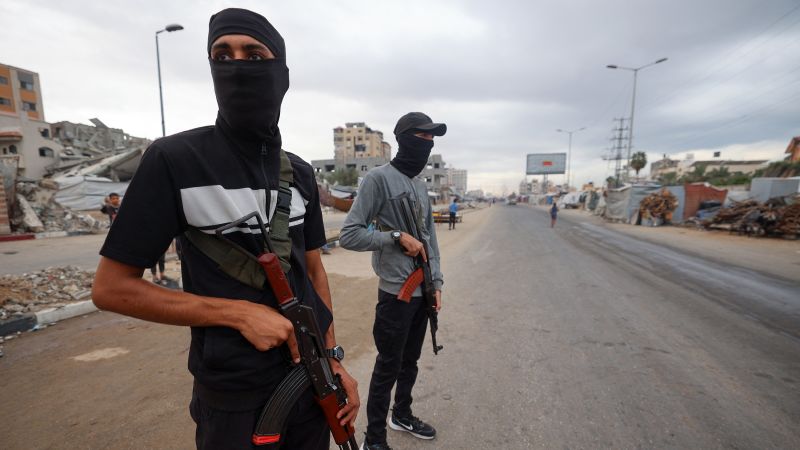
Hamas is reasserting control of the unoccupied Gaza Strip as the ceasefire takes hold, but the security of the territory remains uncertain if the group is disarmed.
Hamas internal security forces were photographed on the streets of Gaza City on Saturday, and there have been reports of clashes between Hamas and opposing clans in recent days.
The Hamas-affiliated telegraph agency Palestine Homeland Front announced on Sunday that “a number of collaborators and informants have been arrested in Gaza City who were found to be involved in enemy espionage” and “participated in the assassination of several resistance fighters.”
“Security authorities and resistance forces are carrying out large-scale field operations across the Gaza Strip from north to south, identifying and arresting collaborators and informants,” it said.
A video distributed by the Hamas-affiliated Telegram channel on Saturday showed an alleged collaborator being beaten at an unknown location.
Other social media videos showed armed and masked Hamas personnel walking through a street market in Gaza City, and the Hamas-run Interior Ministry shared images of police officers wearing rifles and baseball caps that read “Police” interacting with local residents in Gaza City.
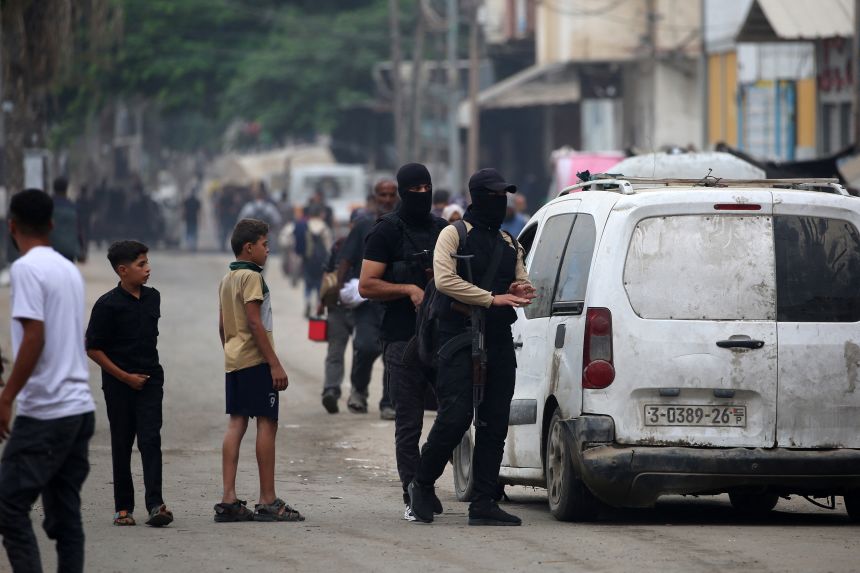
Hamas maintained an iron grip over Gaza for many years, which continued even after the war began. CNN reported that Hamas has executed and seriously injured alleged looters, a sign that Hamas continues to hold power despite being weakened by Israel.
The Hamas-controlled Interior Ministry declared a one-week amnesty starting Monday for members of the criminal organization “not involved in bloodshed or murder.”
But Hamas’ control of Gaza has been challenged in recent months by several clans, particularly in the south. Some of those groups receive protection from the Israeli military.
Social media channels affiliated with Hamas reported that Mohammad Imad Aqel, the son of a senior Hamas military official, was killed in clashes between a prominent family and security forces in Gaza City’s Sabra district.
Hamas forces surrounded Damush’s neighborhood on Friday night. Sources told CNN that dozens of masked and armed men were stationed around a Jordanian hospital in Gaza City where several family members were killed.
CNN reported Sunday that clashes continued in the area.
In southern Gaza, a group opposed to Hamas known as the People’s Army has refused to lay down its arms.
The group is involved in convoying aid supplies and has publicly challenged Hamas, which has vowed to confront so-called criminal organizations.
One of the commanders, Hussam al-Astar, posted on Facebook on Saturday: “You Hamas bastards, the tunnels have been destroyed and your rights no longer exist. Repent before it’s too late. From today on, Hamas no longer exists.”
“We are trying to be an alternative to Hamas,” al-Astar told Israel’s network Channel 12. “They are focusing on psychological warfare and will do everything in their power to prove that there is no other option on the Strip.”
However, members of the People’s Army are believed to have moved inside the so-called “Yellow Line” within southern Gaza, where Israeli forces are still stationed.
It is unclear how security and police will function in the Gaza Strip in the coming weeks and months.
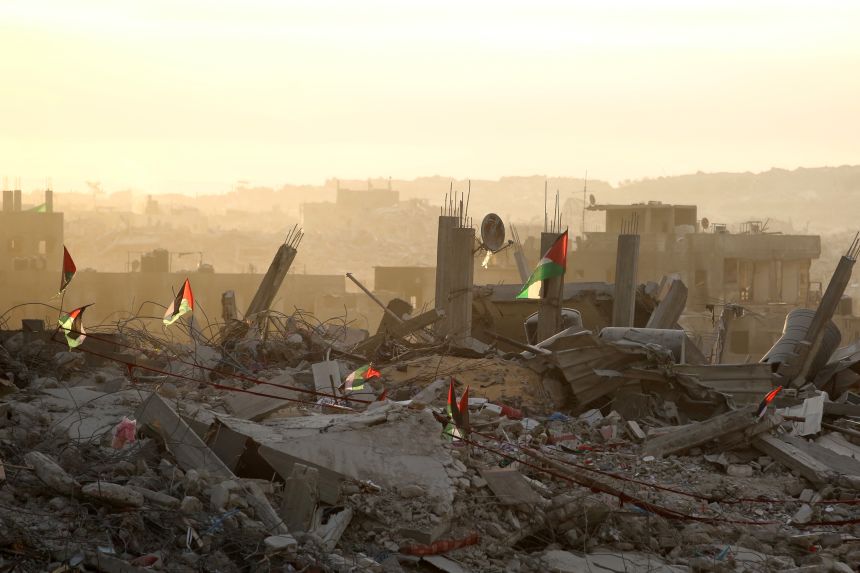
Israel has long called for Hamas to disarm, but Hamas has resisted this.
A 20-point peace plan announced by US President Donald Trump last week states that “members of Hamas who commit to peaceful coexistence and disarmament will be granted amnesty.”
The report also states that Gaza’s demilitarization process will take place “under the supervision of independent monitors,” including placing weapons permanently out of service through an agreed decommissioning process.
According to President Trump’s plan, the International Stability Force (ISF) would immediately deploy to Gaza to replace Hamas and “provide training and support for vetted Palestinian police forces.”
But key details of the security forces and planned international monitoring mechanisms have yet to be worked out beyond the vague bullet points of the initial plan.
Given the complex reality of the current situation in Gaza, the establishment of such a force could take months or more, especially in the midst of a humanitarian crisis and extensive damage to buildings and other infrastructure.
Chatham House, a London-based think tank, said: “Deploying the required numbers (of ISF) would need to occur over time and would pose a major logistical challenge.”
“The problems of coordination, direction and management of an untested multinational venture of the required scale will also be formidable,” the report said last week.
Two years of conflict have left Gaza police dead and injured, leading to a worsening security situation and the looting of aid goods becoming commonplace.
Jordan and Egypt are expected to play a leading role in training and supervising the new police force. However, it is unclear when the forces will begin patrolling Gaza’s streets and whether Hamas’ internal security forces will disappear when they do.
