

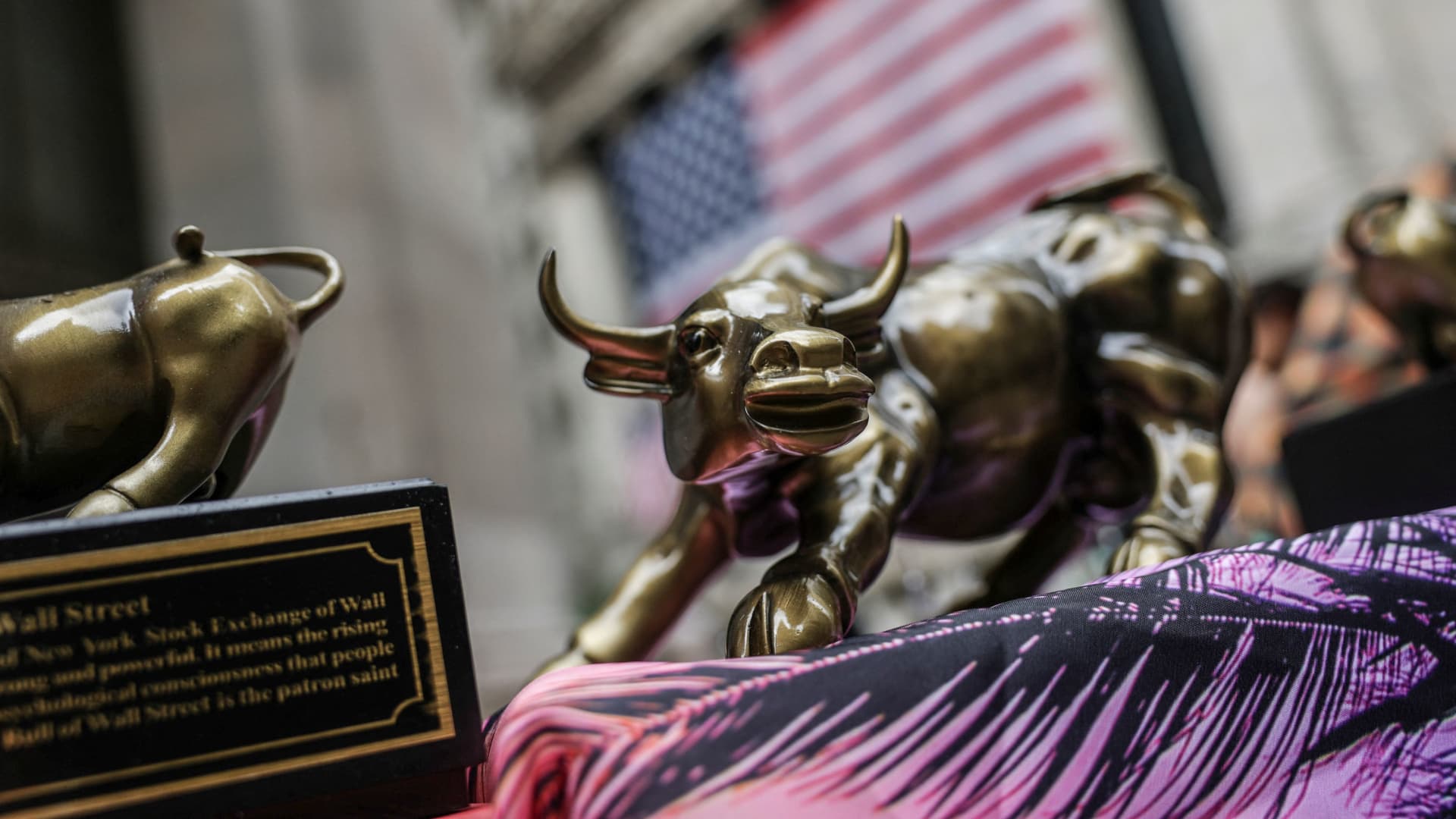
A small replica of the Charging Bull statue is seen at a street vendor outside the New York Stock Exchange on July 11, 2025.
Gina Moon | Reuters
Global markets may be due for a reality check after this year’s relentless rally, as Goldman Sachs and Morgan Stanley warned investors on Tuesday to brace for drawdowns over the next two years.
Stock prices around the world have soared this year, hitting record highs on the back of rising AI-related demand and expectations for interest rate cuts. Over the past month, major U.S. indexes have hit new highs, Japan’s Nikkei 225 and South Korea’s Kospi hit new highs, and China’s Shanghai Composite Index hit a 10-year high on the back of easing U.S.-China tensions and a weaker dollar.
“We’re likely to see a 10 to 20 percent drawdown in the stock market over the next 12 to 24 months,” Goldman Sachs CEO David Solomon said at the Global Financial Leaders Investment Summit in Hong Kong. “Things move forward and then they step back so people can reevaluate.”
But Solomon pointed out that such reversals are a normal feature of secular bull markets, and the investment bank’s consistent advice to clients is to stay invested and reassess portfolio allocations rather than trying to time the market.
“Even through virtuous market cycles, 10-15% drawdowns are common,” he said. “It doesn’t change our fundamental, structural beliefs about how we want to allocate capital.”
Morgan Stanley CEO Ted Pick, speaking on the same panel, argued that investors should welcome periodic pullbacks, saying they are a healthy development rather than a sign of crisis.
“We should also welcome the possibility of a drawdown that is not caused by some macro cliff effect, a 10-15% drawdown,” he said.
Solomon and Pick’s views come as the IMF recently warned of the possibility of a sharp correction, while Federal Reserve Chairman Jerome Powell and Bank of England Governor Andrew Bailey have also warned about soaring stock prices.
Bright topics in Asia
Goldman Sachs and Morgan Stanley said Asia will be a bright spot in the coming years, driven by recent developments such as the U.S.-China trade deal. Goldman expects global capital allocators to remain interested in China, adding that it remains one of the world’s “largest and most important economies.”
Morgan Stanley remains bullish on Hong Kong, China, Japan and India, citing their unique growth stories. Corporate governance reform in Japan and infrastructure development in India were selected as multi-year investment themes.
“I can’t help but be excited about the three very different stories of Hong Kong, China, Japan and India, but all part of the global Asian story,” Ted said. He particularly emphasized China’s AI, EV, and biotechnology sectors.
