

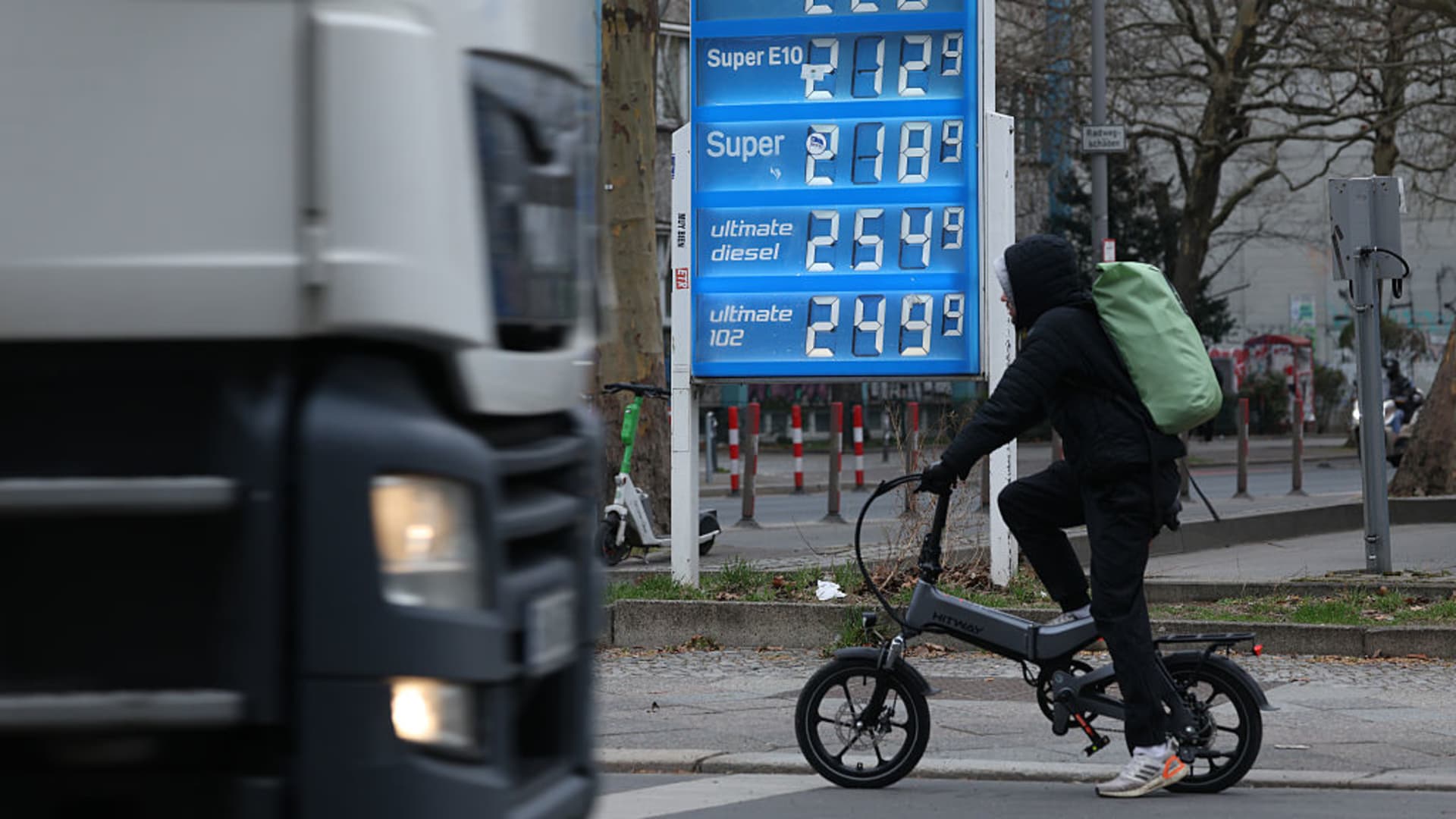
BERLIN, GERMANY – MARCH 16: A truck and a bicycle pass by a gas station where gas prices are well over 2.00 euros per liter on March 16, 2026 in Berlin, Germany. The German government is considering enacting new legislation to curb the soaring prices in response to the dramatic rise in gasoline prices in Germany since the outbreak of the military conflict between the United States, Israel, and Iran. Gasoline prices in Germany have become higher than in other parts of Europe. (Photo by Sean Gallup/Getty Images)
Sean Gallup Getty Images News | Getty Images
Germany has stopped gas stations from raising pump prices more than once a day as costs rise due to the Iran war and oil supply disruptions.
The country’s federal government introduced regulations on Wednesday that would allow price increases only once a day at 12 p.m. The government said prices were fluctuating up to 22 times a day as energy costs rose sharply amid the ongoing war between the US and Iran.
Outlining the regulation, the German government said it aims to break the “rocket and feather effect” in which “in the past, when oil prices rose, fuel prices often rose quickly, but when oil prices fall they only fall slowly.”
Price reductions may occur from time to time. Gas companies could be fined up to 100,000 euros ($116,000) if they violate the ban.
Germany is also introducing legal reforms that will make it easier to crack down on powerful companies that engage in “wild fuel price hikes.”
Oil prices have soared to more than $100 a barrel as Iran has effectively blocked the Strait of Hormuz, through which about 25% of the world’s oil passes, causing massive supply disruptions.
West Texas Intermediate crude oil futures were last down 2% on Wednesday, trading above $98 per barrel, while Brent crude futures were down 2% at more than $101 per barrel.

This is one of a series of measures European countries are taking to limit the impact of rising fuel prices.
British Prime Minister Keir Starmer last month announced a £53 million package to support vulnerable households affected by rising energy prices. He also outlined the extension of utility bill caps and fuel tax caps until September.
Denmark’s Energy Minister Lars Aagaard encouraged citizens to cut their energy use and drive less in the country, which relies on oil reserves, in view of rising prices.
Austria and Hungary have also introduced limits on fuel price increases, and France has started checks to prevent price gouging.
Fatih Birol, CEO of the International Energy Agency, warned in a speech on Wednesday that the energy crisis will worsen in April after the agency’s 32 member countries agreed to release 400 million barrels of oil from emergency oil reserves to partially offset supply disruptions.
Birol also said the IEA was considering releasing more oil reserves in response.
