

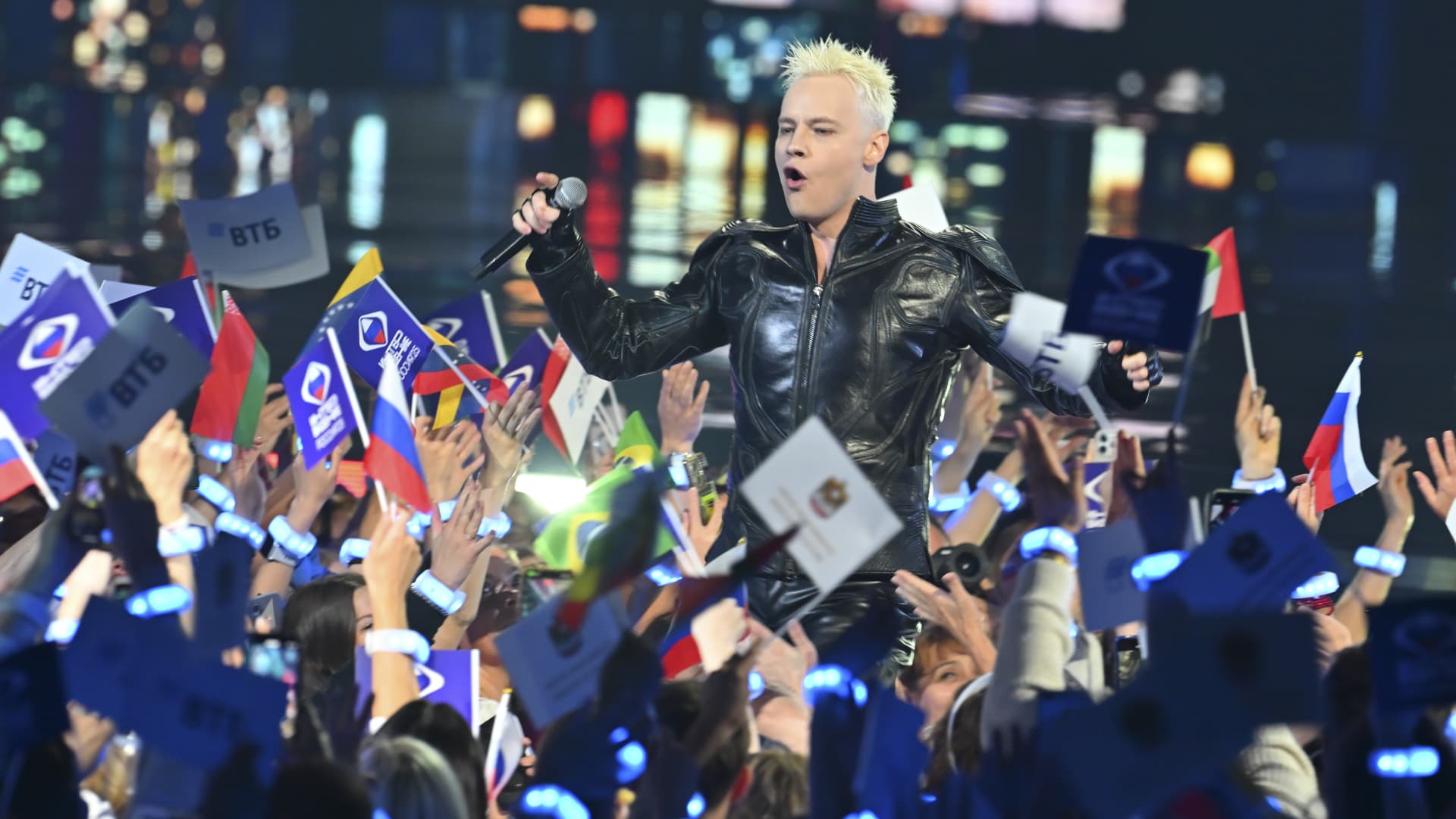
MOSCOW, RUSSIA – SEPTEMBER 21: Russian shamans perform at a new global singing contest called Intervision, held on September 21, 2025 in Moscow, Russia (Photo by: Sefa Karacan/Anadolu, Getty Images)
Anadolu | Anadolu | Getty Images
Ever since Russia was forced out of the Western cultural and sporting sphere following its full-scale invasion of Ukraine, it has made serious attempts to create something like a “parallel world” of alternative events and institutions.
After starting a war with its neighbor in 2022, Russia was banned from participating in the Olympic Games, where it has traditionally performed well, but its success has often been accompanied by various doping scandals. More casual cultural events, such as the Eurovision Song Contest, were also banned.
However, Russia is trying to turn the expulsion to its advantage by replacing such events with events hosted by its own country.
Although Russians understand that such replacements are inauthentic, many see efforts to recreate sports and cultural events as patriotic efforts to rekindle Russia’s Soviet past, something Russian President Vladimir Putin frequently refers to fondly.
Anton Barbashin, a Russian political analyst and editorial director of Riddle magazine, told CNBC on Thursday that “the vast majority of Russians believe that Russia has been unfairly excluded from most international events. So in terms of providing an alternative, these alternatives make sense.”
“(They) have a kind of attitude that ‘it’s better than nothing,’ but of course only a few people treat that as real. For older generations, it is a reminder of events organized by the Soviet Union. Often President Putin frames it this way as well, as a revival of old traditions,” Balbasin said in an email.
Barbashin characterized Russia’s “import substitution” strategy as driven by “pure necessity.”
Soviet Union revival?
The Kremlin has frequently described its isolation from the West as “Russophobic,” and has sought to position itself as a victim of Western hegemony while calling for a new “world order.”
The war in Ukraine has certainly led Russia to look beyond the West to foster economic and cultural ties, with varying degrees of success.
Russia announced in May 2023 that it would create an Olympic replacement event known as the “World Friendship Games,” but then announced at the end of 2024 that it would postpone the games indefinitely without giving a reason.
The postponement came after heavy criticism from the International Olympic Committee. The committee called the tournament a “cynical attempt” to politicize sport and called on athletes to boycott the tournament.
An event that was ostensibly more successful was Russia’s resumption of the Soviet-era Intervision Song Contest in September of this year. Russia is replacing the popular European event Eurovision, saying its version of the contest promotes cultural ties between countries outside the Western world.
Although some commentators were confused about the contest, and critics called it a propaganda tool, the contest attracted singers from 23 countries (notably, the original entrant, the United States, withdrew from the contest at the last minute) and was won by Vietnam’s Duc Phuc.
On September 20, 2025, an image of Russian President Vladimir Putin was displayed on the main stage screen of the Intervision Song Contest at the Live Arena in Moscow.
Olesya Krupyaeva | AFP | Getty Images
One Russian analyst said the events were intended as an alternative, not a replacement, to international events that Russia was no longer able to participate in.
“It is true that[Russian alternative events]cannot replace genuine international events, and that is not the aim, but to create an alternative platform, a space where Russia can operate and develop things that are ‘friendly’ and yet international,” Tatiana Stanovaya, a Russian political analyst and founder of the political analysis firm R.Politic, told CNBC on Thursday.
“This is based on the idea of Western decline and forced multipolarity. Domestically, it has important implications in terms of control of resources, political dividends and visibility,” Stanovaya said.
Does Russia want to come back?
The war in Ukraine continues, and despite US President Donald Trump’s calls for a ceasefire and Moscow’s calls for the negotiating table, there are few signs that Russia wants to re-engage with the West, especially regarding Kiev.
The Kremlin says it wants peace, but demands that Russia cede part of Russian-occupied territory in eastern Ukraine to Russia, which Kiev has rejected.
Despite the ongoing war and the anti-Western rhetoric embedded in the Kremlin and state media commentary, Russia is likely ready and willing to participate in future global cultural and sporting events should the situation change.
Russian President Vladimir Putin passes the symbolic baton of the FIFA World Cup to Qatar’s Emir Tamim bin Hamad Al-Thani (not pictured) during a ceremony at the Kremlin in Moscow, Russia, on July 15, 2018. Qatar will host the FIFA World Cup in 2022.
Mikhail Svetlov | Getty Images
“We have seen many times before that it is very important for Russia to participate in international and global events. The 2018 FIFA World Cup (hosted by Russia) was the best moment in Russia’s history in that respect,” Barbashin said, adding: “It is very important for our people.”
Asked whether Russia would like to participate in world events again after the Ukraine war ends, Barbashin emphasized:
“Without a doubt, Russia has a first chance. Russia’s entire dialogue is always with the West and with the West. A return to the West is inevitable,” he said.
